Victorian Resources Online (archived)
Barwon River Land System
Download the pdf version of this document: Barwon River Land System (PDF - 472 KB)
To view the information, PDF requires the use of a PDF reader. This can be installed for free from the Adobe website (external link).
| The flood-plains of the Barwon River and its tributaries extend from the foothills of the northern side of the Range to the basalt plains near Winchelsea and encompass a comparatively wide climatic variation. The vegetation reflects these changes, with tall open forests of Eucalyptus viminalis and E. ovata occurring in the south and woodlands of E. camaldulensis dominating in the north. The soils also show a gradual transition from acid, freely drained profiles to heavier neutral soils as the influence of basalt-derived alluvium increases towards the north. Flooding and siltation are common on these plains. Waterlogging of soils is a problem, particularly on low-lying areas such as cut-off meanders and infilled swamps. Gully erosion and stream-bank erosion are also common. | 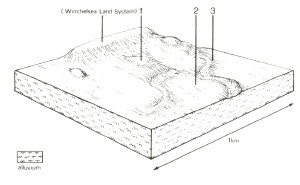 |
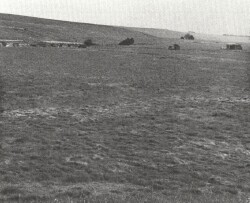 Gully erosion and stream-bank erosion are particularly common on these alluvial plains, where streams emerge from the foothills of the Otway Range. | 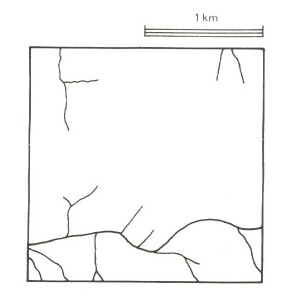 |
Area: 762 km2 | Component and its proportion of land system | ||
1 5% | 2 85% | 3 10% | |
| CLIMATE Rainfall, mm | Annual: 600 – 1,000, lowest January (30), highest August (80) | ||
| Temperature, 0oC | Annual: 13, lowest July (8), highest February (9) | ||
Temperature: less than 10oC (av.) June – August (Also September in higher-rainfall areas) | |||
Precipitation: less than potential evapotranspiration October – April in lower-rainfall areas November – March in higher-rainfall areas | |||
| GEOLOGY Age, lithology | Recent alluvium – sand, silt, clay and gravel | ||
| TOPOGRAPHY Landscape | Alluvial flood plain of the Barwon River and its tributaries with numerous cut-off meanders | ||
| Elevation, m | 90 - 150 | ||
| Local relief, m | 3 | ||
| Drainage pattern | Deranged with major meandering channel | ||
| Drainage density, km/km2 | 1.6 | ||
| Land form | Plain | ||
| Land form element | Rise | Plain | Streambank, infilled meanders |
| Slope (and range), % | 4 (1-6) | 1 (0-2) | 2 (1-8) |
| Slope shape | Convex | Straight | Convex |
| NATIVE VEGETATION Structure | Woodland | ||
| Dominant species | E. ovata, E. viminalis, Acacia melanoxylon, in north E. camaldulensis | ||
| SOIL Parent material | Sandy alluvium | Clayey alluvium | Sandy alluvium |
| Description | Brown sandy loam soils, uniform texture | Grey gradational soils | Brown sandy loam soils, uniform texture |
| Surface texture | Fine sandy loam | Fine sandy clay loam | Fine sandy loam |
| Permeability | Very high | Moderate | Very high |
| Depth, m | >2 | >2 | >2 |
| LAND USE | Dairy farming; cropping; sheep and beef cattle grazing. | ||
| SOIL DETERIORATION HAZARD Critical land features, processes, forms | High permeability and leaching lead to nutrient decline. | High seasonal water table leads to waterlogging, soil compaction and salting. Dispersible clay subsoils are prone to gully and tunnel erosion. High discharge rates along some watercourses lead to flooding and siltation. | High discharge rates and weakly structured soils lead to streambank erosion and siltation. High seasonal water tables lead to waterlogging. |
