Victorian Resources Online (archived)
Bellbrae Land System
Download the pdf version of this document: Bellbrae Land System (PDF - 669 KB)
To view the information, PDF requires the use of a PDF reader. This can be installed for free from the Adobe website (external link).
| Below the lateritized plateaux to the east of the Otway Range lie a series of rolling hills have formed by dissection along the valleys of Spring Creek and Jan Juc Creek. Weathering of limestone and marl exposed along these valleys has resulted in calcareous soils. Fertility is moderate, and thus contrasts with the surrounding impoverished soils of the lateritic plateaux and acid sands and clays. The red soils, or those deeper profiles transitional to the red soils, are the most favoured for agriculture and are used or cropping as well as dairy-farming. Grazing of sheet and beef cattle is also common. Agricultural use is decreasing, however, as the township of Torquay extends its urban limits. Subdivision int small farmlets in other parts of the valleys also tends to decrease agricultural production. Sheet erosion occurs on some of the cropped steeper slopes, while gully erosion and slumping are problems of the dispersible duplex soils. | 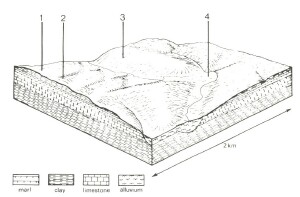 |
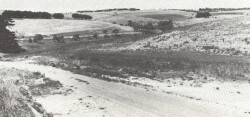 Wide drainage lines and rounded hills typify this landscape, as it rises to the lateritic plateau in the distance | 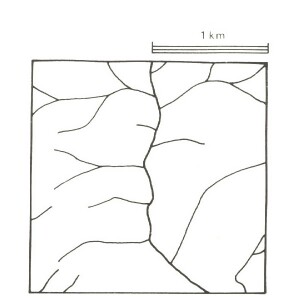 |
Area: 25 km2 | Component and its proportion of land system | |||
1 25% | 2 40% | 3 20% | 4 15% | |
| CLIMATE Rainfall, mm | Annual: 600 – 650, lowest January (30), highest August (65) | |||
| Temperature, 0oC | Annual: 14, lowest July (10), highest February (18) | |||
Temperature: less than 10oC (av.) July | ||||
Precipitation: less than potential evapotranspiration early October – early April | ||||
| GEOLOGY Age, lithology | Miocene limestone and marl | |||
| TOPOGRAPHY Landscape | Rolling hills dissected out below the lateritic plateaux | |||
| Elevation, m | 5 – 70 | |||
| Local relief, m | 60 | |||
| Drainage pattern | Dendritic | |||
| Drainage density, km/km2 | 3.0 | |||
| Land form | Hill | |||
| Land form element | Upper slope | Middle slope | Steeper slope | Lower slope, drainage |
| Slope (and range), % | 5 (3-9) | 11 (5-14) | 15 (7-20) | 7 (1-9) |
| Slope shape | Linear | Linear | Convex | Concave |
| NATIVE VEGETATION Structure | Open forest | Open forest | Open forest | Open forest |
| Dominant species | E. viminalis, E. sideroxylon, E. obliqua | E. leucoxylon. E. sideroxylon, E. viminalis | E. viminalis, E. ovata, Acacia melanoxylon | E. viminalis, E. sideroxylon, E. leucoxylon, E. ovata |
| SOIL Parent material | Truncated lateritic remnants | Calcareous clay and deeply weathered limestone | Limestone | Colluvial limestone, clay, lateritic material |
| Description | Brown duplex soils, coarse structure | Yellow-brown calcareous sodic duplex soils, coarse structure | Red calcareous gradational soils | Yellow sodic duplex soils |
| Surface texture | Fine sandy loam | Fine sandy loam | Fine sandy clay loam | Loamy sand |
| Permeability | Low | Moderate | High | Moderate |
| Depth, m | >2 | >2 | 0.7 | >2 |
| LAND USE | Cleared areas: Dairy farming; beef cattle grazing; residential; cropping Minor uncleared areas: Forest grazing; active and passive recreation; hardwood forestry for fuel, posts and poles | |||
| SOIL DETERIORATION HAZARD Critical land features, processes, forms | Dispersible subsoils receiving seepage water are prone to gully erosion, slumping and rilling. | Highly dispersible subsoils are prone to gully erosion and slumping. | Steeper slopes are prone to sheet erosion. | Highly dispersible subsoils are prone to gully erosion and tunnel erosion. |
