Victorian Resources Online (archived)
Bunker Hill Land System
Download the pdf version of this document: Bunker Hill Land System (PDF - 639 KB)
To view the information, PDF requires the use of a PDF reader. This can be installed for free from the Adobe website (external link).
| Deeply dissected hills north and west of Gellibrand possess Tertiary sands and clays on the higher parts of the landscape and outcrops of Cretaceous sediments on the steeper and lower parts. The soils become heavier and more fertile on the Cretaceous sediments and this is reflected in the occurrence of Eucalyptus obliqua and E. viminalis open forests with dense understoreys. Most areas are too steep for agriculture, and remain forested with native hardwoods or pines. Clearing operations necessary for pine conversion and hardwood harvesting may result in severe scour gullying and landslips on the steep parts of the landscape. Access tracks are difficult to site and prone to scouring. In general, careful management is required. | 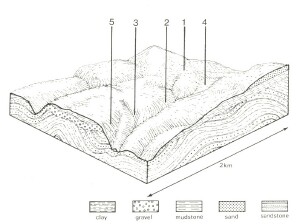 |
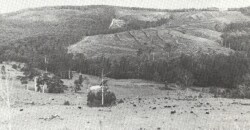 The steep land and irregular nature of the terrain makes these areas difficult to manage. | 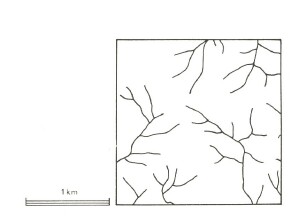 |
Area: 41 km2 | Component and its proportion of land system | ||||
1 25% | 2 20% | 3 40% | 4 9% | 5 6% | |
| CLIMATE Rainfall, mm | Annual: 900 – 1,050, lowest January (45), highest August (130) | ||||
| Temperature, 0oC | Annual: 12, lowest July (7), highest February (18) | ||||
Temperature: less than 10oC (av.) June – August | |||||
Precipitation: less than potential evapotranspiration early November – late March | |||||
| GEOLOGY Age, lithology | Palaeocene unconsolidated sand, silt and clay | Lower Cretaceous sandstone and mudstone | Palaeocene unconsolidated sand, silt and clay | ||
| TOPOGRAPHY Landscape | Deeply dissected hills abutting the Gellibrand River to the west of Love Creek | ||||
| Elevation, m | 60 – 290 | ||||
| Local relief, m | 95 | ||||
| Drainage pattern | Dendritic with some radial areas | ||||
| Drainage density, km/km2 | 3.2 | ||||
| Land form | Hill | ||||
| Land form element | Crests, upper slope | Slope | Steep lower slope | Gentle slope | Crest, upper slope |
| Slope (and range), % | 20 (5-35) | 30 (20-35) | 45 (30-65) | 15 (4-20) | 13 (1-20) |
| Slope shape | Convex | Convex | Linear | Concave | Convex |
| NATIVE VEGETATION Structure | Woodland | Open forest | Open forest | Low woodland | Woodland |
| Dominant species | E. nitida, E. radiata, E. baxteri | E. baxteri, E. obliqua | E. obliqua, E. ovata, E. viminalis, E. aromaphloia, on southern aspect E. cypellocarpa | E. nitida, E. ovata, E. baxteri | E. radiata, E. baxteri, E. nitida, E. obliqua |
| SOIL Parent material | Sand | Sand, silt and clay | In-site weathered rock | Sand | Quartz gravel, some clay, sand and silt |
| Description | Grey sand soils, uniform texture | Yellow gradational soils, weak structure | Brown gradational soils | Grey sand soils with hardpans, uniform texture | Stony yellow gradational soils |
| Surface texture | Loamy sand | Sandy loam | Loam | Loamy sand | Loamy sand |
| Permeability | Very high | High | Moderate | Very low | Very high |
| Depth, m | >2 | >2 | 0.9 | 0.5 | >2 |
| LAND USE | Uncleared areas: Hardwood forestry for posts and poles, some sawlogs on better soils; nature conservation; water supply; gravel extraction; softwood plantations. Cleared areas: Beef cattle and sheep grazing on mainly unimproved pastures; water supply | ||||
| SOIL DETERIORATION HAZARD Critical land features, processes, forms | Low inherent fertility and high permeability lead to leaching and nutrient decline. When disturbed and compacted, steeper slopes are prone to erosion (scouring). | Low inherent fertility and high permeability lead to nutrient decline. Weakly structured surface soils are prone to sheet erosion on steeper slopes. | Steeper slopes are prone to sheet and rill erosion. Clay subsoils subject to periodic saturation are prone to landslips | Low inherent fertility leads to nutrient decline. Hardpans restrict vertical drainage leading to seasonal waterlogging. | Very low inherent fertility and high permeability lead to leaching and nutrient decline. |
