Victorian Resources Online (archived)
Hordern Vale Land System
Download the pdf version of this document: Hordern Vale Land System (PDF - 542 KB)
To view the information, PDF requires the use of a PDF reader. This can be installed for free from the Adobe website (external link).
| In the vicinity of Cape Otway, Tertiary clay, silt, sand, limestone and marl all outcrop. Three separate areas exist – at Johanna, Hordern Vale and inland from Point Franklin and Blanket Bay. All areas are generally similar, but possess distinct differences in specific features. The limestone and marl outcrops are confined to marine terraces at Hordern Vale. The Johanna area is distinguished by its dominance of red sands. The area east of Cape Otway includes hilltops of kaolinitic clay and silt and these carry rare low woodlands of Eucalyptus kitsonia. In general, these landscapes are old with areas of lateritized soils on the highest parts. Recent dissection has often been superimposed on the more undulating areas, resulting in straight slopes with youthful soil profiles. Land uses are very diverse. Areas that have been cleared are used for dairy farming, grazing of sheep and beef cattle and a small amount of potato growing. Those areas that remain uncleared are selectively logged, and also have nature conservation values. Sheet erosion and landslips have been quite severe on some of the steeper areas, and some gully erosion occurs on the slopes coming away from the lateritized areas. | 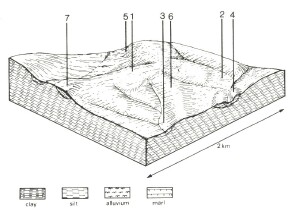 |
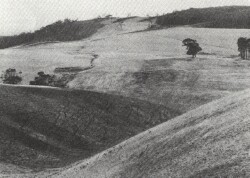 Youthful dissection with steep straight slopes and young soils is encroaching on many of the more gently undulating higher parts of the landscape. | 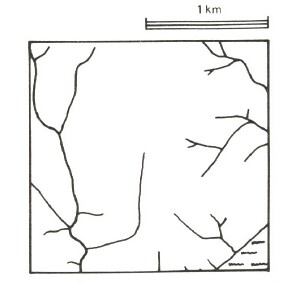 |
Area: 38 km2 | Component and its proportion of land system | ||||||
1 20% | 2 8% | 3 7% | 4 4% | 5 25% | 6 30% | 7 6% | |
| CLIMATE Rainfall, mm | Annual: 900 – 1,250, lowest January (50), highest July (130) | ||||||
Temperature, 0oC | Annual: 13, lowest July (9), highest February (17) | ||||||
Temperature: less than 10oC (av.) July | |||||||
Precipitation: less than potential evapotranspiration late November - February | |||||||
GEOLOGY Age, lithology | Paleocene unconsolidated sand, clay and silt | ||||||
Limestone, marl | |||||||
TOPOGRAPHY Landscape | Undulating coastal plains surrounding Cape Otway | ||||||
Elevation, m | 0 - 200 | ||||||
Local relief, m | 60 | ||||||
Drainage pattern | Dendritic | ||||||
Drainage density, km/km2 | 2.1 | ||||||
| Land form | Rise | Valley floor | Rise | ||||
| Land form element | Upper slope, crest | Slope, river terrace | Swale | Marine terrace | Steeper slope | Upper slope, crest | Rise |
| Slope (and range), % | 5 (1-15) | 7 (1-15) | 0 (0-1) | 25 (10-55) | 30 (3-45) | 8 (2-20) | 3 (0-7) |
| Slope shape | Convex | Linear | Concave | Convex | Linear | Linear | Irregular |
| NATIVE VEGETATION Structure | Open forest | Open forest | Closed scrub | Woodland | Open forest | Tall open forest | Low woodland |
| Dominant species | E. obliqua, E. baxteri, E. cypellocarpa, E. aromaphloia, E. viminalis | E. obliqua, E. baxteri, E. viminalis, E. ovata | Leptospermum lanigerum | E. obliqua, E. viminalis | E. obliqua, E. cypellocarpa, E. baxteri | E. cypellocarpa, E. obliqua, E. viminalis, E. globulus | E. kitsoniana, Melaleuca squarrosa, Melaleuca ericifolia |
| SOIL Parent material | Lateritized sediments | Clay, silt and sand | Alluvial clay, silt and sand | Freshly weathered limestone and marl | Quartz sand | Clay, silt and sand | Kaolinitic clay, silt and sand |
| Description | Mottled yellow and red gradational soils with ironstone | Yellow-brown gradational soils, coarse structure | Grey gradational soils | Black calcareous gradational soils | Red sandy loam soils, uniform texture | Brown gradational soils | Pale brown gradational soils, weak structure |
| Surface texture | Gravelly sand | Fine sandy loam | Sandy loam | Fine sandy clay loam | Loamy sand | Fine sandy loam | Silty loam |
| Permeability | Moderate | Low | Very low | Low | Very high | High | Very low |
| Depth, m | >2 | >2 | >2 | 0.5 | >2 | >2 | >2 |
| LAND USE | Cleared areas: Beef cattle grazing; dairy farming; sheep grazing; row crops Uncleared areas: Hardwood forestry for sawlogs and pulpwood; sand extraction; nature conservation; passive recreation | ||||||
| SOIL DETERIORATION HAZARD Critical land features, processes, forms | Low inherent fertility and phosphorus fixation lead to nutrient decline | Dispersible subsoils are prone to gully erosion. | High seasonal water table and low permeability lead to waterlogging and soil compaction. | Clay subsoils on steep slopes subject to periodic saturation are prone to landslips | Steep slopes with weakly structured soils are prone to some sheet erosion. High rainfall and high permeability lead to nutrient decline. | High rainfall, high permeability and leaching lead to nutrient decline and surface compaction upon disturbance. | Low permeability and high annual rainfall lead to waterlogging and soil compaction. |
