Victorian Resources Online (archived)
Porcupine Land System
Download the pdf version of this document: Porcupine Land System (PDF - 424 )
To view the information, PDF requires the use of a PDF reader. This can be installed for free from the Adobe website (external link).
| Tertiary quartzitic sands outcrop in many areas north and west of the Range. Widespread surface redistribution of this sand has resulted in a gentle landscape with sands overlying more clayey material at four localities. The largest area is east of Kawarren in the catchment of Porcupine Creek, and another extensive areas is found in the upper reaches of Tomahawk Creek. Somewhat steeper slopes with a predominance of deep relatively uniform sands occur to the east of Forrest, while the area near Princetown has broader crests and narrower drainage lines. Hardpans are a feature of the soils and the impeded drainage leads to waterlogging on many sites. The native vegetation consists of woodlands of Eucalyptus nitida and E. radiata, with closed scrubs of shrub species in the drainage lines. Clearing of these areas for agriculture has been attempted in many areas, but impeded drained on sites with hardpans and excessive drainage on sites without them create management difficulties. Deep ripping of the hardpans may improve site drainage, but low soil pH and low fertility also have to be contended with for successful pasture establishment. Most areas remain as wildlife habitats, with the exception of one near Princetown and part of the area near Tomahawk Creek, which border the Heytesbury Settlement Scheme. | 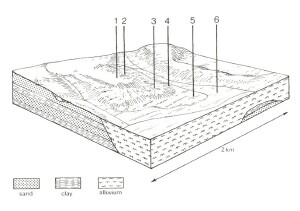 |
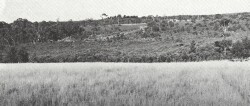 Drainage of these landscapes is poor, and the waterlogged soils carry woodlands of E. nitida and E. radiata with closed scrubs in the drainage lines. | 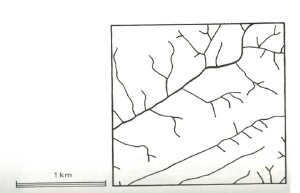 |
Area: 71 km2 | Component and its proportion of land system | |||||
1 30% | 2 25% | 3 15% | 4 15% | 5 5% | 6 10 | |
| CLIMATE Rainfall, mm | Annual: 800 – 1,000, lowest January (40), highest August (120) | |||||
| Temperature, 0oC | Annual: 13, lowest July (8), highest February (18) | |||||
Temperature: less than 10oC (av.) June – August | ||||||
Precipitation: less than potential evapotranspiration late October – March | ||||||
| GEOLOGY Age, lithology | Paleocene unconsolidated marine sand | Paleocene unconsolidated marine clay, sand and silt | ||||
| TOPOGRAPHY Landscape | Undulating plains | |||||
| Elevation, m | 60 – 230 | |||||
| Local relief, m | 45 | |||||
| Drainage pattern | Trellis | |||||
| Drainage density, km/km2 | 3.8 | |||||
| Land form | Rise | Terrace | Drainage line | |||
| Land form element | Crest, slope | Upper slope | Mid slope | Lower slope | - | - |
Slope (and range), % | 21 (9-38) | 9 (2-21) | 5 (2-11) | 16 (5-33) | 2 (0-5) | 0 (0-1) |
Slope shape | Convex | Convex | Linear | Convex | Linear | Linear |
NATIVE VEGETATION Structure | Woodland | Low woodland | Open woodland | Woodland | Open forest | Closed scrub |
Dominant species | E. radiata, E. nitida | E. radiata, E. nitida | E. radiata, E. nitida | E. radiata, E. nitida, E. ovata | E. ovata, E. viminalis, E. radiata, E. baxteri | Melaleuca squarrosa, Casuarina littoralis, Aotus ericoides |
SOIL Parent material | Sand | Sand | Colluvial sand on clay | Colluvial sand on silt, sand and clay | Colluvial sand on alluvial clay, silt and sand | Plant remains alluvial sand, silt and clay |
Description | Grey sand soils, uniform texture | Grey sand soils, with hardpans, uniform texture | Grey sand soils, structured clay underlay | Grey sand soils, weakly structured clay underlay | Grey sand soils, structured clay underlay | Black sand soils, uniform texture |
Surface texture | Loamy sand | Loamy sand | Sandy loam | Sandy loam | Sandy loam | Silty loam |
Permeability | Very high | Very low | Very low | Low | Very low | High |
Depth, m | >2 | 0.8 | >2 | >2 | >2 | >2 |
| LAND USE | Uncleared areas: Nature conservation; water supply; sand and gravel extraction; hardwood forestry for posts, poles and fuel Minor cleared areas: Beef cattle grazing; water supply | |||||
| SOIL DETERIORATION HAZARD Critical land features, processes, forms | Very low inherent fertility and high permeability lead to nutrient decline. Steeper slopes with compacted soils are prone to sheet, rill and scour gully erosion. | Hardpans restrict drainage, leading to seasonal waterlogging. Very low inherent fertility and leaching of highly acidic permeable surfaces lead to nutrient decline. | Low permeability and seasonal perched water tables lead to waterlogging and soil compaction. | Weakly structured soils of low permeability on steeper slopes are prone to sheet erosion. | Low permeability and seasonal perched water tables lead to waterlogging and soil compaction. | High water tables lead to waterlogging and soil compaction. Run-off from adjacent hills lead to flooding and siltation. |
