Victorian Resources Online (archived)
Point Roadknight Land System
Download the pdf version of this document: Point Roadknight Land System (PDF - 268 KB)
To view the information, PDF requires the use of a PDF reader. This can be installed for free from the Adobe website (external link).
| Along the coast from Breamlea to Eastern View, coastal dunes occur discontinuously. In some localities a primary and a secondary dune form a thin barrier between the sea and the Tertiary sediments, but in the locality of Point Impossible the dune system is more complex and extensive. The foredune and secondary dune material is aeolian sand and shell grit. On older dunes, mobilization of calcium carbonate has resulted in the formation of calcarenite, which may outcrop on blowouts or steep slopes. Away from these calcarenite pavements, the soils are freely drained calcareous sands. The exposed calcarenite pavements may support red calcareous gradational soils, but extensive sheet erosion has removed most of this material. Recreation and access to the foreshore are the main land uses. Some buildings have been sited in these dunes at Breamlea and Fairhaven. Native grasses and shrubs that colonize these dunes are very sensitive to disturbance and, once devoid of vegetative cover, wind erosion is likely to occur. Hand planting of Ammophila arenaria has been necessary to stabilize many areas. | 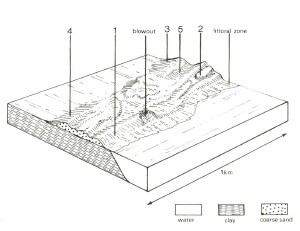 |
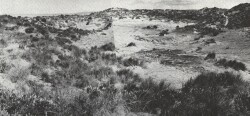 Sections of coastline in the drier eastern parts of the study area often have extensive calcareous dune systems. On many of these dunes the native vegetation has been trampled and destroyed and the hand planting of Ammophila arenaria has been necessary to restabilize the dune system. |  |
Area: 8 km2 | Component and its proportion of land system | ||||
1 20% | 2 50% | 3 25% | 4 2% | 5 3% | |
| CLIMATE Rainfall, mm | Annual: 600 – 750, lowest January (30), highest August (75) | ||||
| Temperature, 0oC | Annual: 14, lowest July (10), highest February (18) | ||||
Temperature: less than 10oC (av.) July | |||||
Precipitation: less than potential evapotranspiration mid October - early April | |||||
| GEOLOGY Age, lithology | Recent aeolian sand and shell grit | Cemented deposits (calcarenite and travertine) | |||
| TOPOGRAPHY Landscape | Longitudinal coastal dunes to the east of the Otway Range | ||||
| Elevation, m | 0 – 25 | ||||
| Local relief, m | 15 | ||||
| Drainage pattern | Absent | ||||
| Drainage density, km/km2 | - | ||||
| Land form | Foredune | Shifting dune | Older more stable dunes | Interdune corridor | |
| Land form element | Windward exposed slope | Leeward and windward slopes | Gentler slope | Steeper slope | - |
Slope (and range), % | 40 (10-65) | 30 (5-65) | 9 (0-20) | 15 (5-10) | 3 (0-7) |
Slope shape | Irregular | Irregular | Convex | Linear | Concave |
NATIVE VEGETATION Structure | Tussock grassland | Open heath | Low woodland | Low woodland | Possibly open heath |
Dominant species | Spinifex hirsutus, Tetragonia tetragonioides | Helichrysum paralium, Leucopogon parviflorus | Melaleuca lanceolata, Leptospermum laevigatum, Leucopogon parviflorus | Melaleuca lanceolata, Leucopogon parviflorus, Acacia longifolia | Helichrysum paralium |
SOIL Parent material | Coarse sand, shell grit | Coarse sand, shell grit | Coarse sand, shell grit | Calcarenite, coarse sand | Calcarenite, travertine |
Description | Yellow calcareous sand soils, uniform texture | Yellow calcareous sand soils, uniform texture | Brown calcareous sand soils, uniform texture | Stony black calcareous sand soils, uniform texture | Red calcareous gradational soils |
Surface texture | Coarse sand | Coarse sand | Loamy sand | Loamy sand | Sandy loam |
Permeability | Very high | Very high | Very high | Moderate | Very low |
Depth, m | >2 | >2 | >2 | >2 | 0.3 |
| LAND USE | Uncleared areas: Passive and active recreation; foreshore access; nature conservation; sand extraction. Minor cleared areas: Recreational facilities; refuse tip; foreshore access; residential | ||||
| SOIL DETERIORATION HAZARD Critical land features, processes, forms | Marine erosion and accretion occur seasonally. Native vegetation is sensitive to trampling and disturbance. Weakly structured sands are prone to wind erosion. Low inherent fertility and high permeability lead to nutrient decline. | Native vegetation is sensitive to trampling and disturbance. Weakly structured sands are prone to wind erosion. Low inherent fertility and high permeability lead to nutrient decline. | Weakly structured sands are prone to wind erosion. Low inherent fertility, high alkalinity and high permeability lead to nutrient decline. | Weakly sands with restricted drainage on steep slopes are prone to sheet erosion. Low inherent fertility and high alkalinity lead to nutrient decline. | Low permeability and weak structure lead to sheet erosion, exposing calcarenite pavement. |
