Victorian Resources Online (archived)
Tomahawk Creek Land System
Download the pdf version of this document: Tomahawk Creek Land System (PDF - 401 KB)
To view the information, PDF requires the use of a PDF reader. This can be installed for free from the Adobe website (external link).
| Tomahawk Creek and its tributaries have dissected out deep valleys with characteristic north-not’-west- and south-sou’-east-oriented parallel rides and spurs. Small remnants of lateritic plateaux on the high parts of the landscape are bounded by scarps on which ironstone outcrops. Tertiary sand is often exposed in a narrow band below these scarps, and springs are often present at this level. Silt and clay are the more common parent materials on long straight slopes leading down to the valley floor. Small dissected terraces are found along the wider valleys. The terrain to the south and east of Tomahawk Creek shows a lower local relief than the area to the north and west. Areas of lateritic plateaux are often wider and surrounding slopes are shorter and more gentle. Site drainage is affected by the more subdued relief. Woodlands and lowlands appear to have been more common in this area, with open forests to the north and west. Most of this land system has been cleared as part of the Heytesbury Settlement Scheme, and dairy farming is the main land use. Subsoils on many slopes are dispersible and gully and tunnel erosion are quite active. Some landslips have occurred, particularly below springs at the base of scarps. | 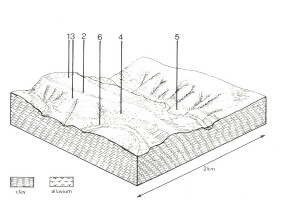 |
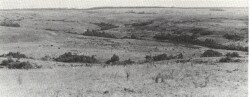 Cattle graze the undulating plateau country. | 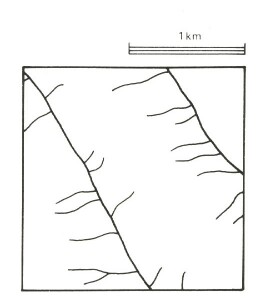 |
Area: 101 km2 | Component and its proportion of land system | |||||
1 15% | 2 6% | 3 10% | 4 50% | 5 9% | 6 10% | |
| CLIMATE Rainfall, mm | Annual: 850 – 1,050, lowest January (40), highest August (125) | |||||
| Temperature, 0oC | Annual: 13, lowest July (8), highest February (19) | |||||
Temperature: less than 10oC (av.) June – August | ||||||
Precipitation: less than potential evapotranspiration November – March | ||||||
| GEOLOGY Age, lithology | Pliocene lateritized sand and clay | Miocene unconsolidated sand, silt and clay | ||||
| TOPOGRAPHY Landscape | Deep valleys dissected out from lateritic plateaux | |||||
| Elevation, m | 50 – 160 | |||||
| Local relief, m | 70 | |||||
| Drainage pattern | Trellis predominantly, some dendritic areas | |||||
| Drainage density, km/km2 | 2.9 | |||||
| Land form | Plateau remnants | Scarp | Valley floor | |||
| Land form element | - | Upper slope | Upper slope | Mid slope | Lower slope | - |
| Slope (and range), % | 1 (0-3) | 28 (13-40) | 12 (8-18) | 12 (8-20) | 5 (1-8) | 0 (0-2) |
| Slope shape | Straight | Concave | Straight | Straight | Straight | Concave |
| NATIVE VEGETATION Structure | Open forest | Open forest | Woodland | Open forest | Low woodland | Woodland |
| Dominant species | E. obliqua, E. baxteri | E. obliqua, occasionally E. viminalis | E. radiata, E. baxteri, E. viminalis | E. ovata, E. obliqua, E. radiata, E. baxteri | E. radiata, E. ovata | E. viminalis, E. ovata |
| SOIL Parent material | Lateritic remains | Colluvial lateritic ironstone | Siliceous sand | Sandy clay (in-situ) | Colluvial/alluvial sand over sandy clay | Sand and clay alluvium |
| Description | Mottled yellow and red gradational soils with ironstone | Stony red gradational soils | Grey sand soils, uniform texture | Yellow-brown gradational soils, coarse structure | Grey sand soils, structured clay underlay | Grey gradational soils |
| Surface texture | Sandy loam | Gravelly sandy loam | Coarse sandy loam | Sandy loam | Sandy loam | Sandy loam |
| Permeability | Moderate | Very high | Very high | Low | Very low | Very low |
| Depth, m | 1.6 | 1.0 | >2 | >2 | >2 | >2 |
| LAND USE | Cleared areas: Mainly dairy farming; some beef cattle grazing. Uncleared areas: Hardwood forestry for sawlogs, some posts and poles, gravel extraction; nature conservation. | |||||
| SOIL DETERIORATION HAZARD Critical land features, processes, forms | Low inherent fertility and phosphorus fixation lead to nutrient decline. Leaching of salts leads to increased salinity of drainage waters. | Steep slopes with weakly structured surfaces of low water-holding capacity are prone to sheet erosion. Low inherent fertility and high permeability lead to nutrient decline. | Emergence of springs from these permeable aquifers leads to seasonal waterlogging and soil compaction. Permeable soils of low inherent fertility are prone to nutrient decline. | Highly dispersible clay subsoils of low permeability receiving seepage water are prone to gully and tunnel erosion and to landslips and slumping. | Dispersible soils of low permeability receiving seepage water are prone to gully and tunnel erosion, waterlogging and surface compaction. Permeable surfaces of low inherent fertility are prone to nutrient decline. | Dispersible clay subsoils of low permeability receiving rapid run-off from surrounding hills are prone to gully erosion. Rising water tables and low permeabilities lead to seasonal waterlogging and soil compaction. |
