Victorian Resources Online (archived)
Yahoo Creek Land System
Download the pdf version of this document: Yahoo Creek Land System (PDF - 360 KB)
To view the information, PDF requires the use of a PDF reader. This can be installed for free from the Adobe website (external link).
| North of the Gellibrand River, Cretaceous sandstones and mudstones outcrop in the valleys of the Yahoo Creek, Gum Gully Creek and an unnamed creek to the west of Black Bridge road. These sediments belong to the Moonlight Head Beds of the Otway Group. Slopes are steep and valleys are narrow, in sharp contrast to the rounded hills of adjacent Tertiary sediments. The soils are similar to those found on other outcrops of Cretaceous sediments in the Range, with the exception that surface horizons contain appreciably more sand and the parent material is usually highly weathered. Open forests of Eucalyptus obliqua, E. ovata and E. aromaphloia are similar to those found on the drier slopes of the Forrest land system. Most parts of the valleys remain virtually uncleared and quite remote. Hardwood forestry is the main land use, although the rugged terrain makes access difficult. Some softwood plantations have been established in the catchment of Yahoo Creek. Landslips occur on these soils under native forest, and the incidence increases dramatically following clearing. Sheet erosion and gully erosion are also prone to occur. | 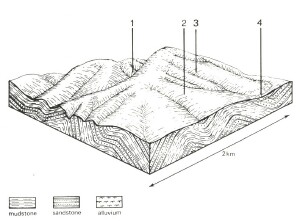 |
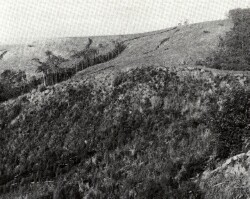 The steep and rugged hills surrounding Yahoo Creek are difficult to manage. Scrub regrowth rapidly takes over recently cleared slopes. | 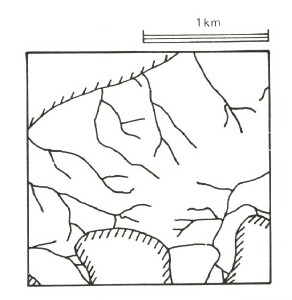 |
Area: 32 km2 | Component and its proportion of land system | |||
1 35% | 2 45% | 3 15% | 4 5% | |
| CLIMATE Rainfall, mm | Annual: 850 – 1,000, lowest January (40), highest August (130) | |||
| Temperature, 0oC | Annual: 12, lowest July (7), highest February (18) | |||
Temperature: less than 10oC (av.) June – September | ||||
Precipitation: less than potential evapotranspiration November – March | ||||
| GEOLOGY Age, lithology | Low Cretaceous highly feldspathic sandstone and mudstone (Moonlight Head Beds) | |||
| TOPOGRAPHY Landscape | Deeply dissected hills to the north of Gellibrand River | |||
| Elevation, m | 60 – 270 | |||
| Local relief, m | 110 | |||
| Drainage pattern | Dendritic with small radial areas | |||
| Drainage density, km/km2 | 3.0 | |||
| Land form | Hill | |||
| Land form element | Steep slope | Crest, upper slope | Slope | Swale, gentle lower slope |
| Slope (and range), % | 50 (20-70) | 15 (2-30) | 35 (15-45) | 13 (1-25) |
| Slope shape | Linear | Linear | Linear | Concave |
| NATIVE VEGETATION Structure | Open forest | Open forest | Open forest | Open forest |
| Dominant species | E. ovata, E. obliqua, E. radiata, E. aromaphloia, E. viminalis | E. obliqua, E. ovata, E. aromaphloia, E. radiata | E. viminalis, E. obliqua | E. viminalis, E. obliqua, Acacia melanoxylon |
| SOIL Parent material | In-situ weathered rock, colluvial rock | In-situ deeply weathered rock | In-situ weathered rock | Colluvium |
| Description | Stony brown gradational soils | Yellow-brown gradational soils, coarse structure | Brown gradational soils | Dark brown gradational soils |
| Surface texture | Fine sandy loam | Sandy clay loam | Loam | Loam |
| Permeability | High | Low | Moderate | Moderate |
| Depth, m | 0.7 | 1.2 | 0.9 | >2 |
| LAND USE | Uncleared areas: Hardwood forestry for sawlogs, posts and poles; nature conservation; water supply Minor cleared areas: Sheep and beef cattle grazing; water supply | |||
| SOIL DETERIORATION HAZARD Critical land features, processes, forms | Stony shallow soils with weak structure and low water-holding capacity on steep slopes are prone to sheet erosion and landslides. | Soils of low permeability on the steeper slopes are prone to sheet and rill erosion. Dispersible subsoils are prone to gully erosion. | Clay subsoils on steep slopes subject to periodic saturation are prone to landslips. Steep slopes are prone to sheet erosion. | Weakly structured soils receiving run-off from adjacent hills are prone to scour gullying, siltation and flooding. |
