Victorian Resources Online (archived)
CLRA44
Location: Swan Bay Road, Queenscliff district, Bellarine Peninsula
Australian Soil Classification: Bleached-Sodic, Sodosolic, Redoxic HYDROSOL
General Landscape Description: Coastal flat
Geology: Quaternary coastal dune deposits: beach deposits, coastal and inland dunes, lunettes and swamps; sand, silt, clay, calcarenite deposits
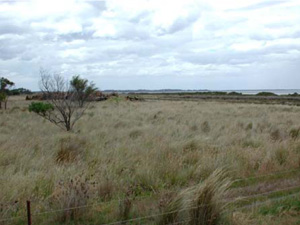
CLRA44 Landscape. Coastal flats of Swan Bay
Soil Profile Morphology:
Surface Soil
A1 | 0–15 | Black (10YR2/1); loamy sand; apedal single grain structure; pH 8.5; sharp boundary to: | 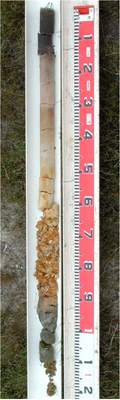 CLRA44 Profile | |||
A21 | 15–30 | Brown (10YR5/3); sand; apedal single grain structure; pH 8.5; abrupt boundary to: | ||||
A22 | 30–55 | Light olive brown (2.5Y5/6); sand; apedal single grain structure; pH 8.5; gradual boundary to: | ||||
A23 | 55–85 | Yellowish brown (10YR5/8) with common medium faint to distinct yellowish brown mottles (10YR5/8); sand; many small to medium angular shell fragments; apedal single grain structure; pH 8.5; abrupt boundary to: | ||||
Subsoil | ||||||
B1h | 85–95 | Dark grey (5Y4/1); sand; common small to medium angular shell fragments; apedal single grain structure; pH 8.5; abrupt boundary to: | ||||
B2 | 95–110 | Olive (5Y4/3) with common medium faint dark yellowish brown (10YR4/6) mottles; medium clay; few distinct slickenside cutans; few medium manganiferous nodules; pH 8.5. | ||||
Soil Profile Characteristics:
Horizon | Sample Depth (cm) | pH (water) | pH (CaCl2) | EC 1:5 | Exchangeable Cations | |||
Ca | Mg | K | Na | |||||
meq/100g | ||||||||
A23/B1h/B2 | 55–110 | 7.2 | 7.1 | 3.8 | 6.5 | 5.8 | 1.9 | 7.5 |
Management Considerations:
- This is a sandy, alkaline soil with clay at depth. The clay can have a major effect by reducing and/or redirecting the internal drainage and restricting root growth beyond the upper horizons. Salinity is an issue in these coastal locations. Soil salinity at depth will affect deeper rooting plants and may indicate water movement restrictions. It is important not to increase the ground water level bringing the salinity closer to the surface; more efficient use of water by plants and/or deep drainage is suggested. This is also notes by the high sodium levels.
- Sodic subsoils are another key feature of many of the soils in the CMA, particularly in the drier areas. These subsoils usually have poor structure (generally as coarse domed columns). The poor structure results in dispersion (and subsequent clogging of pores), restricting water and gas movement through the subsoil. These subsoils are hardsetting and have limited opportunity for cultivation without further damage to soil structure. The application of gypsum is used to counter the effect of the sodicity. Penetration by deep-rooted crops is also useful as is minimum tillage practices which avoids bring the sodic, dispersive material to the surface.
Profile Described By: David Rees, Doug Crawford, Nathan Robinson, Keith Reynard & Grant Boyle (December 2002).
