Victorian Resources Online (archived)
CLRA05
Location: Indented Head, St Leonards district, Bellarine Peninsula
Australian Soil Classification: Eutrophic, Mottled-Subnatric, Yellow SODOSOL
General Landscape Description: Lower slope of Dunes
Geology: Quaternary Aeolian: coastal and inland dunes: dune sand, some swamp deposits.
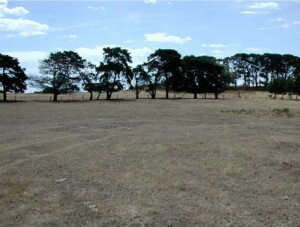
CLRA5 Landscape. Low aeolian dunes near Indented Head
Soil Profile Morphology:
Surface Soil
A11 | 0–5 cm | Very dark grey (10YR3/1); sandy loam; very few (2–6 mm) subangular quartz gravels; weak medium sub-angular blocky structure; roughfabric; weak consistence dry; pH 6.0; smooth abrupt boundary to: | 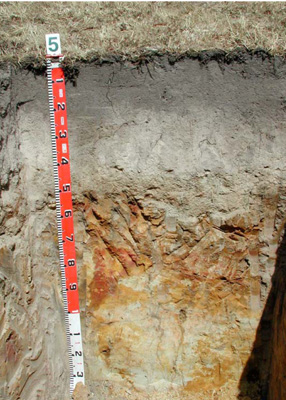 CLRA5 Profile CLRA5 Profile | |||
A12 | 5–20 cm | Very dark grey (10YR3/1); sandy loam; very few (2–6 mm) subangular quartz gravels; weak medium subangular blocky structure; rough ped fabric; weak consistence (dry); very few (6–60 mm) ferruginous nodules; pH 5.5; smooth clear boundary to: | ||||
A21 | 20–40 cm | Light brownish grey (10YR6/2); conspicuous bleach (10YR7/2); sand; very few (2–6 mm) subangular quartz gravels (2–6 mm); apedal massive structure; sandy fabric; loose consistence (dry); very few (6–60 mm) ferric nodules; pH 6.5; wavy clear boundary to: | ||||
A22 | 40–55 cm | Brown (10YR5/3); conspicuous bleach (10YR7/3); sand; few (2–6 mm) subangular quartz gravels (2–6 mm); apedal massive structure; sandy fabric; very weak consistence (dry); few (6–60 mm) ferric nodules; pH 6.5; wavy abrupt boundary to: | ||||
| Subsoil | ||||||
B21 | 55–70 cm | Brownish yellow (10YR6/6) with many very large red and light and dark brown (10R4/4, 10YR6/3, 10YR3/2) distinct mottles; medium clay; very few (2–6 mm) subangular quartz gravels; strong coarse columnar parting to medium prismatic structure; smooth ped fabric; common prominent clay skin and other cutans; very strong consistence (dry); pH 6.0; wavy clear boundary to: | ||||
BC | 70–100 cm | Brownish yellow (10YR6/6) with many very large red and light and dark brown (10R4/4, 10YR6/3, 10YR3/2) prominent mottles; fine sandy clay; very few (2–6 mm) subangular quartz gravels; weak coarse columnar parting to medium prismatic structure; smooth ped fabric; few distinct clay skin and other cutans; strong consistence (dry); pH 7.0; wavy gradual boundary to: | ||||
C1 | 100–125 cm | Light grey (10YR7/2) with common large yellow (10YR6/6) prominent mottles; clayey fine sand; apedal massive structure; earthy fabric; very firm consistence (dry); pH 7.5; smooth clear boundary to: | ||||
C2 | 125–155+ cm | Light grey (10YR7/2) with common large yellow (10YR6/6) prominent mottles; clayey fine sand; apedal massive structure; earthy fabric; weak consistence (moderately moist); pH 7.7. | ||||
Soil Profile Characteristics:
Horizon | Sample Depth (cm) | pH (water) | pH (CaCl2) | EC 1:5 | Exchangeable Cations | |||
Ca | Mg | K | Na | |||||
meq/100g | ||||||||
A11 | 0–5 | 5.2 | 4.5 | 0.1 | 3.5 | 1.2 | 0.24 | 0.34 |
A12 | 5–20 | 4.9 | 4.2 | 0.05 | 2.2 | 0.46 | 0.06 | 0.19 |
A21 | 20–40 | 5.2 | 4.5 | <0.05 | 0.61 | 0.11 | <0.05 | <0.05 |
A22 | 40–55 | 5.8 | 5 | <0.05 | 1 | 0.5 | <0.05 | 0.15 |
B21 | 55–70 | 6.3 | 5.2 | 0.1 | 1.4 | 4.2 | 0.08 | 0.99 |
BC | 70–100 | 6.8 | 5.8 | 0.14 | 0.5 | 3.1 | 0.06 | 1.2 |
C1 | 100–125 | 7.6 | 6.4 | 0.16 | ||||
C2 | 125–135+ | 7.7 | 6.7 | 0.21 | ||||
Horizon | Sample Depth (cm) | Exchangeable Aluminium mg/kg | Exchangeable Acidity cmolc/kg | Field Capacity pF2.5 | Wilting Point pF4.2 | Coarse Sand (0.2- 2.0 mm) | Fine Sand (0.02- 0.2 mm) | Silt (0.002- 0.02 mm) | Clay (<0.002 mm) |
A11 | 0–5 | <10 | 8.5 | 16.1 | 7.5 | 31.8 | 54.4 | 1 | 11 |
A12 | 5–20 | 22 | 7.4 | 18.7 | 4.2 | 54.9 | 33.9 | 3.5 | 4 |
A21 | 20–40 | 23 | 3.3 | 9.3 | 1.3 | 50.4 | 42.6 | 3 | 3 |
A22 | 40–55 | <10 | 4.3 | 9.7 | 2.9 | 59.9 | 28.8 | 5 | 6.5 |
B21 | 55–70 | 4.3 | 24.0 | 14.6 | 22.8 | 33.7 | 1 | 42.5 | |
BC | 70–100 | 2.5 | 19.1 | 11.0 | 2.2 | 63.8 | 9.5 | 22 | |
C1 | 100–125 | ||||||||
C2 | 125–135+ |
Management Considerations:
- This soil has a strong texture contrast between the deep sandy soil and the subsoil which is sodic. It is important to maintain or improve the upper soil by increasing organic matter (particularly in the subsurface soil). The organic carbon content of the litter surface is 3.2% and the surface is 1.6%. It would be advisable not to bring the very dispersive subsoil [Emerson class 2(4)] to the surface as it would promote surface sealing (hardsetting) as well as adverse nutrient affects.
- Maintenance of a vegetative cover is important for soil stability particularly where the surface soil is light and susceptible to water and wind erosion.
- Root penetration of the clayey subsoil may be difficult with the hardsetting nature of the soil, coarse structure and nutrient imbalance (alkalinity with high sodicity and some salinity), but the sandy soil above provides a suitable physical medium for growth though with little water and nutrient holding capacity.
Profile Described By: David Rees (December 2002).
