Victorian Resources Online (archived)
Profile Number 60
| Laboratory number: | 0934 | 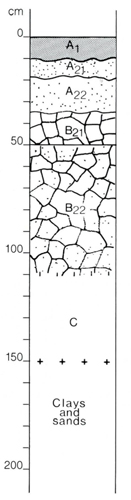 | Profile Description | ||
| Site number: | 381 | A1 | 0-10 cm | Very dark greyish brown (10YR 3/2) sandy clay loam; strong medium (5 mm) crumb structure; rough-ped fabric; slightly hard when dry; abundant fine and few large roots; pH 5.7; clear wavy boundar | |
| Classification: | Northcote (1979) – Db2.41 Stace et al (1972) – Soloth – Yellow Podzolic Soil intergrade | A21 | 10-18 cm | Dark greyish brown (10YR 4/2) sandy clay loam; common distinct yellowish brown (1 mm) mottles; apedal; earthy fabric; slightly hard when dry; abundant fine and few large roots; 5% ferruginous nodules up to 3 mm; pH 5.8; clear wavy boundary | |
| Location: | Traralgon 8221, grid ref. 581675 12 km S of Traralgon | A22 | 18-35 cm | Brown (10YR 5/3) light sandy clay; common distinct yellowish brown (5-15 mm) mottles; apedal; earthy fabric; hard when dry; abundant fine and few large roots; 5% ferruginous nodules up to 3 mm; pH 6.0; clear wavy boundary | |
| Land system, component: | Westbury 2, 1 | B21 | 35-50 cm | Dark yellowish brown (10YR 4/4) heavy clay; common distinct reddish brown (5-15 mm) mottles; strong coarse (20 mm) angular blocky structure; few roots; rough-ped fabric; extremely hard when dry; pH 5.5; clear boundary | |
| Topography: | 2% slope in undulating terrain | B22 | 50-110 cm | Dark yellowish brown (10YR 4/6) heavy clay; common distinct grey (5-15 mm) mottles; moderate coarse (30 mm) angular blocky structure; smooth-ped fabric; very hard when dry; few roots; 5% ferruginous nodules up to 3 mm; pH 6.0; diffuse smooth boundary | |
| Elevation: | 100 m | C | 110-150 cm | Light red (2.5YR 6/8) heavy clay; abundant prominent grey (>15 mm) mottles; apedal; earthy fabric; very hard when dry; pH 7.3 | |
| Drainage: | Poor | ||||
| Parent material: | Tertiary and Pleistocene clay and sand with some intermixed quartz gravel | ||||
| Vegetation: | Grassy open forest II: Eucalyptus radiata, E. ovata, Acacia melanoxylon, A. mearnsii, Casuarina littoralis and Leptospermum juniperinum predominant shrub species | ||||
| LABORATORY ANALYSES 934 | |||||||||||||||||||
Horizon | Sample Depth cm | Lab. texture | Particle size distribution | Atterberg limits | 1:5 soil water suspension | Clay mineralogy by x-ray diffraction | |||||||||||||
Gravel % | Coarse sand % f.e. | fine sand % f.e. | Silt % f.e. | Clay % f.e. | liquid limit % | plastic limit % | plasticity index % | linear shrinkage % | pH | EC 25°C µS/cm | Cl- % | Depth cm | Composition % | ||||||
A1 | 0-10 | L | 2 | 20 | 42 | 20 | 15 | 5.6 | 79 | 0.009 | 50-60 | Kaolinite 90; Illite intergrade 10 | |||||||
A21 | 10-18 | L | 3 | 22 | 42 | 19 | 17 | 26 | 15 | 11 | 6.0 | 5.6 | 42 | 0.005 | |||||
A22 | 30-35 | C | 4 | 15 | 29 | 15 | 40 | 5.6 | 33 | 0.002 | |||||||||
B21 | 35-50 | C | 2 | 9 | 16 | 8 | 64 | 5.6 | 51 | 0.002 | |||||||||
B22 | 60-90 | C | 2 | 7 | 15 | 5 | 71 | 97 | 24 | 73 | 9.0 | 6.0 | 52 | 0.004 | |||||
Horizon | Sample Depth cm | Org. C % | Total N % | 1.3C N | Free Fe2O3 % | Available | HCl extract | Exchangeable cations | |||||||||||
P ppm | K ppm | P % | K % | Ca | Mg | K | Na | CEC | Ca % of CEC | Mg | K | Na | H | ||||||
Milliequivalents/100g | |||||||||||||||||||
A1 | 0-10 | 2.45 | 0.18 | 18 | 2.3 | 13 | 70 | 0.012 | 0.037 | 3.2 | 1.8 | 0.1 | 0.2 | 14.0 | 23 | 13 | 1 | 1 | 62 |
A21 | 10-18 | 1.28 | 0.094 | 18 | 3.6 | 1 | 20 | 0.072 | 0.022 | 1.9 | 1.2 | 0.08 | 0.09 | 9.9 | 19 | 12 | 1 | 1 | 67 |
A22 | 30-35 | 5.0 | 0.006 | 0.066 | 2.2 | 3.5 | 0.06 | 0.3 | 146.4 | 13 | 21 | <1 | 2 | 64 | |||||
B21 | 35-50 | 5.2 | 0.007 | 0.094 | 2.8 | 5.5 | 0.09 | 0.8 | 24.2 | 12 | 23 | <1 | 3 | 62 | |||||
B22 | 60-90 | 0.6 | 0.006 | 0.13 | 2.9 | 6.5 | 0.09 | 1.0 | 22.7 | 13 | 29 | <1 | `4 | 5 | |||||
