Victorian Resources Online (archived)
EGS258
Location: Glenaladale North
Australian Soil Classification: Bleached-Sodic, Mesotrophic, Brown CHROMOSOL
Map Unit: Glenmaggie (Component 1)
Previous Site Name: EG258
General Landscape Description: Rolling to steep low hills.
Site description: Mid-slope, WSW aspect 8% slope
Land Use: Grazing
Native Vegetation: Shrubby dry forest
Geology: Late Devonian freshwater sediments
Soil Profile Morphology:
Surface Soil
| A1 | 0 – 5 cm | Very dark greyish brown (10YR3/2); clay loam; weak fine subangular block structure; weak consistence dry; clear change to: | 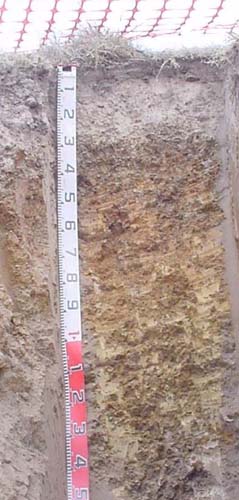 EG258 Profile |
| A21 | 5 – 15 cm | Dark greyish brown (10YR4/2), conspicuously bleached, light brownish grey dry (10YR6/2d); very fine sandy clay loam; massive; few (<2%) angular charcoal fragments (<20 mm); abrupt change to: | |
| A22 | 15 – 23 cm | Brown (10YR5/3) conspicuously bleached light grey dry (10YR7/2); very fine sandy clay loam; massive; few (<2%) angular charcoal fragments (<20 mm abrupt change to: | |
| Subsoil | |||
| B21 | 23 – 40 cm | Brown (10YR4/3; medium clay; strong fine angular blocky structure; strong consistence dry; very few (<2%) ferruginous medium nodules (<6 mm); clear change to: | |
| B22 | 40 – 60 cm | Dark yellowish brown (10YR4/6); medium clay; moderate very coarse angular blocky structure; very strong dry; very few (<2%) ferruginous medium nodules (<6 mm); clear change to: | |
| C1 | 60 – 90 cm | Yellowish brown (10YR5/4); medium clay; massive; few fine round organic segregations; very strong dry; few (2-10%) ferruginous, organic and earthy nodules and veins; gradual change to: | |
| C2 | 90 – 120+ cm | Brownish yellow (10YR6/6); medium clay; massive; few fine round organic segregations; very strong dry; few (2-10%) ferruginous, organic and earthy nodules and veins; changes to: | |
| R | 120+ cm | Decomposing shale. |
Key Profile Features:
- Strong texture contrast between the surface (A) and subsoil (B) horizons.
- Strongly bleached subsurface horizon.
Soil Profile Characteristics:
pH | |||
Surface soil (A horizon) | Strongly Acid | Non-Sodic | None |
Subsoil (B21 horizon) | Moderately Acid | Non-Sodic | None1 |
Deep subsoil (90-120cm) | Slightly Acid | Sodic | Strong |
Chemical and Physical Analysis:
Horizon | Horizon Depth (cm) | pH (water) | pH CaCl2 | EC dS/m | Organic Carbon % | Total Nitrogen % | Exchangeable Aluminium ppm | Exchangeable Acididty meq/100g | Exchangeable Cations | Coarse Sand (0.2-2.0 mm) % | Fine Sand (0.02-0.2 mm) % | Silt (0.002-0.02 mm) % | Clay (<0.002 mm) % | Field Capacity % w/w | Wilting Point % w/w | |||
Ca | Mg | K | Na | |||||||||||||||
meq/100g | ||||||||||||||||||
A1 | 0-5 | 5.2 | 4.4 | 0.09 | 5.3 | 0.34 | 110 | 16 | 2.4 | 1.1 | 0.5 | <0.1 | 8 | 46 | 27 | 10 | 36.3 | 10.3 |
A21 | 5-15 | 5.5 | 4.6 | <0.05 | 0.38 | <0.05 | 53 | 11 | 1.4 | 0.9 | 0.2 | <0.1 | 9 | 51 | 28 | 12 | 24.4 | 4.8 |
A22 | 15-23 | 5.7 | 4.8 | <0.05 | 1.9 | 0.08 | 27 | 8.5 | 1 | 1.1 | 0.2 | <0.1 | 4 | 50 | 28 | 15 | 24.7 | 4.9 |
B21 | 23-40 | 5.7 | 4.4 | 0.06 | 150 | 14 | 1 | 4.6 | 0.3 | 0.5 | 4 | 24 | 18 | 53 | 34.1 | 19.6 | ||
B22 | 40-60 | 5.7 | 4.4 | 0.07 | 250 | 14 | 0.5 | 5.6 | 0.3 | 0.7 | 1 | 27 | 17 | 53 | 38.4 | 19.8 | ||
C1 | 60-90 | 6.2 | 4.8 | 0.09 | 51 | 7.6 | 0.2 | 7.8 | 0.1 | 1.3 | 1 | 31 | 18 | 46 | 29.6 | 16 | ||
C2 | 90-120 | 7.9 | 6.5 | 0.13 | <5 | 3.4 | 0.3 | 9.8 | <0.1 | 1.9 | 1 | 32 | 24 | 44 | 28.2 | 15.9 | ||
Management Considerations
Whole profile
- Plant available water capacity is considered to be low (estimated at 55 mm) for this soil profile. This is based on an estimated effective rooting depth of 35 cm (i.e. surface soil and the top of the clay horizon). The dense and coarsely structured upper subsoil is likely to restrict rooting depth.
Surface (A) horizons
- The surface soil is strongly acid. This indicates aluminium toxicity could occur in crops sensitive to aluminium toxicity, eg lucerne. Test strips may be used to determine if lime is economically justified.
- The surface (A1) horizon has a very low nutrient holding capacity (based on the sum of the exchangeable calcium, magnesium, potassium and sodium cations). Organic matter is important for maintaining soil fertility, water holding capacity and enhancing surface soil structure; especially in soils such as these with high fine sand contents.
- Potassium levels are moderate and no response to potassium would be expected.
- The low wilting point values (i.e. 10.3 and 4.8) of the surface horizons indicates plants will be able to utilise very light rains when the soil is dry. However, due to the low water storage capacity, plants will soon suffer moisture stress unless further rainfall occurs.
- The presence of a conspicuously bleached subsurface (A2) horizon indicates periodic waterlogging occurs above the more slowly permeable subsoil. This horizon also has a very low inherent fertility (based on the level of exchangeable cations) and will become ‘spewy’ when wet.
Subsoil (B) horizons
- The dense and coarsely structured subsoil is sodic. This will result in significantly restricted root and water movement into the subsoil. The use of gypsum in association with deep ripping has been advocated by some researchers as an effective way to ameliorate sodic subsoils, but this may not be an economic option. Deep ripping should not be carried out when the subsoil is in a moist to wet condition.
- The deep subsoil slakes considerably and shows moderate dispersion when wet. Such soils are prone to tunnel and gully erosion, particularly where subsoil water accumulates, for example in gullies.
Profile Described By: Ian Sargeant, 2001.
