Victorian Resources Online (archived)
GN14
| Group: Nagambie Landcare Group | |
| Australian Soil Classification: Bleached, Eutrophic, Red CHROMOSOL; sandy / clay loamy | Northcote Factual Key: Dr 2.41 |
| Great Soil Group: no suitable group | |
| General Landscape Description: Alluvial plain with original vegetation including Yellow Box (Eucalyptus melliodora) and Grey Box (E. microcarpa). According to Skidmore (1993) the alluvial deposits in this area originated from prior activity of Hughes Creek. | |
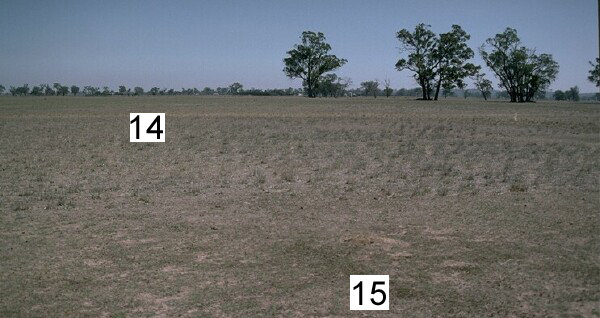 GN14 & 15 Landscape |
Soil Profile Morphology
Surface Soil
| A1 | 0-20 cm | Dark yellowish brown (10YR4/4); light sandy loam; massive structure; firm consistence dry; pH 4.9; sharp change to: | 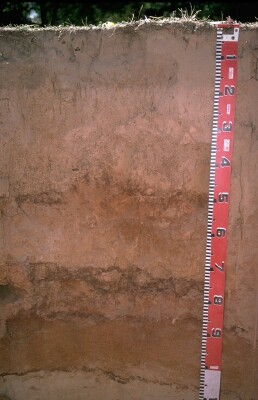 GN14 Profile |
| A2 | 20-45 cm | Strong brown (7.5YR4/6) conspicuously bleached (5YR7/3d); loamy sand; massive structure; weak consistence dry; pH 5.2; abrupt and wavy change to: | |
| Subsoil | |||
| B21 | 45-60 cm | Yellowish red (5YR4/6); sandy clay loam; weakly structured; very firm consistence moist; pH 5.8; abrupt change to: | |
| 2A11 | 60-70 cm | Yellowish red (5YR5/6); clayey sand; massive structure; very firm consistence dry; pH 6.1; sharp change to: | |
| 2B21 | 70-85 cm | Strong brown (7.5YR4/6); fine sandy clay loam; weak coarse structure; strong consistence moist; pH 6.5; sharp change to: | |
| 3A1 | 85-87 cm | Red (2.5YR4/6); sandy loam; massive structure; strong consistence moist; abrupt change to: | |
| 3B21 | 87-105 cm | Strong brown (7.5YR4/6); sandy clay; massive structure; very weak consistence moist; sharp change to: | |
| 4A | 105+ cm | Brownish yellow (10YR6/6); fine sand (micaceous); weak consistence moist. Bands of red (2.5YR4/6); sandy loamoccur within this horizon. | |
| This soil occurs with the Mangalore Sands soil/geomorphic unit as described by Skidmore (1993). | |||
Key Profile Features
- Hardsetting surface horizon.
- Buried soil horizons occur.
- Weak structural development throughout profile.
Key Profile Characteristics
pH | Salinity Rating | |||
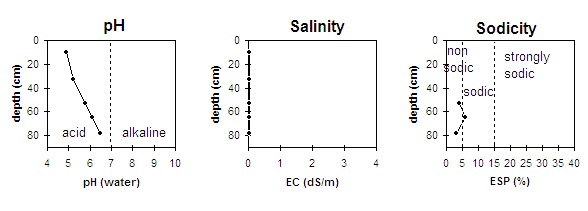
Surface (A1 horizon) | very strongly acid | very low | non-sodic | none |
Subsoil (B21 horizon) | moderately acid | very low | non-sodic | none1 |
Deeper subsoil (at 1 m) | slightly acid | very low | non-sodic | none1 |
| 1 Moderate dispersion after remoulding. | ||||
 |
Management Considerations:
Surface (A) Horizons
- The very strongly acid surface soil indicates that aluminium and manganese toxicity may occur. The level of exchangeable aluminium measured in the laboratory suggests that highly sensitive species such as barley, lucerne, medics and some wheat varieties may be affected. Raising the pH level of the surface soil will help reduce the toxicity. A lime test (sampled at the paddock level) may be appropriate to determine whether lime is needed to raise pH levels. Deficiencies in molybdenum, calcium, magnesium and potassium may also occur.
- The overall nutrient status of the surface soil is very low. Total nitrogen levels are also very low which may lead to problems with plant growth. Nitrogen levels may be improved by adding fertilisers or legumes, although these may accentuate the acidity problem.
- The plant available water holding capacity of the surface horizon is relatively low. However, the low wilting point (3.9%) means that plants will be able to utilise light rains falling on relatively dry soil.
- Organic carbon levels are low. This can be improved by increasing soil organic matter content by direct drilling, minimising tillage and maintaining crop residues. Improved organic matter levels will reduce surface structural problems such as hardsetting and increase fertility as well as soil water holding capacity. Although increasing organic matter improves soil structure, it may also increase soil acidity.
Subsoil (B) Horizons
- pH levels increase with depth down the profile. (The preferred range of pH is between 6.0 and 7.5).
- The overall nutrient status of the subsoil is very low.
- Plant available water capacity is very low (estimated at 40mm) for this profile - based on the laboratory data available.
Comments from Landholder
- Cropped regularly until 10 years ago with lupins.
- Rotations: 2 years grains - 1 year lupins - 2 years grains.
- Barley unsuccessful.
