Victorian Resources Online (archived)
GN16
| Group: Nagambie Landcare Group | Australian Soil Classification: Vertic (and Magnesic) Mesonatric, Grey SODOSOL. |
| Northcote Factual Key: Dy 2.42 | Great Soil Group: solodic soil |
| General Landscape Description: Crest of a gently undulating sedimentary rise. This site has been disturbed due to the removal of gravel from the surface horizons. | |
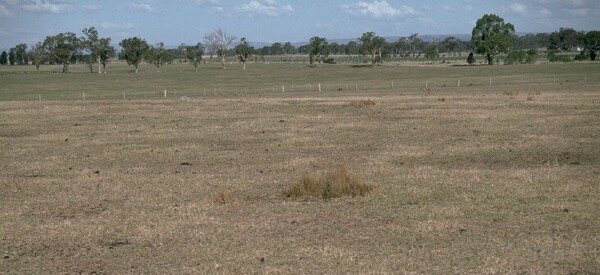 GN16 Landscape |
Soil Profile Morphology
Surface Soil
| A1 | 0-15 cm | Dark brown (7.5YR3/2) light fine sandy clay loam; weak, medium to coarse polyhedral structure; very firm consistence dry; pH 5.6; abrupt change to: | 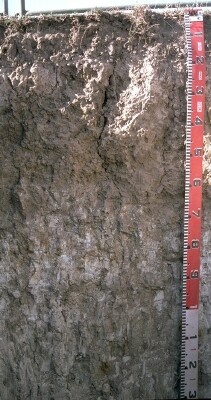 GN16 Profile |
| A2 | 15-20 cm | Discontinuous A2 horizon; greyish brown (10YR5/2) conspicuously bleached fine sandy clay loam; very strong consistence dry; contains a very heavy (90%) amount of coarse gravel (ironstone and siltstone); abrupt change to: | |
| Subsoil | |||
| B21 | 20-70 cm | Pale brown (10YR6/3) medium to heavy clay with gravel segregations; moderate coarse to very coarse blocky structure; cracks deeply; very strong consistence dry; pH 7.5; diffuse and wavy change to: | |
| B/C | 70-120 cm | Light grey (2.5Y7/2) silty clay loam (50% substrate); moderate very coarse prismatic structure: | |
| C | 120+ cm | Weathered base rock (siltstone). | |
Key Profile Features
- Strong texture contrast between the surface (A) horizons and the subsoil (B) horizons.
- Discontinuous A2 horizon.
- Hardsetting surface.
Key Profile Characteristics
pH | Salinity Rating | |||
Surface (A1 horizon) | moderately acid | very low | non-sodic | _ |
Subsoil (B21 horizon) | slightly alkaline | very low | strongly sodic | strong |
Management Considerations:
Surface (A) Horizons
- The moderately acid surface horizon indicates that aluminium toxicity may become a problem, inhibiting the growth of plants.
- Organic carbon and nitrogen levels are relatively high.
- The available water holding capacity of the surface soil is relatively high but overall plant available water will be restricted by limited available water in subsoil.
Subsoil (B) Horizons
- The coarsely structured and dense subsoil is strongly sodic and strongly dispersive. This indicates that water and plant root movement into the subsoil will be restricted. The presence of a bleached A2 horizon (although discontinuous) above the sodic subsoil indicates that periodic waterlogging may occur in patches.
- The subsoil has a very low calcium:magnesium ratio (0.1). This will also result in structural problems restricting root and water movement into the subsoil. A calcium deficiency may also occur.
- The subsoil varies deeply and will significantly swell and shrink upon wetting and drying. This will have implications for building foundations etc.
Comments from Landholder:
- The subsoil is not acidic as lucerne is growing.
- Area has been extensively stripped for gravel approximately 50 years ago. Gypsum and topsoil were added before cropping.
- Gypsum has been applied at the rate of 1 tonne per hectare.
- Superphosphate was added in early 1995 (added annually prior to 1993).
