Victorian Resources Online (archived)
GN20
| Location: East Shepparton Landcare Group. | Australian Soil Classification: Vertic (and Sodic), Calcic, Red CHROMOSOL |
| Northcote Factual Key: Dy 2.33 | Great Soil Group: red-brown earth |
| General Landscape Description: Level plain. This soil has been mapped as Lemnos Loam by Skene and Freedman (1944). | |
| ||
Surface Soil
| A1 | 0-7 cm | Brown (7.5YR4/4); sandy loam; hardsetting surface condition; strong consistence dry; weak coarse blocky structure; contains very few ironstone nodules and a few (2-5%) quartz gravels (2-5 mm size); pH 5.7; sharp and wavy change to: | 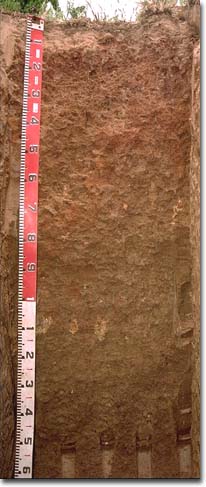 Site GN20 Profile |
| A2 | 7-10 cm | Yellowish red (5YR5/6) and strong brown (7.5YR5/6) sporadically bleached; sandy clay loam; massive; very strong consistence dry; contains a few (3%) quartz gravels (2-5 mm size); pH 6.2; sharp and discontinuous change to: | |
| Subsoil | |||
| B21 | 10-30 cm | Yellowish red (5YR5/6); medium clay; weak to moderate coarse blocky structure; very strong consistence dry; pH 6.7; gradual and wavy change to: | |
| B22 | 30-60 cm | Strong brown (7.5YR4/6); medium clay; weak to moderate coarse blocky structure; very strong consistence dry; contains a few (5%) dark manganese stains; pH 7.7; clear change to: | |
| B31 | 60-100 cm | Yellowish brown (10YR5/6) [with patches of yellowish red (5YR5/8)]; light medium clay; moderate coarse blocky, parting to moderate medium blocky structure; some slickensides evident; strong consistence moist; contains a few (5%) dark flecks and very few (2%) soft and hard carbonates; pH 8.5; gradual change to: | |
| B32K | 100-150 cm | Yellowish brown (10YR5/6) [with patches of yellowish red (5YR5/8)]; medium heavy clay; moderate coarse polyhedral, parting to strong medium polyhedral structure; firm consistence moist; contains a few (5-10%) soft carbonates and some hard nodules; pH 8.5; gradual change to: | |
| B33 | 150+ cm | Brown (7.5YR5/4) [with light yellowish brown (10YR6/4) in patches]; light medium clay; strong medium polyhedral, parting to strong fine polyhedral structure; weak consistence moist; contains a few (5-10%) soft dark segregations; pH 8.6. | |
- Strong texture contrast between surface (A) horizons (< 15% clay) and subsoil (B21) horizon (43% clay).
- Vertic properties in deeper subsoil.
Soil Profile Characteristics:
pH | Salinity Rating | |||
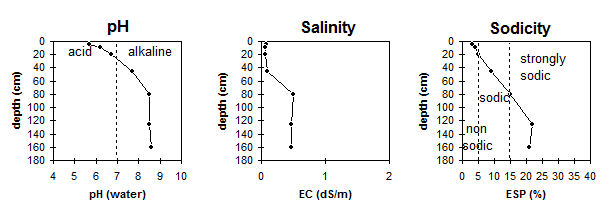
Surface Soil (A1 horizon) | moderately acid | very low | non-sodic | none |
Upper Subsoil (10 - 30 cm) | slightly acid | very low | non-sodic | slight1 |
Deep Subsoil
(at 100 cm) | moderately alkaline | low | strongly sodic | strong |
Deeper Subsoil (at 150+ cm) | strongly alkaline | low-medium | strongly sodic | - |
Management Considerations:
Whole Profile
- Plant available water capacity (PAWC) is considered to be medium (estimated at 120 mm) for the top metre of soil at this site. This is based on available laboratory data and should be considered as a potential capacity only, as roots will be restricted by the dense and coarsely structured subsoil, which is strongly sodic at depth.
Surface (A) Horizons
- The surface soil has a high fine sand and silt content (62%) and is hardsetting when dry. Organic matter is beneficial for such soils in order to maintain aggregation and prevent slaking. Organic matter levels can be improved by minimising or avoiding cultivation, incorporating organic materials and mulching. Organic matter is also beneficial for increasing soil water holding capacity and fertility.
- The surface soil disperses slightly after remoulding which indicates that some dispersion may occur if the soil is cultivated in a moist to wet condition, resulting in structural degradation. Raindrop impact on bare soil may also promote dispersion so maintenance of surface cover is important.
- Cultivation of such soils (with high fine sand and salt contents) when too dry can also result in structural degradation as they become "powdery".
- The surface horizon (0-7 cm) is moderately acid. Low pH levels can result in nutrient imbalances (e.g. aluminium and/or manganese toxicity) and phosphate becoming poorly available. Lime or gypsum can be used to increase pH levels. The use of gypsum may also have a beneficial effect on subsurface and upper subsoil structure. A pH test taken across a larger area will give a better indication of pH levels than this one measurement made at the pit site.
The subsurface (A2) horizon disperses strongly after remoulding. It is liable to develop into a plough pan if cultivated in a moist to wet condition.
Subsoil (B) Horizons
- Although the top of the coarsely structured subsoil is non-sodic, it disperses slightly. This could be in part due to the high exchangeable magnesium percentage (i.e. 37%). This may cause conditions which result in some restricted root and water movement through the subsoil. The presence of a sporadically bleached A2 horizon above the subsoil indicates that some waterlogging occurs as a result of impeded subsoil drainage.
- The upper subsoil disperses completely after remoulding. This suggests that tillage of this layer whilst in a moist to wet condition can result in structural degradation occurring.
- Soil structural conditions do not improve with depth as the deeper subsoil becomes increasingly sodic and the calcium:magnesium ratio declines to below a value of 1 (i.e. magnesium becomes dominant). The soil is likely to swell strongly when wet and disperse which will result in soil pores becoming blocked. Root and water movement will be restricted as a result.
- The deeper subsoil displays slight vertic properties (i.e. presence of some slickensides in 60 - 100 cm horizon). The subsoil may, therefore, be subject to significant shrinking and swelling during wetting and drying cycles. This would explain the presence of deep cracks, which occur in the upper soil profile when dry. In soils that have strong vertic properties there are implications for engineering purposes (e.g. building foundations).
Comments from Landholder:
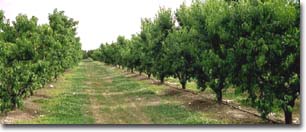
- Peach trees (12 years old) are grown here. Peaches have been grown here for 35 years.
- Lime and gypsum applied.
Profile Described By: Mark Imhof, Paul Rampant, Sonia Thompson (1996).
