Victorian Resources Online (archived)
GN24
| Location: East Shepparton Landcare Group. | Australian Soil Classification: Haplic, Eutrophic, Red KANDOSOL |
| General Landscape Description: Level plain with prior stream activity. This site is associated with channel deposits of a prior stream and has been mapped as Broken Sand by Skene and Freedman (1944). Pears are grown at this site. | |
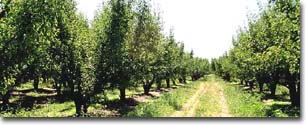 Site GN24 Landscape |
Soil Profile Morphology:
Surface Soil
| A1 | 0-23cm | Brown (7.5YR4/4) loamy sand; hardsetting surface condition; weakly structured; firm consistence dry; contains a few (5%) quartz gravel (2-5 mm size); pH 5.6; abrupt change to: | 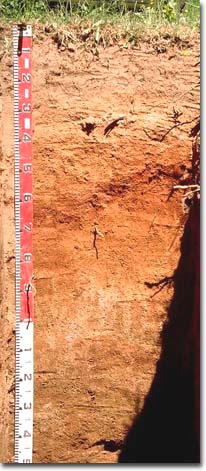 Site GN24 Profile |
| A21 | 23-40cm | Yellowish red (5YR5/8) sandy loam; structureless; firm consistence dry; contains a common (15%) amount of quartz gravel (4 mm size); pH 7.0; clear change to: | |
| A22 | 40-50cm | Yellowish red (5YR5/8); sandy loam; structureless; very firm consistence dry; contains a common (20%) amount of quartz and feldspar gravel (2-8 mm size); pH 7.0; abrupt and wavy change to: | |
| Subsoil | |||
| B21 | 50-60cm | Dark red (2.5YR4/8); coarse sandy clay loam; structureless; firm consistence moist; contains many (25%) quartz, slate and feldspar gravels (2-8 mm size); pH 7.0; clear and wavy change to: | |
| 2A1 | 60-90cm | Yellowish red (5YR5/8) sandy loam; structureless; weak consistence moist; contains a common (20%) amount of quartz and feldspar gravel (2-8 mm size); pH 7.2; clear change to: | |
| 2A2 | 90-110cm | Light reddish brown (5YR6/3) with yellowish red (5YR5/8) mottles; loamy sand; structureless; weak consistence moist; contains many (25%) quartz and feldspar gravels (2-8 mm size); pH 7.6; clear change to: | |
| 2B2 | 110-130cm | Strong brown (7.5YR5/6) with yellowish red (5YR5/8) mottles; sandy clay loam; structureless; contains a few (5-10 %) quartz gravels; firm consistence moist; pH 7.4; clear change to: | |
| 2B3 | 130 cm+ | Brown (7.5YR4/4) sandy loam; structureless; firm consistence moist; large manganese stains present; pH 6.2. | |
- Variable textured subsoil horizons due to prior stream channel deposition.
- High coarse sand and gravel content throughout profile.
Soil Profile Characteristics:
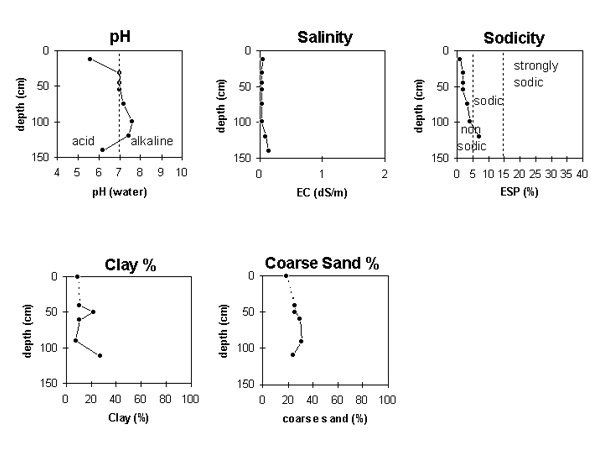
pH | Salinity Rating | |||
Surface (A1 horizon) | moderately acid | very low | non-sodic | none |
Upper Subsoil (B21 horizon) | neutral | very low | non-sodic | none |
Deeper subsoil (at 1 m) | slightly alkaline | very low | non-sodic | none |
Deep subsoil (at 130 cm+) | slightly acid | low | non-sodic | - |
Management Considerations:
Whole Profile
- Plant available water capacity (PAWC) is considered to be potentially low (estimated at 70 mm) for the top metre of the soil profile. Most tree roots observed in the soil profile occurred before 1 m depth.
- Soluble salt levels are low throughout the profile.
- The high sand and gravel content in the top metre of the soil profile will ensure that infiltration and movement of water will be relatively high. Nutrients are likely to be more easily leached than for heavier textured soils.
Surface (A) Horizons
- The surface soil has a high combined fine sand and silt content (i.e. 70%). Organic matter is important for such soils in order to maintain soil aggregation.
- The inherent fertility (based on the sum of the exchangeable cations) is relatively low in the surface horizons compared to the heavier textured soils in the area. Organic matter is an important source of cation exchange on these light textured soils.
- The surface (0-23 cm) layer is moderately acid. At low pH levels, imbalances in nutrient levels (e.g. aluminium and/or manganese toxicity) may occur and phosphate can become poorly available. Lime can be used to raise pH but further testing over a larger area of this soil type should be carried out to determine whether lime use is economical. In the deeper surface horizons, pH has increased which is beneficial.
Subsoil (B) Horizons
- The subsoil horizons are structureless which may hinder root development to some extent. They are, however, non-sodic and have a relatively high calcium:magnesium ratio which should promote favourable conditions for root and water movement. Water movement is likely to be relatively high in the subsoil compared to heavier textured soils.
