Victorian Resources Online (archived)
ASH98 (plot 2)
| Site: ASH98 (Plot 2) | Land Unit: Dundas Redgum |
General Land Unit Description:
The flat surface of the Dundas Tablelands predominantly consists of Brown Chromosols and to a lesser extent Yellow Chromosols with a ferric horizon, typically occurring above the clay subsoil. The soil is commonly developed over a highly weathered mottled zone. This red and white mottling, sometimes referred to as ‘tiger mottles’, is thought to be the result of deep chemical weathering which occurred during the late Tertiary period. Red gums are the dominant vegetation found on this surface.
2.5 year old Eucalyptus globulus plantation on ex-agricultural land.
Site Description:
| Geology: Cainozoic duricrust | Landform pattern: Undulating plain |
| Position in landscape: Lower slope | Internal drainage: Imperfectly drained |
Soil Profile Morphology
| A1 | 0-10 cm | Very dark greyish brown (10YR3/2) loam; weak subangular blocky structure (20-50 mm); firm consistence when dry; common very fine macropores; areal porosity 0.07%; many medium roots; clear and smooth transition to: | 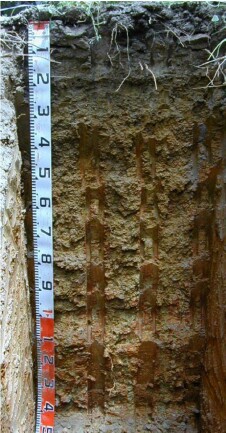 |
| A2 | 10-20 cm | Brown (10YR5/3) loam; massive structure; firm consistence when dry; few medium ferruginous nodules; common very fine macropores; areal porosity 0.8%; common medium roots; abrupt and smooth transition to: | |
| Subsoil | |||
| B21 | 20-60 cm | Yellowish brown (10YR5/6) with common medium distinct reddish yellow (5YR5/6) mottles, light medium clay; moderate polyhedral structure (20-50 mm) parting to strong granular structure (5-10 mm); firm consistence when moderately moist; few very fine macropores; areal porosity 0.03%; few very fine roots; diffuse and smooth transition to: | |
| B22 | 60-100 cm | Brown (10YR6/7) with many coarse faint red (2.5YR4/8) and red (2.5YR4/6) mottles, light medium clay; moderate polyhedral structure (20-50 mm) parting to strong granular structure (5-10 mm); firm consistence when moderately moist; few very fine macropores; areal porosity 0.03%; few very fine roots; diffuse and smooth transition to: | |
| B23 | 100-150 cm | Yellowish brown (10YR5/5) with many coarse prominent red (2.5YR4/8) mottles, light medium clay; moderate polyhedral structure (20-50 mm) parting to moderate granular structure (5-10 mm); firm consistence when moderately moist; few very fine macropores; areal porosity 0.01%; few very fine roots. | |
| 150-200 cm | Similar to layer above. | ||
| 200-240 cm | Silty clays. | ||
| 240-320 cm | Mixed bands of mainly silty clays and some fine sandy clays. | ||
| 320-400 cm | Weathering Silurian mudstones, impeding layer at 320 cm. | ||
Notes: The Mudstone layer does not appear to offer a large water holding capacity.
Sampled by: Ian Sargeant, Paul Feikema and Martin Clark (6 December 2000)
