Victorian Resources Online (archived)
ELL98 (Plot 2)
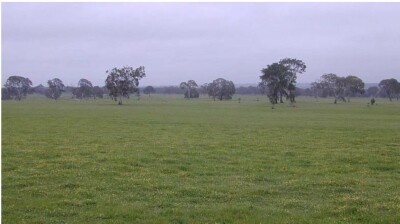
| Site: ELL98 (Plot 2) | Land Unit: Marl |
 |
General Land Unit Description:
|
Site Description:
| Slope: 0% | Geology: Tertiary marl |
| Landform pattern: Gently undulating plain | Internal drainage: Imperfectly drained |
Soil Profile Morphology
| A1 | 0-20 cm | Very dark greyish brown (10YR3/2) loamy sand; weak polyhedral structure (10-20 mm); very weak consistence when moist; common medium roots; clear and smooth transition to: | 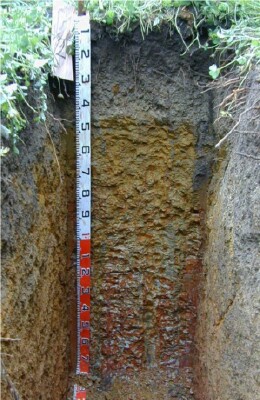 |
| A21 | 20-30 cm | Brown (10YR5/3) loamy sand, single grain structure; weak consistence when moist; many coarse ferruginous nodules; common very fine roots; clear and smooth transition to: | |
| A22 | 30-45 cm | Pale brown (10YR6/3), loamy sand, single grain structure; weak consistence when moist; many coarse ferruginous nodules; few very fine roots; abrupt and wavy transition to: | |
| Subsoil | |||
| B21 | 45-80 cm | Yellowish brown (10YR5/6) with common medium distinct yellowish red (5YR4/6) mottles, light medium clay, strong polyhedral structure (20-50 mm) parting to strong polyhedral structure (5-10 mm), weak consistence when moderately moist; few fine macropores; areal porosity 0.1%; few very fine roots; diffuse and smooth transition to: | |
| B22 | 80-120 cm | Light grey (10YR7/1) with many medium distinct red (2.5YR5/8) and yellowish red (5YR4/6) mottles, light medium clay; strong lenticular structure (20-50 mm) parting to strong polyhedral structure (5-10 mm), very few medium ferruginous nodules; weak consistence when moderately moist, few fine macropores; areal porosity 0.05%; few very fine roots; diffuse and smooth transition to: | |
| B23 | 120-160 cm | Light grey (10YR7/1) with many coarse prominent red (2.5YR4/8) mottles, medium clay, strong lenticular structure (50-100 mm) parting to strong polyhedral structure (5-10 mm), weak consistence when moist; few fine macropores; areal porosity 0.01%; very few fine roots. | |
| 160-400 cm | Mottled red and grey clays, well structured, weathering basalt, no impeding layer | ||
Notes: Sampled by: Ian Sargeant and Paul Feikema (24 October 2000)
