Victorian Resources Online (archived)
GL109
| Site: GL109 | Land Unit: Merino Tablelands |
| Aust. Soil Class.: Episodic, Epipedal, Grey VERTOSOL (confidence level 1) | |
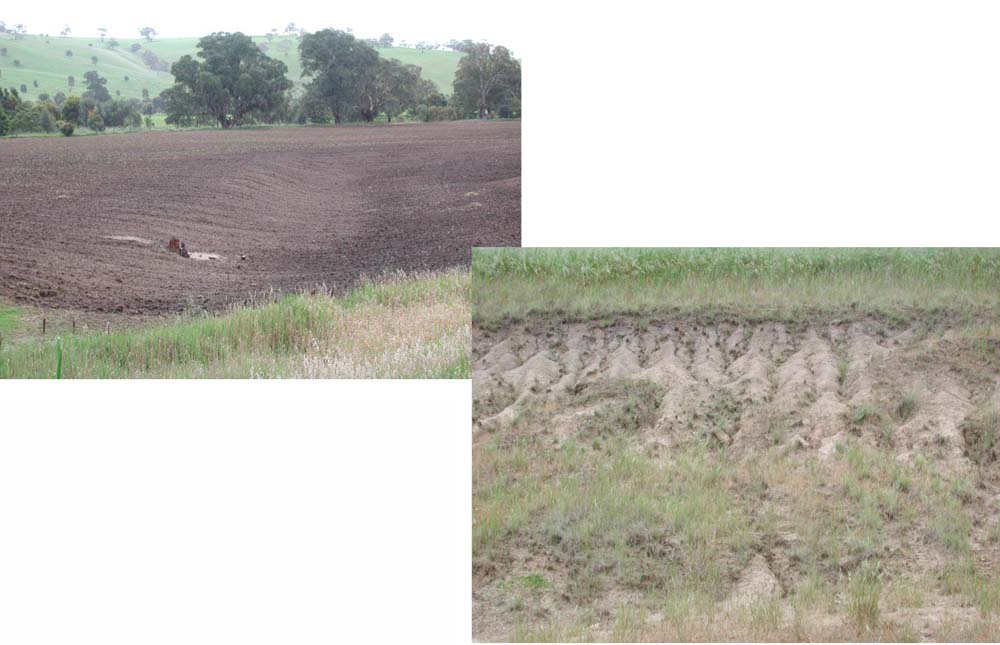 |
This unit consists of the Cretaceous non-marine sandstone of the dissected Merino Tablelands. The tablelands were thought to have formed under swamp conditions and a warm climate. As a result, the soils tend to be high in clay and there tends to be carbon rich seams of charcoal deposits at depth in some of the profiles. The main soil type used to represent this land unit is black cracking clays (Vertosols) that can be sodic at depth. This soil type, along with Black Sodosols, Chromosols and Dermosols, are commonly found in the broad crests or drainage lines. The slopes often consist of Brown Chromosols, Sodosols or Dermosols, although black soils can also occur on the slopes. The lower slopes commonly have Grey Vertosols or Sodosols as the major soil type. The reasonably deep sodic soils on short steep slopes tend to be prone to landslips. The grey soils, in particular are prone to water erosion. 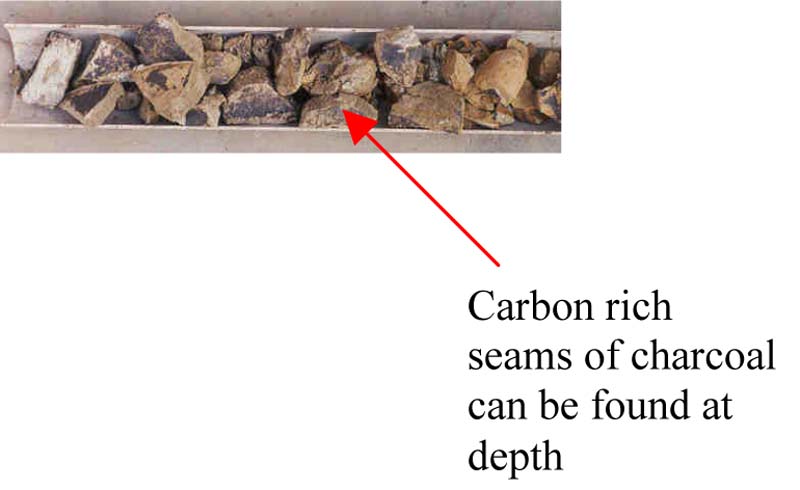 |
Site Description:
| Geology: Cretaceous non-marine sandstone | Landform pattern: Rolling rises and undulating low hills |
| Position in landscape: Lower slope | Internal drainage: Imperfectly drained |
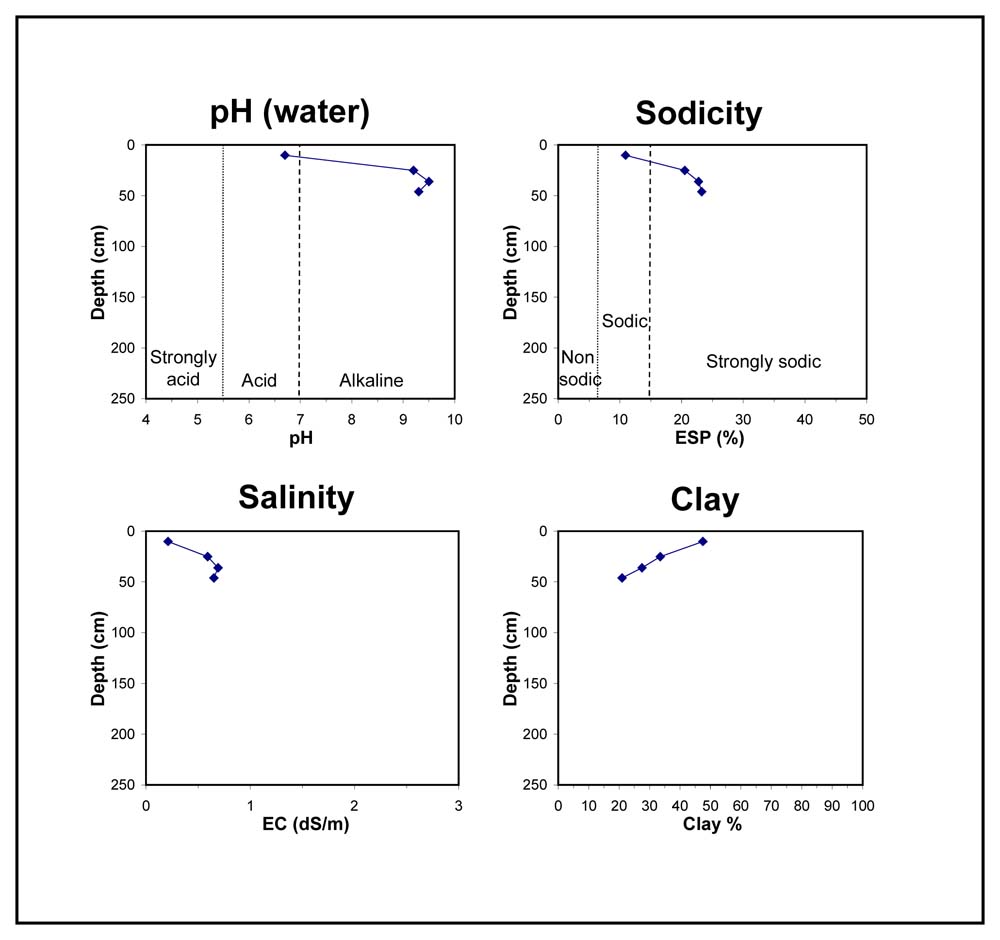
| A1 | 0-20 cm | Very dark greyish brown (2.5Y3/2) medium clay, moderate to strong subangular blocky structure (2-10 mm), very strong consistence when dry, pH 6.7; transition to: |
| Subsoil | ||
| B21 | 20-30 cm | Dark greyish brown (2.5Y3/2) medium heavy clay, moderate subangular blocky structure (5-10 mm), strong consistence when dry, weathered sandstone fragments are abundant, pH 9.2; transition to: |
| B22 | 30-45 cm | Brownish yellow (10YR6/6) light clay, weak structure (20-50 mm), strong consistence when dry, many medium coal nodules (2-5 mm), pH 9.5; transition to: |
| B3 | 45-60 cm | Light yellowish brown (2.5Y6/6) coarse sandy light clay, weak structure (20-50 mm), strong consistence when dry, many medium coal nodules (2-5 mm), pH 9.3; |
| BC | 60-80 cm | Brownish yellow (10YR6/6) weathered sandstone, siltstone and mudstone. |
| C | 80+ cm | Light grey (5Y7/2) |
Key profile features:
- Sodic topsoil
- Sodic subsoil
- Alkaline subsoil
- Clay texture throughout
- Topsoil dispersive when dry
- Subsoil dispersive when dry