Victorian Resources Online (archived)
GL155
| Site: GL155 | Land Unit: Dundas Trachyte |
| Aust. Soil Class.: Endocalcareous, Self-mulching, Black VERTOSOL (confidence level 1) | |
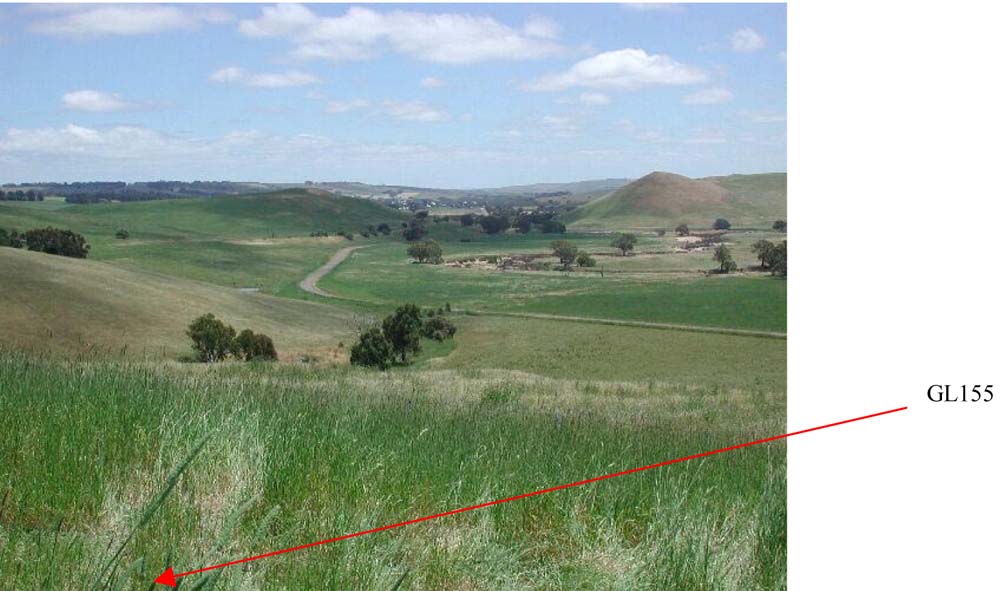 | General Land Unit Description: There are a few isolated outcrops of Jurassic trachyte in the north-western portion of the study area, with the largest outcrop being north east of Coleraine. There are also some colluvial slopes on the edge of trachyte outcrops around the Dundas and Merino Tablelands. The trachyte hills often have rock outcrop and reasonably shallow soils on the crests and upper slopes. The main soil type on the upper slopes is a Brown Sodosol although Chromosols also occur and they are commonly sodic at depth. The soils on the colluvial slopes tend to be black cracking clays (Vertosols) or Black Vertic Sodosols. These soils are similar to the black soils of the dissected Merino Tablelands land unit. The soils on these slopes are a complex mix of different soil forming processes. This site is situated on the edge of the Tablelands. It is on a mid slope leading to an alluvial valley. The landscape of the Tablelands is very dissected and variable. |
Site Description:
| Slope: 18% | Geology: Jurassic trachyte |
| Landform pattern: Low hills, rises | Position in landscape: Mid slope |
| Internal drainage: Imperfectly drained |
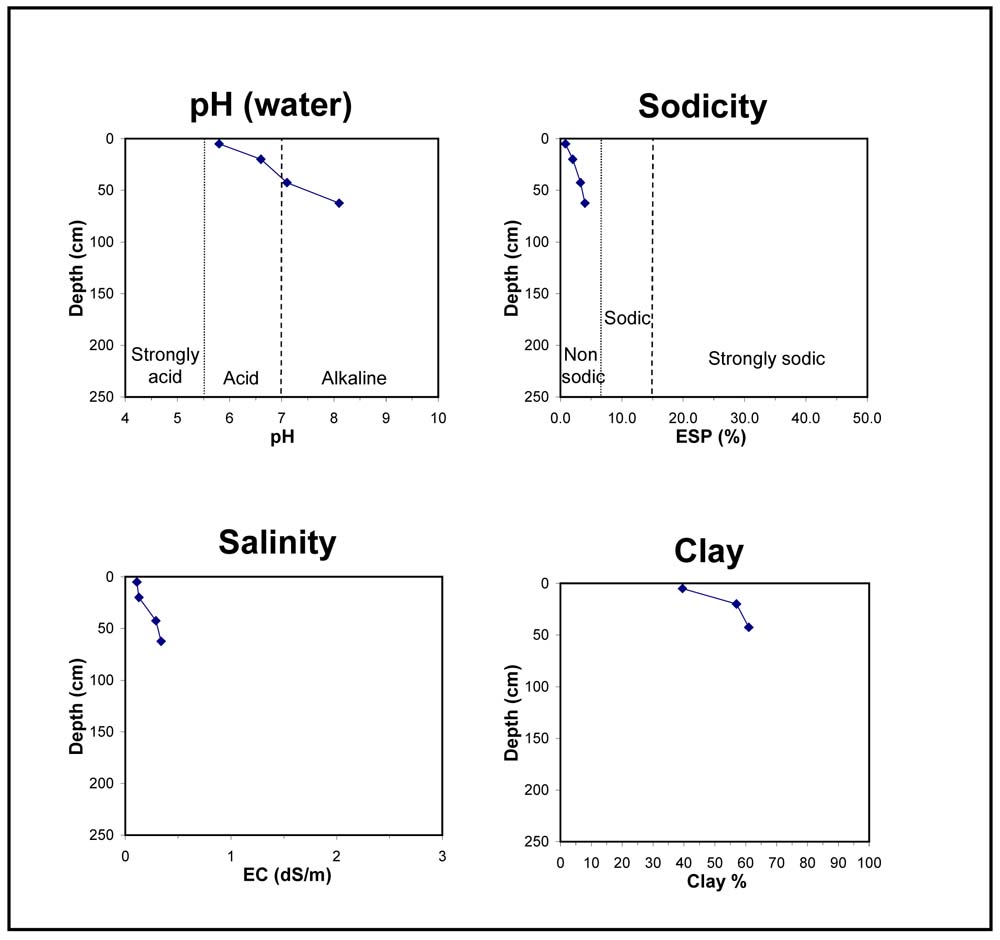
| A1 | 0-10 cm | Black (10YR2/1) light clay, strong subangular blocky structure (2-5 mm), selfmulching surface condition, pH 5.8; clear transition to: | 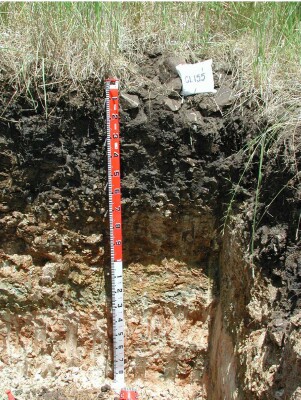 |
| Subsoil | |||
| B21 | 10-30 cm | Black (10YR2/1) heavy clay with many distinct, medium yellow and orange mottles, strong lenticular structure (10-20 mm), parting to strong polyhedral structure (5-10 mm), slickensides are evident, a few basalt and rhyolite coarse fragments (60-200 mm), pH 6.6; gradual and wavy transition to: | |
| B22 | 30-55 cm | Dark greyish brown (2.5Y4/2) heavy clay, many distinct medium yellow and orange mottles, strong lenticular structure (10-20 mm), parting to strong polyhedral structure (5-10 mm), a few basalt and rhyolite coarse fragments (60-200 mm), black organic veins evident due to cracking, pH 7.1; gradual transition to: | |
| BC | 55-70 cm | Olive brown (2.5Y4/3) heavy clay, many distinct orange, yellow and red mottles (derived from weathered rock), strong polyhedral structure (5-10 mm), a few soft calcareous segregations occurring in patches, a few basalt and rhyolite coarse fragments (60-200 mm), black veins evident due to cracking, pH 8.1; clear and wavy transition to: | |
| C | 70-110 cm | Weathered trachyte/basalt rock, soft calcareous segregations occurring in patches are common, many basalt and rhyolite coarse fragments (20-60 mm); abrupt transition to: | |
| D1 | 110-135 cm | A thin band of Cretaceous sediments. | |
| D2 | 135-180+ cm | Weathered Rhyolite, massive sandy structure. |
Key profile features:
- Shallow topsoil
- Mottled subsoil
- Topsoil dispersive when worked when wet
- Subsoil dispersive when worked when wet
- Alkaline subsoil
- Clay throughout
- Soil cracks when dry
- Clacareous at depth