Victorian Resources Online (archived)
MM243
| Site: MM243 | Land Unit: Nullarwarre Sedimentary |
| Aust. Soil Class.: Ferric, Mottled-Subnatric, Brown SODOSOL | |
| General Land Unit Description: The gently undulating plains in the Nullarwarre areas are formed on Tertiary sediments. The soil types consist of Mottled Brown Chromosols on the mounds or very slight rises with Bleached and Mottled Brown Chromosols occurring on the flats, shallow depressions or blow-outs between the mounds. The shallow saucer-shaped blowouts, which range from 20-100 m in diameter, may also contain Black or Brown, Sodosols or Chromosols. |
Site Description:
| Geology: Tertiary sedimentary | Landform pattern: Gently undulating plain |
| Position in landscape: Crest | Internal drainage: Imperfectly drained |
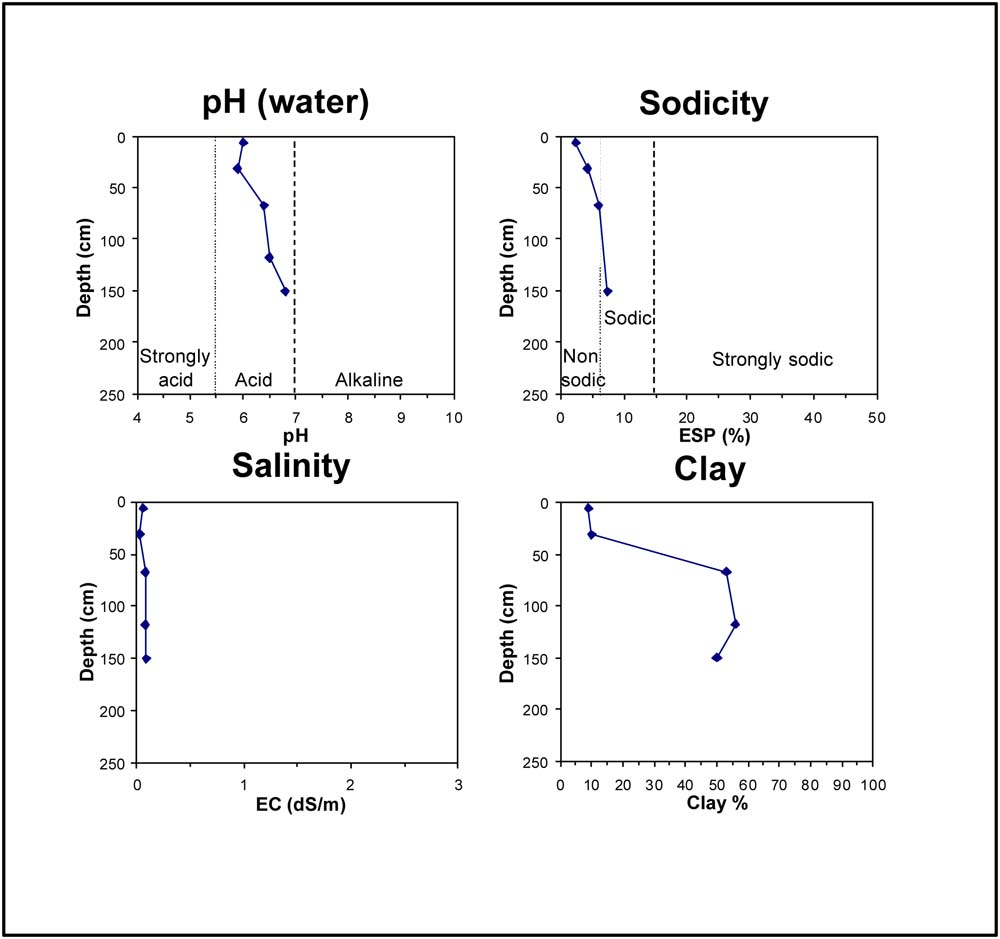
| A1 | 0-10 cm | Very dark greyish brown (10YR3/2) fine sandy loam, very weak consistence when dry, pH 6. Sharp transition to: |
| A2 | 10-50 cm | Strong brown (7.5YR5/6) fine sandy loam, conspicuously bleached (7.5YR7/4) when dry, very weak consistence when dry, pH 5.9. Sharp transition to: |
| Subsoil | ||
| B21 | 50-85 cm | Yellowish brown (10YR5/6) medium clay, yellowish red mottles (5YR4/6), strong structure, firm consistence when moist, pH 6.4. Gradual transition to: |
| B22 | 85-150 cm | Yellowish brown (10YR5/6) medium clay, red mottles (2.5YR4/6), moderate blocky structure (10-20 mm), very firm consistence when moist, ferromanganiferous nodules are common, pH 6.5. Gradual transition to: |
| B23 | 150+ cm | Yellowish brown (10YR5/6) medium clay, red mottles (2.5YR4/6), ferromanganiferous nodules are abundant, pH 6.8. |
Key profile features:
- Strong texture contrast between topsoil and subsoil
- Bleached A2 horizon
- Mottled subsoil
- Sodic subsoil
- Ferromanganiferous nodules abundant in the subsoil