Victorian Resources Online (archived)
MM256
| Site: MM256 | Land Unit: Hamilton Basalt Rises |
| Aust. Soil Class.: Ferric-Sodic, Eutrophic, Red CHROMOSOL (confidence level 1) | |
| General Land Unit Description: The undulating basalt rises around Hamilton consist of Red and Brown Chromosols with shallow surface horizons, and friable red gradational soils (Dermosols). Either of the co-dominant soils may be dominant locally. The Red Dermosols would be better drained than the Chromosols and may have high free irons (Ferrosols). Due to the favourable physical properties of the red soils, they tend to have less restrictions for land use compared to the Chromosols. |
Site Description:
| Geology: Quaternary basalt | Landform pattern: Undulating rises |
| Position in landscape: Upper slope | Internal drainage: Moderately well drained |
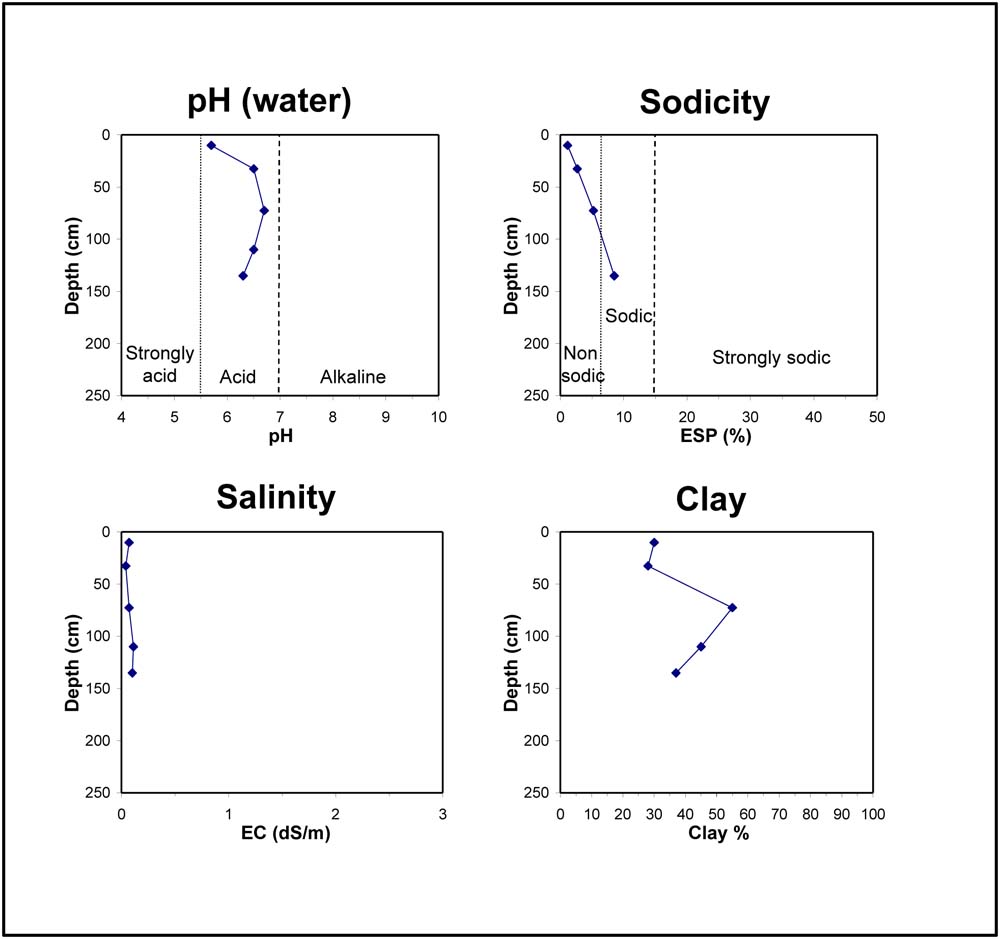
| A1 | 0-20 cm | Dark reddish brown (5YR3/3) clay loam, moderate subangular blocky structure (10-20 mm), weak consistence when dry, pH 5.7. Clear transition to: |
| Subsoil | ||
| B21 | 20-45 cm | Dark reddish brown (2.5YR3/4) light medium clay, many coarse fragments, strong blocky structure (5-10 mm), very weak consistence when moderately moist, many ferromanganiferous nodules, pH 6.5. Clear transition to: |
| B22 | 45-60 cm | Strong blocky structure (5-10 mm), firm consistence when moderately moist. Gradual transition to: |
| B23 | 60-85 cm | Yellowish red (5YR4/6) medium clay, strong blocky structure (2-5 mm), firm consistence when moderately moist, pH 6.7. Gradual transition to: |
| B24 | 85-135 cm | Brown (7.5YR4/4) medium clay, firm consistence when moderately moist, pH 6.5. |
| B25 | 135+ cm | Yellowish red (5YR4/6) medium clay, firm consistence when moist, coarse fragments are abundant, pH 6.3. |
Key profile features:
- Strong texture contrast between topsoil and subsoil
- Sodic subsoil at depth
- Many manganiferious nodules in B21