Victorian Resources Online (archived)
QUA98 (Plot 2)
| Site: QUA98 (Plot 2) | Land Unit: Drumborg Basalt Hills |
| Aust. Soil Class.: | |
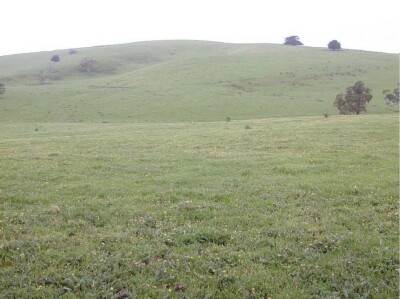 | General Land Unit Description: This land unit consists of the undulating rises of Sugarloaf Hill and Sheaok Rise, north of Heywood. The soils consist of Red Dermosols and occasionally Kurosols on the crests and slopes of the rises. On the lower slopes and plains in between the rises, Ferric Brown Chromosols or Dermosols predominate. There are minor occurrences of Black Vertosols in local depressions. Here a two year old Eucalyptus globulus plantation exists on ex-agricultural land |
Site Description:
| Geology: Quaternary basalt | Landform pattern: Undulating rises to low hills |
| Position in landscape: Lower slope | Internal drainage: Moderately well drained |
| A1 | 0-20 cm | Dark brown (7.5YR3/2) clay loam, moderate granular structure (10-20 mm) parting to moderate granular (2-5 mm), very weak consistence when moderately moist, few medium ferruginous nodules, many medium roots. Clear and smooth transition to: | 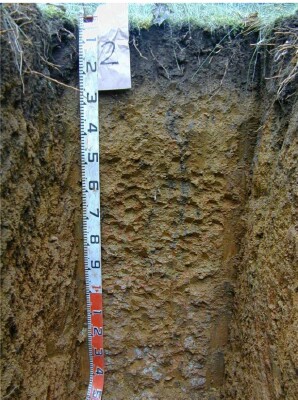 |
| Subsoil | |||
| B21 | 20-60 cm | Reddish yellow (7.5YR6/8) with common medium faint yellowish red (5YR5/8) mottles, light clay, moderate polyhedral structure (20-50 mm) parting to moderate granular structure (5-10 mm), weak consistence when moderately moist, few medium ferruginous nodules, common very fine macropores, areal porosity 0.1%, few very fine roots. Gradual and smooth transition to: | |
| B22 | 60-100 cm | Strong brown (7.5YR5/6) with many coarse distinct yellowish red (5YR4/6) and red (2.5YR4/6) mottles, light clay, strong polyhedral structure (20-50 mm) parting to strong polyhedral structure (10-20 mm), weak consistence when moderately moist, few very fine macropores, areal porosity 0.1%, few very fine roots. Gradual and smooth transition to: | |
| B23 | 100-150 cm | Strong brown (7.5YR5/7) with many coarse prominent red (2.5YR4/6) and pinkish grey (7.5YR6/1) mottles, light clay, moderate polyhedral structure (20-50 mm), firm consistence when moderately moist, few very fine macropores, areal porosity 0.1%, few very fine roots. | |
| 150-200 cm | Similar as above. | ||
| 200-230 cm | B3 horizon. | ||
| 230-400 cm | C horizon, live roots observed at 250 cm in old root channels, strong rock, basaltic material, but no vesicles as in other pits. |
Notes: Mottles increasing down profile from 20 cm, wet patches below 100 cm, water seeping out from pores, biological activity to 1m, worms reworking soil.
