Victorian Resources Online (archived)
MP18
| Location: Yaapeet | Northcote Factual Key: Gc 1.22 |
| General Landscape Description: Upper slope of an east-west undulating dune. | Australian Soil Classification: Epibasic, Pedal, Hypercalcic CALCAROSOL (sandy surface horizons) |
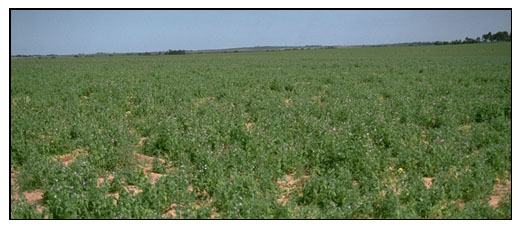 MP18 Landscape |
Soil Profile Morphology:
Surface Soil
| A1 | 0-15 cm | Yellowish brown (10YR5/4); loamy sand; loose surface condition; massive; firm consistence dry; contains very few (<2%) soft carbonates; pH 8.4: | 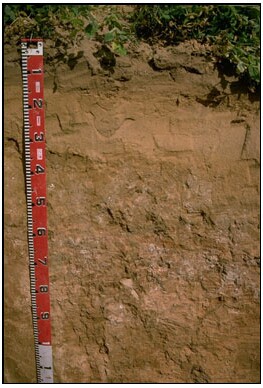 MP18 Profile |
| A2 | 15-30 cm | Brownish yellow (10YR6/6d) conspicuous bleach; loamy sand; massive; firm consistence dry; contains very few (<2%) soft carbonates in patches (2 mm wide); moderately calcareous; pH 9.0; sharp and wavy change to: | |
| Subsoil | |||
| B1 | 30-50 cm | Reddish yellow (7.5YR6/6); light sandy clay loam (becomes sandy clay loam with depth); massive with a hard bleached capping; firm consistence dry; contains a few (10%) soft carbonates; very highly calcareous; pH 8.8: | |
| B21k | 50-80 cm | Reddish yellow (7.5YR6/6) with red (2.5YR5/8) mottles; light clay (sandy); weak medium sub-angular blocky structure (rough faced peds); strong consistence dry; contains many (20-50%) peds with a soft carbonate coatings, in large patches (2-5 cm wide); very highly calcareous; pH 8.9: | |
| B22k | 80-130 cm | Reddish yellow (7.5YR6/6); sandy light clay; moderate medium subangular blocky, parting to fine sub-angular blocky structure with depth; strong consistence dry; contains many (30%) soft carbonates in patches and a few (10%) ped faces have dark flecking; pH 9.1: | |
| B23 | 130+ cm | Yellowish red (5YR5/8); sandy clay loam (clayey); massive; contains very few (<2%) carbonates; pH 9.5. | |
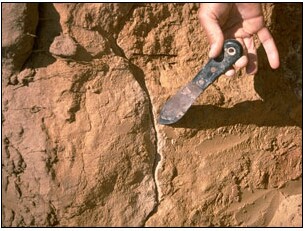
Key Profile Features:
|
Soil Profile Characteristics:
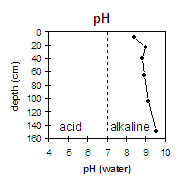 The surface is moderately alkaline. The upper subsoil is strongly alkaline and the deeper subsoil very strongly alkaline at 1m. | 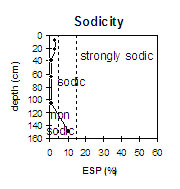 The majority of the soil profile is non-sodic, only becoming sodic at 120 cm. |
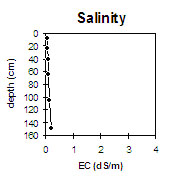 The salinity rating is very low to low throughout the whole profile. | 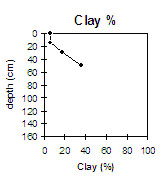 The clay content increases gradually with depth. |
Horizon | Horizon Depth (cm) | pH (water) | pH (CaCl2) | EC 1:5 | NaCI % | Exchangeable Cations | Field Capacity pF 2.5 | Wilting Point pF 4.2 | Coarse Sand (0.2 - 2 mm) | Fine Sand (0.02 -0.2 mm) | Silt (0.002 -0.02 mm) | Clay (<0.002 mm) | |||
Ca | Mg | K | Na | ||||||||||||
meq/100g | |||||||||||||||
A1 | 0-15 | 8.4 | 7.7 | 0.06 | 2.7 | 0.7 | 0.4 | <0.1 | 3.8 | 18 | 58 | 35 | 0 | 6 | |
A2 | 15-30 | 9 | 8.3 | 0.06 | 2.6 | 0.6 | 0.3 | <0.1 | 3.6 | 2 | 57 | 36 | 0 | 6 | |
B1 | 30-50 | 8.8 | 8.1 | 0.1 | 6.7 | 2 | 0.8 | <0.1 | 14 | 16.7 | 42 | 37 | 0 | 18 | |
B21 | 50-80 | 8.9 | 8.1 | 0.11 | 8.5 | 6.3 | 1.6 | 0.1 | 23.8 | 12.1 | 29 | 27 | 0 | ||
B22 | 80-130 | 9.1 | 8.3 | 0.13 | 4.2 | 6.6 | 1.4 | 0.1 | |||||||
B23 | 130+ | 9.5 | 8.6 | 0.18 | 2.3 | 6.2 | 1.4 | 1 | |||||||
Management Considerations:
Whole Profile
- Nabil Badawy suggests planting calcium carbonate tolerant species only, due to the occurrence of carbonate in the surface and subsoil.
- Both the surface soils have a very high sand (93%) content. The levels of organic carbon measured at the pit site is quite low (this may or may not be representative of the whole paddock). Organic matter levels will decline if cropping takes place and can be improved by adopting practices such as residue retention, minimum tillage and utilising pasture rotations. Increased organic matter will both improve aggregation as well as assist in the low water holding capacity, erosion risk and low inherent fertility of the surface soil.
- The low wilting point values (ie. 1.8 % and 2 %) of the surface horizons indicate that plants will be able to utilise very light rains when the soil is dry. However, due to the low water storage capacity, plants will soon suffer moisture stress unless further rainfalls occur.
- Infiltration of water will be rapid in the surface soil and water will rapidly move down towards the subsoil. The presence of a conspicuous bleach is a symptom of the hard sandy capping on the massive subsoil. This occurrence indicates that the A2 horizon is periodically waterlogged and would be ‘soupy’, as water sat on top of the more slowly permeable subsoil. Deep ripping would allow this water to enter the subsoil and thus not be lost to evaporation.
- The subsoil has a moderate inherent fertility throughout which is beneficial for plant growth.
- The strongly alkaline profile suggests that some nutrients (e.g. manganese, zinc, iron, copper) may be poorly available to plants.
- The upper subsoil is non-sodic, however the calcium to magnesium ratio is 0.7 at 80 cm (decreasing with depth) and the soil disperses slightly after remoulding. This coupled with the sandy hard capping, is likely to restrict root and water movement somewhat.
- B21 free lime content 1.7 %.
- Paddock cleared around 1915.
- Peas were the crop in place during time of sampling and MRS were trialing grain legumes with fertilisers.
