Victorian Resources Online (archived)
MP6
| Location: Walpeup. | Australian Soil Classification: Arenic RUDOSOL. |
| Northcote Factual Key: Uc 5.11. | Geology: Quaternary aeolian deposits. |
| General Landscape Description: Crest of an east-west dune on the edge of the Big Desert Land System. | |
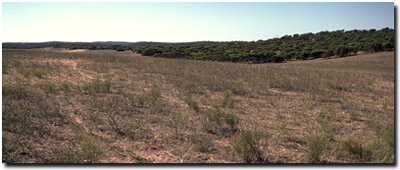 MP6 Landscape |
Soil Profile Morphology:
Surface Soil
| A11 | 0-35 cm | Yellowish red (5YR5/8); sand; loose surface condition; structureless (single grain); loose consistence moist; slightly calcareous; pH 8.3; diffuse change to: | 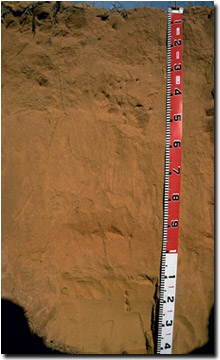 MP6 Profile |
| A12 | 35-90 cm | Strong brown (7.5YR5/8); sand; structureless (single grain); weak consistence moist; slightly calcareous; pH 8.1; diffuse change to: | |
| A13 | 90-100 cm | Yellowish red (5YR5/8); sand (with slight clay); structureless (single grain); weak consistence moist; slightly calcareous; pH 8.0; diffuse change to: | |
| A14 | 100+ cm | Strong brown (7.5YR5/8); sand; structureless (single grain); weak consistence moist; pH 8.8. | |
- Soil profile is sandy throughout.
Soil Profile Characteristics:
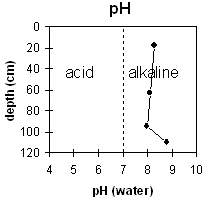 | 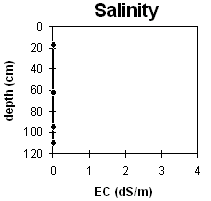 |
The soil profile is moderately alkaline throughout. | The profile has a very low salinity rating throughout. |
Management Considerations:
Whole Profile
- The profile is moderately alkaline throughout so appropriate plants should be chosen accordingly.
- The soil profile is sandy throughout and has a low inherent fertility. Such strongly leached soils are likely to be naturally deficient in nitrogen, phosphorus, sulphur and potassium as well as various trace elements. Increasing the organic matter levels will help to improve these characteristics as well as assisting in soil aggregation. Organic matter will build up under pasture but will decline if cultivation takes place. Practices such as residue retention, minimum tillage and including pasture rotations could be utilised if cropping takes place, in order to build up organic matter.
- Plant Available Water Capacity (PAWC) will be relatively low for these sandy soils.
- These sandy soils can often show a degree of water repellence that restricts water infiltration. However, once water infiltration begins it will move rapidly down the profile
- The low wilting point value indicates that plants will be able to utilise light rains falling on dry soil. However, due to the low water storage capacity, plants will soon suffer moisture stress unless further rainfall occurs. Organic matter is important in these sandy soils to enhance water holding capacity.
- The sandy surface soil will be prone to wind erosion if plant cover is removed and blow-outs can occur.
Profile Described By: Mark Imhof, John Martin and Sonia Thompson (March 1994).
