Victorian Resources Online (archived)
MP12
| Location: Kulwin | |
| General Landscape Description: Mid slope of an East-West dune. | Australian Soil Classification: Hypercalcic, Subnatric, Red SODOSOL |
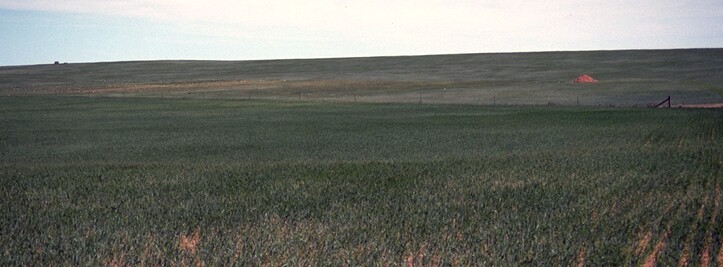 MP12 Landscape |
Soil Profile Morphology:
Surface Soilnin
| A11 | 0-15 cm | Dark brown (7.5YR4/4); loamy sand; soft surface condition; weak granular structure; weak consistence dry; non calcareous; pH 7.1; abrupt change to: | 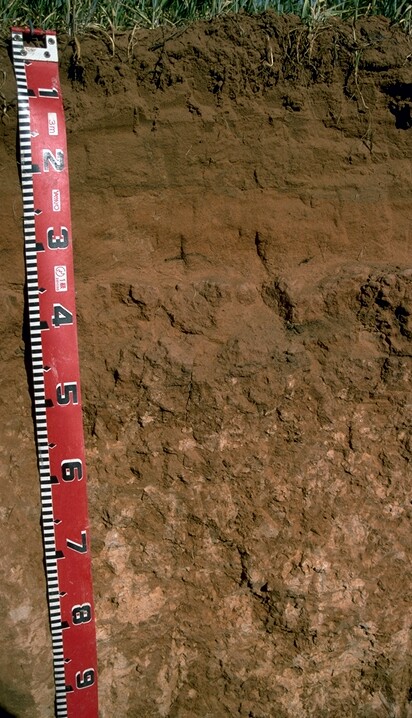 MP12 Profile |
| A12 | 15-22 cm | Strong brown (7.5YR4/6); sandy loam; moderate coarse platy structure; firm consistence dry; non calcareous; pH 7.2; abrupt change to: | |
| A13 | 22-35 cm | Yellowish red (5YR5/8); loamy sand; massive in structure; weak consistence dry; slightly calcareous; pH 8.8; sharp change to: | |
| Subsoil | |||
| B21 | 35-45 cm | Yellowish red (5YR5/8); sandy clay loam; moderate coarse columnar structure (with hard bleached capping); very firm consistence dry; slightly calcareous; pH 9.2; abrupt and wavy change to: | |
| B22k | 45-80 cm | Yellowish red (5YR5/6); light clay (sandy); weak coarse prismatic, parting to moderate coarse blocky structure; strong consistence dry; contains many (20%) silica rich rocks (6-60 mm in size) mixed with sand, soft carbonate and manganese; very highly calcareous; pH 9.7; gradual change to: | |
| B23k | 80-105 cm | Reddish yellow (5YR6/6); light clay (sandy); strong consistence dry; contains many (30%) silica rich rocks coarse fragments (6-20 mm in size) as well as semi-hard and soft calcareous and manganiferous segregations; very highly calcareous; pH 10.0; gradual change to: | |
| B24k | 105+ cm | Yellowish red (5YR5/8); light medium clay (sandy); strong consistence dry; contains many (30%) silica rich rocks coarse fragments (6-20 mm in size), soft calcareous and manganiferous segregations; very highly calcareous; pH 10.0. |
Key Profile Features:
- Columnar structure in upper subsoil with hard bleached capping.
- High accumulation of opalised silica and carbonate within the subsoil.
- Extremely alkaline subsoil at 60 cm depth.
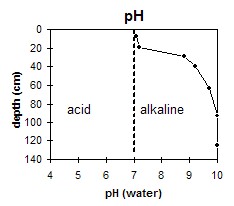 | 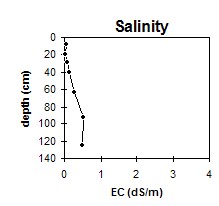 |
| The surface soil is slightly alkaline. The subsoil is very strongly alkaline, becoming extremely so at 60 cm depth. | The salinity rating is very low in the surface soil becoming moderate to high at 1m. |
|
|
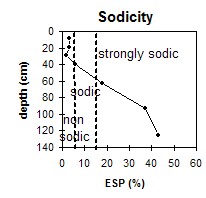
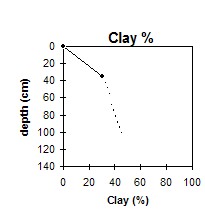
| The surface soil is non-sodic. The upper subsoil is sodic, becoming strongly sodic at 60 cm. | The clay content increases sharply at the A/B horizon interface. |
Management Considerations:
Surface (A) Horizon
- The low wilting point value (ie. 2.7%) of the surface soil indicates that plants will be able to utilise very light rains when the soil is dry, by taking up water immediately. Interestingly, the majority of roots are in the first 30 cm. However, due to the low water storage capacity (i.e. little clay to hold the water), plants will soon suffer moisture stress unless further rainfalls occur.
- Infiltration of water will be rapid in the surface horizons (at least 35 cm) and water will rapidly move down towards the subsoil. The hard bleached capping and columnar structure of the subsoil suggests that these sandy surface horizons are periodically waterlogged as water sits on the slowly permeable subsoil.
- There would be very high evaporation from these surface horizons as they have very sandy textures and water would evaporate just as quickly as if the water was sitting on the upper surface (pers. com. Nabil Badawy).
- These sandy soils have an inherent lack of fertility. This is due to the very low clay levels. Nutrients are unable to attach themselves to the clay and thus wash away. Increasing the low organic matter levels of the surface horizon will help to improve these characteristics as well as assisting in soil aggregation.
- The levels of total nitrogen measured at this pit site are very low. However, this is best assessed by taking a bulked sample from across the paddock.
- The upper subsoil has a moderate inherent fertility which is very beneficial to plant growth. However, due to the physical nature of the upper subsoil (ie. hard bleached capping) only a few roots were found at 80 cm. It would be very hard for roots to penetrate this layer, therefore the beneficial source of available nutrients would be largely untapped (pers. com. Nabil Badawy).
- The very strongly alkaline subsoil suggests that some nutrients (e.g. manganese, zinc, iron, copper) may be poorly available to plants.
- The coarsely structured subsoil below 60 cm depth becomes strongly sodic and has a low exchangeable calcium to magnesium ratio (ie. 0.6 at 45 cm becoming less with depth). Strong dispersion occurs as a result, filling in air spaces with clay particles and thus restricting root and water movement.
- The salinity rating becomes moderate to high at about 1 m. These levels of soluble salts are likely to restrict the growth of salt sensitive plant species (e.g. faba beans, linseed, chickpeas and lupins) especially those which are deep rooted.
- At time of sampling MRS were trialing cereal and grain legumes with fertilisers.
- The landholder finds that a cereal/grain/legume rotation works well.
Profile described by: Mark Imhof and Sonia Thompson (October 1994)
