Victorian Resources Online (archived)
NTF3
| Aust. Soil Class.: Hypercalcic, Mottled-Subnatric, Yellow SODOSOL | |
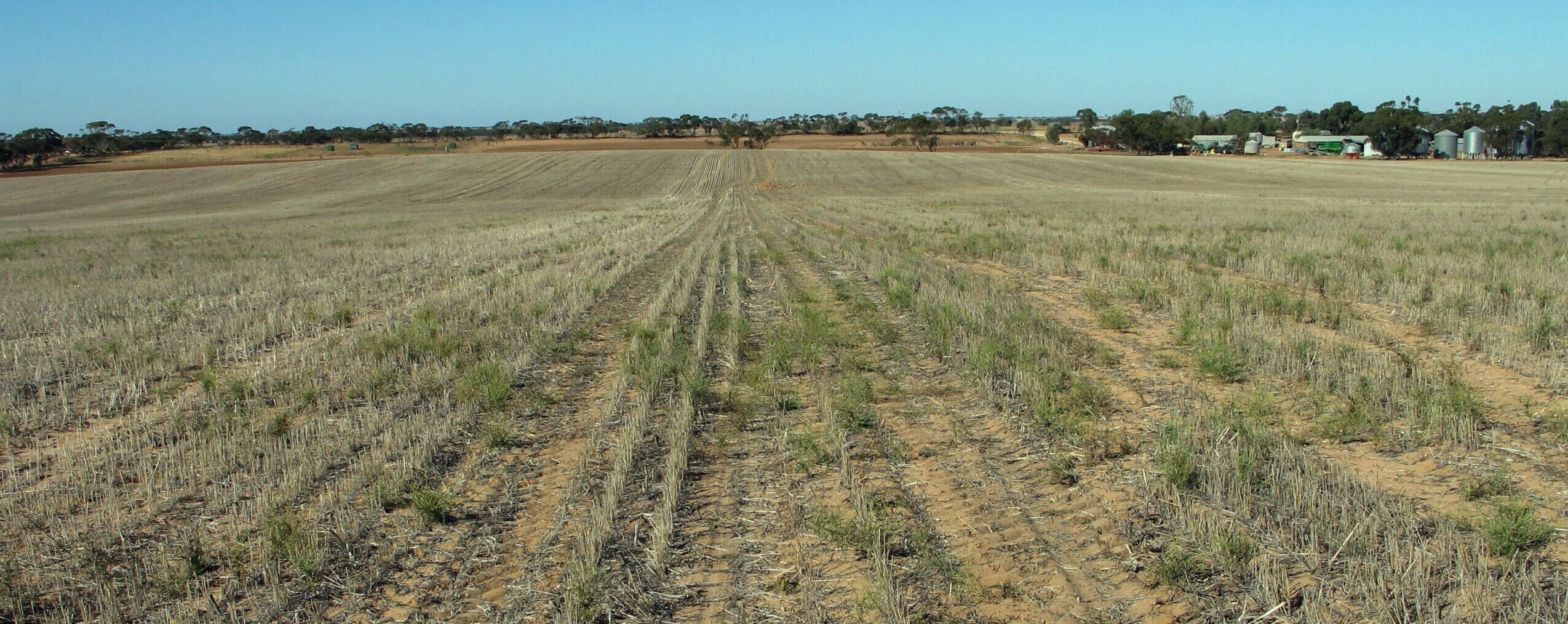
| General Landscape Description: Interdune depression. | Site Description: Stubble paddock - not tilled since 1991 |
| Geology: Quaternary (Woorinen Formation) aeolian deposits | Aspect: 1% (slope) North East aspect |
| Vegetation: Mallee |
 NTF3 Landscape |
Soil Profile Morphology:
Surface Soil
| A1 | 0-17 cm | Brown (7.5YR5/4); loamy sand; apedal; very weak consistence (dry); pH 7.2; abrupt change to: | 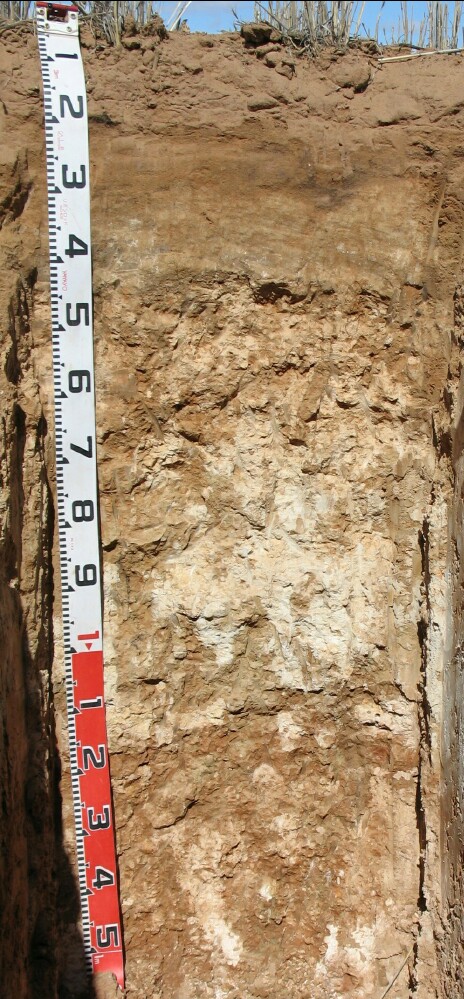 NTF3 Profile |
| A21 | 17-27 cm | Reddish yellow (7.5YR6/6); clayey sand; massive; very firm consistence (dry); pH 7.6; clear change to: | |
| A22 | 27-40 cm | Very pale brown (10YR7/8) with many (40%) faint reddish yellow (7.5YR6/8) mottles; sandy loam (clayey); massive; very firm consistence (dry); disperses strongly after remoulding; pH 8.9; abrupt change to: | |
| Subsoil | |||
| B21k | 40-60 cm | Light yellowish brown (10YR6/4) with many (25%) distinct reddish yellow (5YR6/6) mottles; sandy clay; weak to moderate coarse-medium subangular blocky structure; strong consistence (dry); many (20-50%) extremely coarse (>60 mm) soft calcareous segregations; slightly subplastic; strong dispersion (remoulded); pH 9.6; gradual change to: | |
| B22k | 60-90 cm | Very pale brown (10YR7/3) with distinct yellowish red (5YR5/6) mottles common (20%); sandy clay; weak coarse-medium subangular blocky structure; very firm consistence (moderately moist); very many (55%) fine-earth carbonates; slightly subplastic; pH 10.0; gradual change to: | |
| B23k | 90-120 cm | Very pale brown (10YR7/3) with many (35%) prominent reddish brown (5YR5/6) mottles; sandy clay; moderate coarse to medium subangular blocky structure; very firm consistence (moderately moist); very few (<2%) fine (<2 mm) manganiferous fragments; many (20%) fine-earth carbonates; pH 10.1; gradual change to: | |
| B24k | 120-160+ cm | Yellowish red (5YR5/6) with few (2-10%) distinct very pale brown (10YR7/3) mottles; medium clay; moderate coarse to medium subangular blocky structure; very weak (moist) consistence; few (5%) very coarse (20-60 mm) calcareous organic nodules; fine-earth carbonates common (10%) with very few (<2%) fine (<2 mm) manganiferous segregations; pH 10.1. |
Key Profile Features:
- Texture contrast between surface (A) horizons and subsoil (B21) horizon.
- Accumulation of fine-earth carbonates (lime) in subsoil.Variable accumulations of calcareous segregations (lime) in deeper subsoil
pH | Salinity Rating | |||
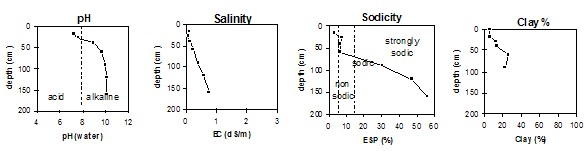
Surface (A1 horizon) | Slightly Alkaline | Very Low | Non-Sodic | None |
Subsoil (B21 horizon) | Very Strongly Alkaline | Low | Marginally Sodic | Moderate1 |
Deeper subsoil (at 120-160+ cm) | Extremely Alkaline | Low-Medium | Strongly Sodic | Moderate-Strong |
 |
Horizon | Horizon Depth | pH (water) | pH CaCl2 | EC 1:5 | Org. Carbon mg/kg | Exchangeable Cations | |||
Ca | Mg | K | Na | ||||||
Meq/100g | |||||||||
A1 | 0-17 | 7.2 | 6.7 | 0.13 | 2.2 | 0.7 | 0.49 | 0.09 | |
A21 | 17-27 | 7.6 | 6.6 | 0.08 | 4.1 | 1.9 | 0.40 | 0.44 | |
A22 | 27-40 | 8.9 | 8.1 | 0.14 | 7.8 | 3.2 | 0.50 | 0.74 | |
B21k | 40-60 | 9.6 | 8.5 | 0.24 | 21 | 7.6 | 0.86 | 1.9 | |
B22k | 60-90 | 10.0 | 8.6 | 0.41 | <0.01 | 2.8 | 6.7 | 1.2 | 4.6 |
B23k | 90-120 | 10.1 | 9.0 | 0.57 | <0.01 | 1.8 | 6.3 | 1.4 | 8.2 |
B24k | 120-160 | 10.1 | 10.1 | 0.75 | 0.03 | 1.5 | 5.5 | 1.7 | 11 |
Horizon | Horizon Depth | Boron mg/kg | Field pF2.5 g/100g | Wilting Point pF4.2 g/100g | Coarse Sand (0.2-2.0mm) % | Fine Sand (0.02-0.2mm) % | Silt (0.002-0.02mm) % | Clay (<0.002mm) % |
A1 | 0-17 | 0.7 | 5.9 | 1.9 | 54 | 39 | 3 | 5 |
A21 | 17-27 | 1.2 | 11.6 | 4.3 | 47 | 39 | 3 | 12 |
A22 | 27-40 | 1.5 | 16.9 | 6.8 | 50 | 31 | 8 | 13 |
B21k | 40-60 | 4.6 | 26.1 | 11.8 | 37 | 27 | 2 | 26 |
B22k | 60-90 | 9.3 | 26.3 | 11.3 | 36 | 28 | 2 | 22 |
B23k | 90-120 | |||||||
B24k | 120-160 |
Management Considerations:
Whole Profile
- Management strategies for all soils should aim to increase organic matter levels in the surface soil; minimise the degradation of soil aggregates and porosity; promote the development of stable biopores; improve the calcium status of the cation exchange complex (particularly when sodium is a significant part), and break up any hardpans. Less frequent tillage; using less aggressive implements, and working the soil at optimum moisture content can all assist in maintaining soil aggregation and porosity as well as reducing the breakdown of organic matter.
- The surface horizons have a low water holding capacity and are likely to become 'droughty' during periods of low rainfall. The low wilting point value (i.e. 1.9), however, indicates that plants will be able to utilise light rains falling on relatively dry soil. Heavier (i.e. more clayey) soils need to have considerable moisture stored before plants can have access to it.
- The surface soil has a low inherent fertility due to the high sand content and low clay content. Leaching of applied fertilisers is likely to be relatively high. Maintaining and improving organic matter levels are important for enhancing fertility, soil aggregation and water holding capacity.
- Infiltration rates are likely to be relatively high for the sandy surface horizons.
- The subsurface (A22) horizon disperses strongly after remoulding. Distribution to this horizon by cultivating when moist to wet could cause structural degradation (e.g. plough pan development).
- The supper subsoil is marginally sodic and dispersive after remoulding. Some restriction to root and water movement is likely to occur – but not as much as for more strongly sodic subsoils in the region.
- The subsoil is very strongly to extremely alkaline throughout which indicates that phosphorus and trace elements such as iron, manganese, zinc and copper may be poorly available for plants. Deficiencies can be determined by plant tissue analysis.
- The subsoil has large amounts of fine-earth carbonates (lime). Some species of plants are highly sensitive to calcareous soils.
- Levels of boron can become high in strongly alkaline soils in the Mallee region. Subsoil boron levels are close to10 ppm in the deeper subsoil at this site. Concentration levels of 10 ppm can, for example, reduce lentil yield. Work at DPI, Horsham indicates that without the presence of significant levels of soluble salts, boron tolerance can be comparatively high, with little reduction in wheat yields of up to 45 ppm (Quinlan 2001). At this site, soluble salt levels are not very high – so boron tolerance is likely to be increased.
Profile described by Mark Imhof and David Rees (April 2005).
