Victorian Resources Online (archived)
ORZC1
| Location: Birchip. | |
| Australian Soil Classification: Vertic (& Epihypersodic), Pedal, Calcic, CALCAROSOL (clayey). | |
| Geology: Woorinen Formation. | |
| General Landscape Description: Located on a westerly facing gentle slope within a gently undulating landscape (low subdued Tertiary beach ridge). This site represents the mound component of the gilgai microrelief. | |
| Site Description: Cropping paddock - currently pasture containing barrel medic. |
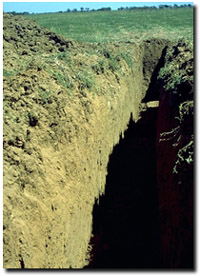 Sites ORZC1 & ORZC2 | 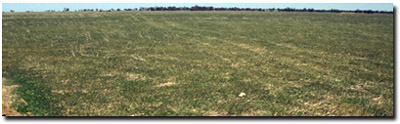 Site ORZC1 Landscape |
Soil Profile Morphology:
Surface Soil
| A1 | 0-10 cm | Dark yellowish brown (10YR4/4); light clay; moderate medium blocky structure; strong effervescence; contains minor amounts of iron sandstone floaters; pH 8.6; abrupt change to: | 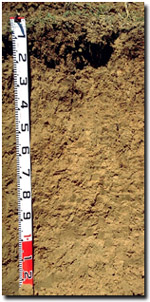 Site ORZC1 Profile |
| Subsoil | |||
| B21 | 10-30 cm | Yellowish red (5YR5/6); light medium clay; strong coarse prismatic, parting to moderate coarse blocky structure; very firm consistence dry; contains few (5-10%) fine earth carbonates and very few (<2%) semi-hard calcareous segregations; pH 9.6; gradual change to: | |
| B22 | 30-65 cm | Reddish yellow (7.5YR7/6) with few (5-10%) yellowish red (5YR5/8) mottles; medium clay; strong coarse prismatic parting to moderate coarse polyhedral structure; very weak consistence dry; contains few (5%) fine earth carbonates; pH 9.8; gradual change to: | |
| B23 | 65-100 cm | Light pinkish brown (7.5YR7/4) with slight pale brown (10YR6/3) mottles; medium clay; lenticular structure with slickensides; weak consistence moist; contains few (2%) fine earth carbonates as well as sand grains throughout; pH 9.6; gradual change to: | |
| B24 | 100+ cm | Very pale brown (10YR7/3) with faint reddish yellow (5YR6/6) and dark red (2.5YR4/8) mottles; medium clay; strong lenticular structure; very weak consistence moist; pH 10.0. |
Key Profile Features:
- Gradual increase in clay content (texture) with depth.
- Vertic properties (i.e slickensides and lenticular peds) in deeper subsoil.
- Soil profile calcareous throughout.
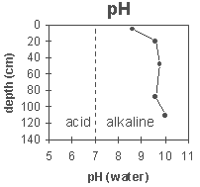
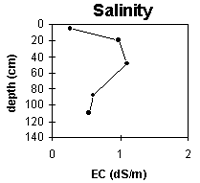
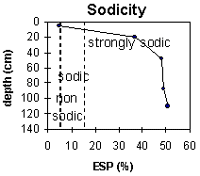
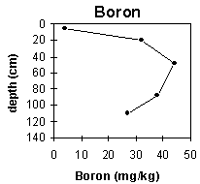
pH | Salinity Rating | |||
Surface (A1 horizon) | Strongly alkaline | Low | Non-sodic | None |
Subsoil (B21 horizon) | Extremely alkaline | High | Strongly sodic | Slight1 |
Deeper subsoil (at 1 m) | Extremely alkaline | Very high | Strongly sodic | Strong |
 |  |  |
 | 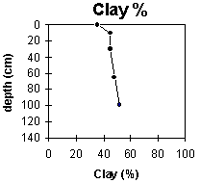 |
Horizon | Horizon Depth (cm) | pH (water) | pH (CaCl2) | EC 1:5 | NaCI % | Exchangeable Cations | Boron mg/kg | Field Capacity pF 2.5 | Wilting Point pF 4.2 | Coarse Sand (0.2 - 2 mm) | Fine Sand (0.02 -0.2 mm) | Silt (0.002 -0.02 mm) | Clay (<0.002 mm) | |||
Ca | Mg | K | Na | |||||||||||||
meq/100g | ||||||||||||||||
A1 | 0-10 | 8.6 | 8 | 0.26 | <0.01 | 2.1 | 7.1 | 2.6 | 1.6 | 3.8 | 43 | 19 | 14 | 22 | 17 | 36 |
B21 | 10-30 | 9.6 | 8.9 | 0.97 | 0.13 | 5.5 | 14 | 1.5 | 12 | 32 | 43 | 25 | 15 | 17 | 12 | 45 |
B22 | 30-65 | 9.8 | 9.1 | 1.1 | 0.2 | 2.7 | 12 | 1.5 | 15 | 44 | 45 | 20 | 18 | 20 | 6 | 45 |
B23 | 65-100 | 9.6 | 9 | 0.6 | 0.23 | 2.4 | 12 | 1.4 | 15 | 38 | 44 | 22 | 19 | 21 | 7 | 48 |
B24 | 100+ | 10 | 9.8 | 0.54 | 0.36 | 2.5 | 12 | 1.4 | 16 | 27 | 48 | 21 | 17 | 20 | 10 | 52 |
Management Considerations:
General
- Management strategies for all soils should include: increasing organic matter levels in the surface soil, minimising the degradation of soil aggregates and porosity, promoting the development of stable biopores, improving the calcium status of the cation exchange complex (particularly when sodium is a significant part), and breaking up any hardpans. Less frequent tillage, using less aggressive implements and working the soil at its optimum moisture content, can all assist in maintaining soil aggregation and porosity, as well as reducing the breakdown of organic matter.
- The soil profile is strongly to extremely alkaline throughout. This indicates that phosphorus and trace elements such as iron, manganese, copper and zinc may be poorly available to plants.
- The gilgai microrelief is caused by the vertic properties of the soil where shrinking and swelling occurs in response to drying and wetting cycles. This forces ‘blocks’ of soil material gradually upward to form mounds (or ‘puffs’). The soil in the mounds are different to the soils in the depressions. Mound soils tend to be lighter in colour and have higher calcium carbonate contents. Salinity and boron levels are also often higher in the upper profile of the mounds. Continuous cultivation results in the smoothing out of many of these gilgai formations. However, the forces that created them are still operating and this is evident by the displacement of fence posts. If the land is left undisturbed over a number of wetting and drying seasons, the gilgai will continue to develop.
- The surface soil has a high cation exchange capacity with relatively high levels of exchangeable calcium and potassium.
- Tillage of clayey soils like these should be avoided if the soil is wet (i.e. wetter than the plastic limit). At such moisture conditions, excessive tillage, trafficking or over-stocking could result in some structural damage (e.g. compaction). Ideally, tillage should take place on clayey soils when the soil is drier than the plastic limit – down to at least the tillage depth.
- The subsoil is strongly sodic throughout and disperses. This is likely to result in restricted root and water movement into the subsoil. The high level of exchangeable sodium in the deeper subsoil can also result in nutrient imbalances and may even have a toxic effect on some plants. The levels of exchangeable magnesium also increase significantly in the subsoil and the calcium to magnesium ration is low (i.e. < 0.4). This is likely to exacerbate the effect of sodicity on soil structure.
- Boron levels are quite high in the subsoil (for the mound components of the gilgai microrelief). These levels are likely to affect the growth of boron-sensitive species (including cereals, pulses, pasture legumes) where concentrations as low as 10 ppm, for example, can reduce lentil yield. Limited data estimates that the threshold level of soluble boron for cereals is 15 mg/kg (Cartwright et al., 1984). Other work at VIDA indicates that where there are low levels of soluble salts, boron tolerance can be comparatively high, with little reduction in wheat yield at levels of up to 45 ppm (Quinlan, 2001).
- The level of soluble salts is high in the upper subsoil, which will restrict the growth of salt-sensitive species. Excessive soil salinity can affect the plant's ability to take up water and can also have a toxic effect on plants.
- The deeper subsoil displays vertic properties (i.e. slickensides and lenticular peds). This indicates that significant shrinking and swelling occurs during drying and wetting cycles. This may disturb the roots of some plant species and has engineering implications (e.g. disturbance to fencelines).
- Surface cracking not evident.
References:
Cartwright, B, Zarcinas, BA, and Mayfield, AH (1984), Toxic concentrations of boron in a red-brown earth at Gladstone, South Australia, Australian Journal of Soil Research 22, 261-72.
Hobson, K (2001), Boron Tolerant Lentils, In On The Pulse pamphlet, NRE.
Quinlan, J (2001), Sorting out the Boron Problem, Wimmera Farming & Landcare Newsletter, 19-20.
Rengasamy, P and Churchman, GJ (1999), Cation Exchange Capacity, Exchangeable Cations and Sodicity, In: Soil Analysis – An Interpretation Manual, (eds. Peverill, KI et al.), CSIRO Publishing.
