Victorian Resources Online (archived)
ORZC11
| Location: Berriwillock. | Australian Soil Classification: Epihypersodic, Pedal, Hypercalcic, CALCAROSOL. |
| Geology: Quaternary (Woorinen Formation) overlying Tertiary (Parilla Sandstone) (within 2 metres of the surface). | |
| General Landscape Description: Level plain, with some low rises. | Site Description: Ploughed paddock, Birchip Cropping Group trial site. |
| Native Vegetation: Mallee. | |
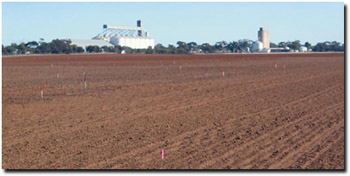 Site ORZC11 Landscape |
Soil Profile Morphology:
Surface Soil
| Ap | 0-13 cm | Brown (7.5YR4/4); heavy fine sandy clay loam; weak coarse blocky structure; weak consistence (dry); highly calcareous; pH 8.6; abrupt change to: | 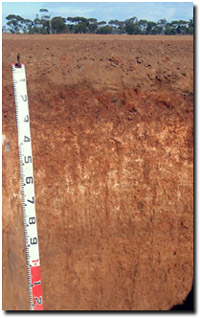 Site ORZC11 Profile |
| Subsoil | |||
| B21 | 13-25 cm | Yellowish red (5YR5/6); light medium clay; moderate-strong coarse to medium to fine blocky structure; firm to strong consistence (dry); slightly-moderately calcareous; pH 9.2; gradual change to: | |
| B22k | 25-50 cm | Yellowish red (5YR5/6); light medium clay; moderate coarse to very coarse prismatic, parting to moderate-strong coarse blocky structure; common (20%) fine earth carbonates; very highly calcareous; pH 9.6; gradual change to: | |
| B23k | 50-75 cm | Strong brown (7.5YR5/8) with some yellowish red (5YR 5/6) root channel infills; light medium clay; weak moderate coarse to very coarse prismatic, parting to moderate coarse to medium blocky structure; fine earth carbonates common (20%); highly calcareous; pH 9.6; gradual change to: | |
| B24 | 75-100 cm | Yellowish red (5YR5/6) with dark red (2.5YR4/8) mottles; medium clay; moderate coarse to medium prismatic structure; non-calcareous; manganese flecks in a continuous band between 80-100 cm depth; pH 9.4; gradual change to: | |
| B3 | 100+ cm | Yellowish red (5YR5/6); light medium clay; structured; non-calcareous; pH 5.8. | |
Key Profile Features:
- Gradual increase in texture (i.e. clay content) with depth.
- Calcareous throughout soil profile.
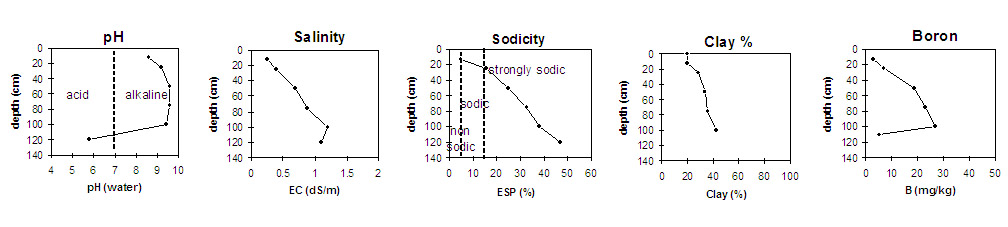
pH | Salinity Rating | |||
Surface soil (Ap horizon) | Strongly Alkaline | Low | Non-Sodic | None |
Upper subsoil 13-25 cm | Very Strongly Alkaline | Low | Strongly Sodic | Moderate |
Deeper subsoil (at 50-75 cm) | Extremely Alkaline | High | Strongly Sodic | Slight1 |
Deep subsoil (at 100+ cm) | Moderately Acid | High | Strongly Sodic | None1 |
 |
Horizon | Horizon Depth (cm) | pH (water) | pH (CaCl2) | EC 1:5 | NaCI % | Exchangeable Cations | Boron mg/kg | Field Capacity pF 2.5 | Wilting Point pF 4.2 | Coarse Sand (0.2 - 2 mm) | Fine Sand (0.02 -0.2 mm) | Silt (0.002 -0.02 mm) | Clay (<0.002 mm) | |||
Ca | Mg | K | Na | |||||||||||||
meq/100g | ||||||||||||||||
Ap | 0-13 | 8.6 | 8.1 | 0.25 | <0.01 | 15 | 7.3 | 1.7 | 1.1 | 3 | 29 | 14 | 26 | 26 | 20 | 21 |
B21 | 13-25 | 9.2 | 8.4 | 0.39 | 0.02 | 12 | 14 | 1.4 | 4.9 | 7.1 | 41 | 21 | 21 | 20 | 25 | 28 |
B22 | 25-50 | 9.6 | 8.8 | 0.68 | 0.07 | 5.2 | 14 | 1.2 | 6.8 | 19 | 40 | 21 | 19 | 19 | 12 | 34 |
B23k | 50-75 | 9.6 | 8.8 | 0.89 | 0.1 | 3.4 | 13 | 1.3 | 8.4 | 23 | 40 | 20 | 19 | 19 | 8 | 36 |
B24 | 75-100 | 9.4 | 8.6 | 1.2 | 0.16 | 3.1 | 14 | 1.4 | 11 | 27 | 41 | 17 | 20 | 23 | 7 | 43 |
B3 | 100+ | 5.8 | 5.3 | 1.1 | 0.16 | 1.8 | 7.3 | 0.8 | 8.5 | 5.1 | ||||||
Management Considerations:
Whole Profile
- The soil profile is strongly to extremely alkaline throughout the upper 1 metre. This indicates that phosphorus and trace elements such as iron, manganese, copper and zinc may be poorly available to plants.
- The surface soil is well suited as a seedbed – the surface condition is soft and the soil has a weak consistence (i.e. it does not become excessively hard). However, it is not deep and should be protected as much as possible from wind and water erosion and over-cultivation. Promoting organic matter levels will be beneficial.
- The upper subsoil is strongly sodic but does not disperse. It is also relatively well structured compared to many of the strongly sodic upper subsoils in the region (parting well to, medium to fine size blocky peds). It will provide fewer restrictions to root growth than the more coarsely structured horizons in the region. The deeper subsoil (i.e. from 25 cm depth) becomes more coarsely structured and disperses only after remoulding, resulting in more restricted root and water movement. Dispersion may be restricted by the high level of soluble salts in much of the subsoil.
- Boron concentrations can be toxic to plant growth. Levels of boron measured at this pit site are highest in the 25-100 cm depth range – varying between 19-27 mg/kg. These levels are quite high and may affect boron-sensitive species (including cereals, pulses, pasture legumes). Concentrations as low as 10 ppm, for example, can reduce lentil yield. Limited data estimates boron tolerance can be comparatively high, with little reduction in wheat yield at levels of up to 45 ppm (Quinlan, 2001). Boron tolerant lines may need to be considered. Also more extensive sampling across the paddock would give a better indication of boron levels.
- The level of soluble salts becomes high enough to restrict the growth of salt sensitive species from 50 cm depth in the soil profile. The level of soluble salts increases with depth down the subsoil.
Cartwright, B., Zarcinas, B.A, and Mayfield, A.H. (1984). Toxic Concentrations of Boron in a Red-Brown Earth at Gladstone, South Australia. Australian Journal of Soil Research. 22. 261-72.
Hobson, K. (2001). Boron Tolerant Lentils. In On The Pulse pamphlet. NRE. 2001.
Maschmedt, D. (2000). Agricultural Land Classification Standards used in South Australia’s Land Resource Mapping Program. Department of Primary Industries South Australia.
Quinlan, J. (2001). Sorting out the Boron Problem. Wimmera Farming & Landcare Newsletter. 19-20.
Rengasamy, P. and Churchman, G.J. (1999). Cation Exchange Capacity, Exchangeable Cations and Sodicity. In: Soil Analysis – An Interpretation Manual. (eds. Peverill, K.I et al). CSIRO Publishing.
White, P.F. (1990). Soil and Plant Factors Relating to the Poor Growth of Lupinus species on Fine Textured Soils – A Review. Australian Journal of Agricultural Research 41: 871-890.
