Victorian Resources Online (archived)
MP1
| Location: Galah-Tiega | Australian Soil Classification: Brown CHROMOSOL |
| Northcote Factual Key: Db 1.53 | |
| General Landscape Description: Upper slope of a gentle rise known as the Limestone Site within the Mid Mallee Land System. | |
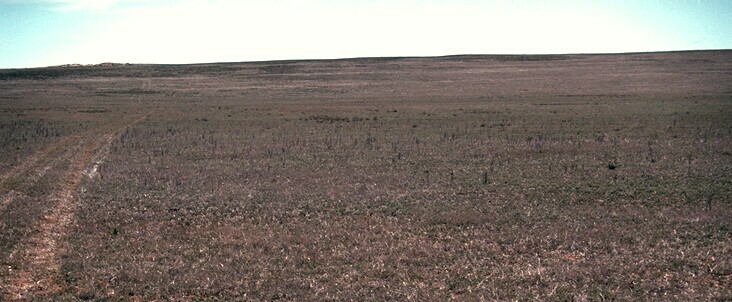 MP1 Landscape |
Soil Profile Morphology:
Surface Soil
| A1 | 0-10 cm | Strong brown (7.5YR5/6); sandy loam; hardsetting surface condition; massive in structure; weak consistence dry; highly calcareous; pH 8.7; sharp and smooth change to: | 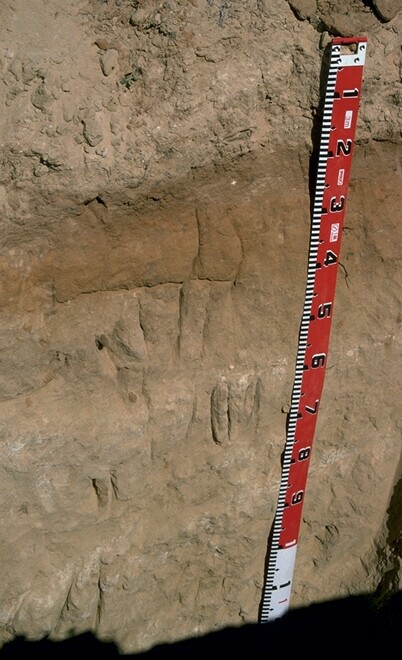 |
| A2 | 10-20 cm | Reddish yellow (7.5YR6/6) with a conspicuous bleach (7.5YR7/4d); light sandy clay loam; massive in structure (possibly cemented by carbonate and clay); strong consistence dry; contains a few (2-10%) carbonate nodules (2-6 mm in size); highly calcareous; pH 9.0; sharp and smooth change to: | |
| A3 | 20-25 cm | Strong brown (7.5YR5/6); sandy loam; granular structure; weak consistence dry; contains very few (<2%) carbonate nodules; moderately calcareous; pH 8.9; abrupt and smooth change to: | |
| Subsoil | |||
| B21 | 25-40 cm | Strong brown (7.5YR5/8); sandy clay loam; massive in structure; cracking observable only on disturbance; firm consistence dry; slightly calcareous; pH 9.0; clear and smooth change to: | |
| B22k | 40-60 cm | Reddish yellow (7.5YR6/6); sandy loam; massive in structure; contains a common (10-20%) amount of soft carbonate; carbonate tubular structures occur in the lower parts of this horizon as well as ovate longitudinal reddish yellow (5YR5/6) lenses which are associated with the carbonate; very highly calcareous; pH 9.0; gradual and smooth change to: | |
| B23k | 60-85 cm | Yellowish red (5YR5/6); fine sandy clay loam; contains many (20-50%) soft carbonates; very highly calcareous; pH 9.0; gradual and smooth change to: | |
| B24k | 85-130 cm | Strong brown (7.5YR5/6); fine sandy light clay; very strong 2 cm cast structures occasionally occur; contains many (20-50%) soft carbonates; very highly calcareous; pH 9.3; smooth change to: | |
| 2A1 | 130+ cm | Reddish yellow (7.5YR6/6); loamy sand; slightly calcareous; pH 10.0. | |
Key Profile Features:
- Hardsetting surface soil.
- Sandy profile throughout.
- Strongly alkaline profile.
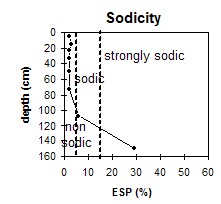
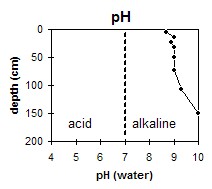 The soil is strongly alkaline throughout, becoming very strongly alkaline at 1 metre depth. | 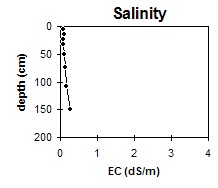 The salinity rating is very low to low throughout the soil profile. |
|
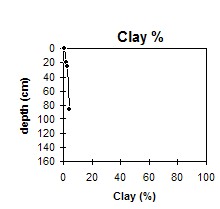
The clay content is very low throughout the profile. |
Management Considerations:
Whole Profile
- The strongly alkaline profile suggest that some nutrients (e.g. manganese, zinc, iron, copper) may be poorly available to plants. Nutrient deficiencies can be assessed by plant tissue analysis. Plant species should be chosen in accordance with this pH level.
- The surface soil is hardsetting and requires organic matter for maintaining soil aggregation. The levels of organic carbon measured at the pit site (which may or may not be representative of the whole paddock) is quite low. Organic matter levels will decline if cropping takes place and can be improved by adopting practices such as residue retention, minimum tillage and utilising pasture rotations.
- The sandy surface horizon has a very low water holding capacity and an inherent lack of fertility. Increasing the organic matter levels of the surface horizon will also help to improve these characteristics as well as reducing the erosion risk.
- The levels of total nitrogen measured at this pit site is quite low. However, this is best assessed by taking a bulked sample from across the paddock.
- Infiltration of water is likely to be high in the surface soil. The presence of a conspicuously bleached A2 horizon indicates that this horizon is periodically waterlogged as water sits on the more slowly permeable subsoil. This A2 layer has had the nutrients leached out of it and has limited goodness for plant growth. Planting legumes may help to increase nutrients into this sandy A2 layer.
- There would be very high evaporation from these surface horizons as they have very sandy textures and water would evaporate just as quickly as if the water was sitting on the upper surface
- The subsoil has a moderate inherent fertility and does not become sodic or very strongly alkaline until after 1 metre in depth. These factors are very advantageous to root development including deep rooted species.
Profile Described By: Profile described by David Rees, Jim Rowan, Mark Imhof, Paul Rampant and Sonia Thompson (March 1994).
