Victorian Resources Online (archived)
NE15
| Group: Springhurst- Byawatha Hills Landcare Group | Australian Soil Classification: Bleached, Eutrophic, Red KUROSOL (medium, slightly gravelly, loamy / clayey, very deep) |
| Northcote Factual Key: Dr 2.41 | Great Soil Group: red podzolic |
| General Landscape Description: Upper slope of an undulating rise (5% slope) below a granite hillslope. Original vegetation included Grey Box (Eucalyptus microcarpa) and Red Box (E.polyanthemos). Blakely's Red Gum (E. blakelyi) occurs on sandier areas. | |
Site Description:
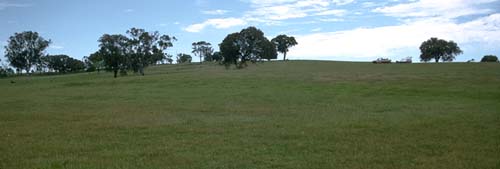 NE15 landscape |
Soil Profile Morphology:
Surface Soil
A1 | 0-5 cm | Dark brown (10YR3/3); sandy loam; hardsetting surface condition; weak medium blocky structure; firm consistence moist; contains a common (15%) amount of quartz gravel (5mm average size); pH 5.4; abrupt change to: | 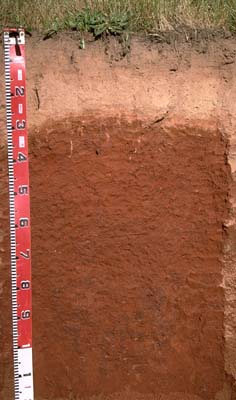 NE15 profile |
A21 | 5-12 cm | Strong brown (7.5YR4/6); sandy loam; structureless; firm consistence moist; contains a few (10%) angular quartz gravels (5mm average size); pH 5.2; abrupt change to: | |
A22 | 12-25 cm | ellowish red (5YR5/8) conspicuously bleached (5YR7/4d); light sandy loam; structureless; firm consistence moist; contains a few (10%) angular quartz gravels (5mm average size); pH 5.2; abrupt change to: | |
| Subsoil | |||
B21 | 25-35 cm | Dark red (2.5YR4/8); light clay; moderate fine blocky, breaking down to moderate very fine polyhedral structure; very firm consistence dry; contains a few (10%) angular quartz gravels (4mm average size); pH 5.0; clear change to: | |
B22 | 35-55 cm | Dark red (2.5YR4/6); light clay; weak medium blocky structure; very firm consistence dry; contains a few (10%) angular quartz gravels (4mm average size); pH 5.5; gradual change to: | |
B23 | 55-80 cm | Dark red (2.5YR3/6); light clay; moderate fine blocky, breaking down to very fine polyhedral structure (shiny faced peds); very firm consistence moist; contains a common (15%) amount of angular quartz gravel (4mm average size); pH 5.5; gradual change to: | |
B24 | 80 cm+ | Dark red (2.5YR3/6); fine sandy clay loam; moderate fine blocky, breaking down to very fine polyhedral structure (shiny faced peds); very firm consistence moist; contains a very few (<2%) ironstone fragments; pH 5.0. | |
160-200 cm | Reddish yellow (7.5YR6/6) with yellowish red (5YR5/8) mottles; sandy loam; contains many (40%) rounded quartz gravels (8mm average size) and very few (<2%) ironstone (‘buckshot’). | ||
Key Profile Features:
- Moderate texture contrast between surface (A) horizons (10% clay) and subsoil (B21) horizon (33% clay).
Soil Profile Characteristics:
Horizon | pH | Salinity Rating | ||
Surface (A1 horizon) | strongly acid | very low | non-sodic | none |
Subsoil (B21 horizon) | strongly acid | very low | non-sodic | none |
Deeper subsoil (at 1 m) | strongly acid | very low | non-sodic | none |
Horizon | Horizon Depth
(cm) | pH
(water) | pH
(CaCl2) | EC 1:5 | Exchangeable Cations | |||
Ca | Mg | K | Na | |||||
meq/100g | ||||||||
A1 | 0-5 | 5.4 | 4.6 | <0.05 | 3.9 | 0.8 | 0.3 | <0.1 |
A21 | 5-12 | 5.2 | 4.3 | <0.05 | 0.7 | 0.2 | 0.3 | <0.1 |
A22 | 12-25 | 5.2 | 4.3 | <0.05 | 0.5 | 0.2 | 0.3 | <0.1 |
B21 | 25-35 | 5.0 | 4.1 | <0.05 | 1.0 | 0.8 | 0.5 | <0.1 |
B22 | 35-55 | 5.5 | 4.5 | <0.05 | 2.1 | 3.1 | 0.9 | <0.1 |
B23 | 55-80 | 5.5 | 4.8 | <0.05 | 1.5 | 4.0 | 0.8 | <0.1 |
B24 | 80+ | 5.0 | 4.3 | <0.05 | 0.4 | 3.8 | 0.5 | <0.1 |
160-200+ | 0.05 | |||||||
Horizon | Horizon Depth (cm) | Exchangeable Aluminium mg/kg | Field Capacity pF 2.5 | Wilting Point pF 4.2 | Coarse Sand (0.2-2.0 mm) | Fine Sand (0.02-0.2 mm) | Silt (0.002-0.02 mm) | Clay (<0.002 mm) |
A1 | 0-5 | 14 | 19.1 | 8 | 29 | 44 | 11 | 10 |
A21 | 5-12 | 73 | 15.9 | 4 | ||||
A22 | 12-25 | 79 | 13.3 | 3.9 | ||||
B21 | 25-35 | 160 | 18.2 | 8.9 | 21 | 34 | 14 | 33 |
B22 | 35-55 | 85 | 27.1 | 16.8 | ||||
B23 | 55-80 | 42 | 26.3 | 16.3 | ||||
B24 | 80+ | 160 | ||||||
160-200+ |
Management Considerations:
Whole Profile
- Plant available water capacity (PAWC) is considered to be low (estimated at approximately 85mm) for this profile. This is based on available laboratory data and assumes an effective rooting depth of 100cm.
- The soil profile is likely to be well draining as the subsoil is non-sodic and contains moderate levels of gravel and coarse sand throughout. The red colour of the subsoil also suggests that the profile has developed under oxidising conditions.
Surface (A) Horizons
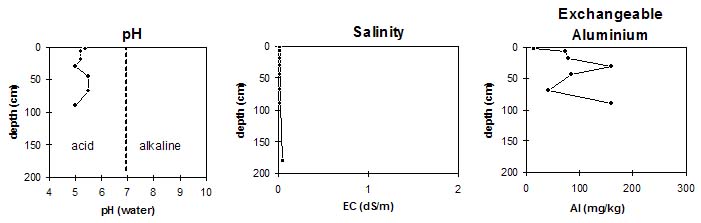
- The surface soil is strongly acid but the exchangeable aluminium level is not high (54 mg/kg) for the bulked sample taken from around this site. Such levels may, however, restrict the growth of highly aluminium sensitive species such as lucerne and phalaris. The addition of lime will increase the soil pH and reduce aluminium toxicity. Other factors need to be considered, however, before lime is recommended (eg. pasture species grown; method of application; local trial responses; soil surface structure; likely cost/benefits). The level of exchangeable aluminium increases slightly in the A2 horizons (73-79 mg/kg).
- In strongly acid soils, deficiencies in phosphorus and molybdenum may occur. High levels of exchangeable aluminium will tend to “fix” phosphorus and make it less available to plants. Increasing soil pH by lime application will enable phosphorus (from superphosphate application) to become more available. The level of phosphorus (Olsen method) measured for the bulked sample is quite low. The State Chemistry Laboratory (SCL) recommends that this part of the paddock be topdressed with 11-12 kg/hectare of actual phosphorus in autumn. Another topdressing at the same rate should be applied in the following year. SCL suggests that molybdenum is commonly required on soils in this region at 50-60 grams/hectare every 5-6 years. Plant tissue analysis, however, may give a more accurate assessment of trace element (eg. molybdenum, copper, zinc, boron) requirements compared to soil samples. A sample of the most dominant clover should be taken in spring for this assessment.
- The sulphur level measured for the bulked sample is also low. SCL recommends that a fertiliser with a reasonable sulphur content (ie. at least 6%) be used. A test strip of gypsum (calcium sulphate) applied at 200-300 kg/hectare in spring could be used to assess sulphur responses on the paddock. Being a lightly textured surface soil, SCL suggests that at least some of the sulphur should be applied in the elemental form (rather than the sulphate form) as it is less easily leached. However, elemental sulphur should be used with caution as it is an acidifying fertiliser.
- The surface soil has a high fine sand content (44%) and organic matter is therefore important for maintaining soil aggregation. If cropping occurs on such soils then it is important to maintain organic matter levels.
Subsoil (B) Horizons
- The top of the subsoil is strongly acid and exchangeable aluminium levels have increased to a level (160mg/kg) which may restrict the growth of a range of aluminium sensitive species.
Comments from Landholder:
- Cropped 10 years ago, but did not prove worthwhile.
- Super applied 3 years ago, and due next year.
- Some salinity occurring at lower slope on waterlogged land.
