Site NE37a
Property: Rutherglen Research Institute.
Paddock Number: PTD 2 (native grass).
Australian Soil Classification: Vertic (and Hypocalcic), Mottled-Subnatric, Grey SODOSOL.
Northcote Factual Key: Dy 3.43.
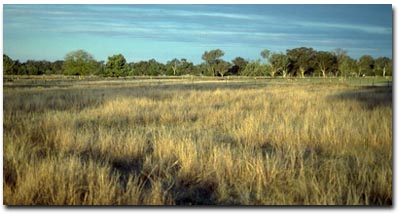
General Landscape Description: This site occurs in a paddock which has never been cultivated. Well developed gilgai microrelief is present.
Soil Mapping Unit: Unit 2 which is a gilgai complex containing four soil types: Rutherglen Loam (deep and normal phases), Lilliput Loam, Type D and Type E.
Site Description: This soil occurs on the edge of the depression component of the gilgai microrelief. It is similar to Lilliput Loam as described by Poutsma and Skene (1961).
Native Vegetation: Wallaby Grass (Danthonia sp.) commonly grows in the gilgai hollows.
 Site NE37a Landscape |
Soil Profile Morphology:
| Surface Soil |
 Site NE37a Profile | ||
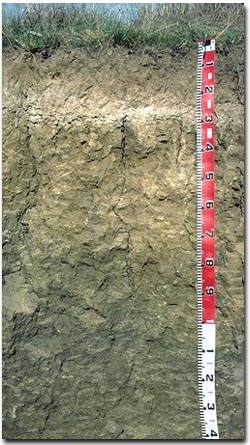
| A1 | 0-20 cm | Brown (10YR4/3); fine sandy clay loam; firm consistence dry; rusty root channel mottling present; pH 5.8; abrupt change to: | |
| A2 | 20-25 cm | Very pale brown (10YR7/3) conspicuously bleached; fine sandy clay loam; contains a few (5%) ferruginous and manganiferous nodules (5-10 mm size); pH 6.6; sharp change to: | |
| Subsoil | |||
| B21 | 25-70 cm | Light brownish grey (10YR6/2) with yellowish brown (10YR5/8) mottles; heavy clay; deep cracks evident; moderate very coarse prismatic structure (slickensides present at 50 cm); bleached material from above present along ped faces; rigid consistence dry; pH 6.7; gradual change to: | |
| B22 | 70-110 cm | Light olive brown (2.5Y6/4); heavy clay; coarsely structured; large slickensides present; contains very few (2%) ferromanganiferous nodules; clear change to: | |
| B23 | 110-140 cm | Light olive brown (2.5Y5/4); heavy clay; slickensides present; contains a trace (< 2%) amount of carbonate-silica nodules (2-10 mm size) and a few (5-10%) ferromanganiferous nodules (2-5 mm size); slickensides present; pH 8.8. | |
Key Profile Features:
- Strong texture contrast between surface (A) horizons (26% clay) and sodic subsoil (B21) horizon (62% clay) i.e. SODOSOL.
- Vertic properties in deeper subsoil.
- Conspicuously bleached subsurface (A2) horizon.
Soil Profile Characteristics:
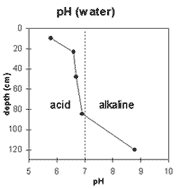 | The surface soil is moderately acid. The upper subsoil is slightly acid and the deeper subsoil is strongly alkaline. | 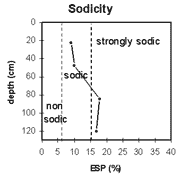 | The upper subsoil is sodic. The deeper subsoil is strongly sodic. Strong to complete dispersion occurs throughout the subsoil. |
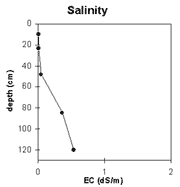 | The salinity rating is very low throughout the upper metre of the soil profile. It becomes low-medium at 120 cm depth. | 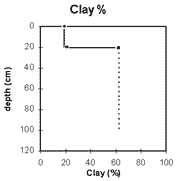 | The clay % increases significantly at the A/B horizon interface. |
Horizon | Horizon Depth (cm) | pH (water) | pH (CaCl2) | EC 1:5 | Exchangeable Cations | Field Capacity pF 2.5 | Wilting Point pF 4.2 | Coarse Sand (0.2 -2.0 mm) | Fine Sand (0.02 -0.2 mm) | Silt (0.002 -0.02 mm) | Clay (<0.002 mm) | |||
Ca | Mg | K | Na | |||||||||||
meq/100g | ||||||||||||||
A1 | 0-20 | 5.8 | 4.6 | <0.05 | 3.6 | 1.8 | 0.54 | 0.26 | 29 | 9 | 8 | 46 | 19 | 26 |
A2 | 20-25 | 6.6 | 4.9 | <0.05 | 2.7 | 2 | 0.18 | 0.46 | 22 | 6 | 10 | 49 | 22 | 21 |
B21 | 25-70 | 6.7 | 5.1 | 0.05 | 9.7 | 8.5 | 0.43 | 1.9 | 39 | 22 | 4 | 23 | 12 | 62 |
B22 | 70-100 | 6.9 | 6.1 | 0.37 | 8.9 | 10 | 0.4 | 4.2 | ||||||
B23 | 100-140 | 8.8 | 8.1 | 0.54 | 11 | 14 | 0.5 | 5 | ||||||
Management Considerations:
Whole Profile
- Plant available water capacity (PAWC) is considered to be low for this profile. Effective rooting depth will be restricted by the sodic and strongly dispersive dense subsoil. Available water for the surface (A1) horizon is estimated at 30 mm.
- The rusty root channel mottling in the surface horizon indicates that periodic waterlogging occurs due to the slowly permeable subsoil.
- The surface soil has a high fine sand and silt content (65%).
- Organic matter is therefore important for maintaining aggregation and preventing slaking.
- The dense and coarsely structured subsoil is sodic and disperses completely. This will result in significant restriction to root and water movement in the subsoil.
- The deeper subsoil exhibits vertic properties (ie. significant cracking, presence of slickensides) which indicates that significant shrinking and swelling occurs in drying and wetting cycles. This will cause subsoil movement and has resulted in the formation of gilgai ("crabholey") microrelief at the surface.
Profile Described By: Mark Imhof and Paul Rampant (7/5/96).
