Victorian Resources Online (archived)
NE24
| Location: Tallangatta Valley Landcare Group. | Australian Soil Classification: Bleached, Mesotrophic, Red CHROMOSOL (moderately deep) |
| Northcote Factual Key: Dr 2.41 | Great Soil Group: red podzolic. |
| General Landscape Description: Midslope (14%) on rolling hills. | |
| Native Vegetation: Original Vegetation included Red Stringybark (Eucalyptus macrorhyncha). | |
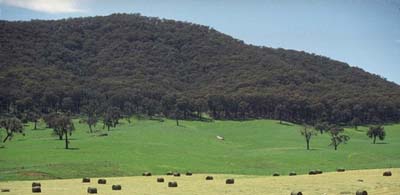 Site NE24 Landscape |
Soil Profile Morphology:
Surface Soil
| A1 | 0-10 cm | Very dark greyish brown (10YR3/2); fine sandy loam; weak fine blocky structure; pH 5.0; clear and wavy change to: | 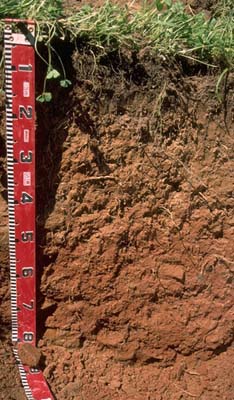 Site NE24 Profile |
| A2 | 10-40 cm | Strong brown (7.5YR5/6) with a conspicuous bleach (7.5YR7/4d); fine sandy loam; weak medium blocky structure; firm consistence dry; contains a few (5%) schistic gravels (5 mm diameter); pH 5.4; clear and wavy change to: | |
| Subsoil | |||
| B21 | 40-70 cm | Yellowish red (5YR4/6); heavy clay loam; moderate medium blocky structure; firm consistence moist; contains many (30%) schist gravels (5 cm average diameter); pH 5.6; clear change to: | |
| B22 | 70-100 cm | Strong brown (7.5YR4/6) with yellowish brown (10YR5/6) mottles; clay loam; mixed with weathered rock; firm consistence moist; pH 5.5: | |
| C | 100 cm + | Schist base rock. | |
Key Profile Features:
- Strong texture contrast between surface horizons (13-14% clay) and the subsoil (33% clay).
Soil Profile Characteristics:
Horizon | pH | Salinity Rating | ||
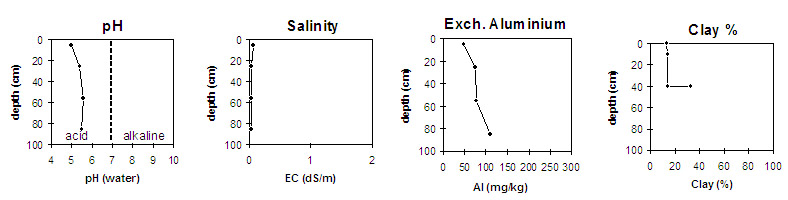
Surface (A1 horizon) | strongly acid | very low | non-sodic | none |
Subsoil (B21 horizon) | moderately acid | very low | non-sodic | none |
Deeper subsoil (at 85 cm) | strongly acid | very low | non-sodic | none |
Horizon | Horizon Depth (cm) | pH (water) | pH (CaCl2) | EC 1:5 | Exchangeable Cations | |||
Ca | Mg | K | Na | |||||
meq/100g | ||||||||
A1 | 0-10 | 5.0 | 4.4 | 0.07 | 6.1 | 1.2 | 0.3 | <0.1 |
A2 | 10-40 | 5.4 | 4.5 | <0.05 | 1.5 | 0.4 | 0.2 | <0.1 |
B21 | 40-90 | 5.6 | 4.7 | <0.05 | 2.3 | 1.7 | 0.5 | <0.1 |
B22 | 90+ | 5.5 | 4.5 | <0.05 | 1.2 | 2.7 | 0.6 | <0.1 |
Horizon | Horizon Depth (cm) | Exchangeable Aluminium mg/kg | Field Capacity pF 2.5 | Wilting Point pF 4.2 | Coarse Sand (0.2-2.0 mm) | Fine Sand (0.02-0.2 mm) | Silt (0.002-0.02 mm) | Clay (<0.002 mm) |
A1 | 0-10 | 47 | 35 | 10 | 16 | 39 | 26 | 13 |
A2 | 10-40 | 75 | 23 | 5 | 15 | 42 | 31 | 14 |
B21 | 40-90 | 77 | 27 | 12 | 13 | 32 | 25 | 33 |
B22 | 90+ | 110 | 28 | 13 |
Management Considerations:
Whole Profile
- Plant available water capacity (PAWC) is considered to be low (estimated at 90 mm) for this site. This is based on available laboratory data and assumes an effective rooting depth of 100 cm. Rooting depth will be restricted by the schist baserock.
- Organic carbon and total nitrogen levels are relatively high in the surface (A1) horizon.
- The level of exchangeable aluminium measured at the pit site may affect highly aluminium sensitive species e.g. lucerne, phalaris. The level of aluminium increases in the subsurface (A2) horizon. A pH/aluminium test sampled from across the paddock, may be appropriate to determine the amount of lime needed to raise pH. However, other factors need to be considered before lime is recommended e.g. pasture species grown, method of application, local trial responses, likely cost/benefit. Deficiencies in molybdenum, phosphorous and potassium may occur in the strongly acid surface soil. Lime application may assist in increasing phosphorous availability. Plant tissue analysis may give a more accurate assessment of molybdenum requirements.
- The surface soil has a high silt (26%) and fine sand (39%) content. These soils are likely to be unstable during rapid wetting and will slake if organic matter levels are low. Significant slaking can result in surface sealing which will restrict seedling emergence and water infiltration as well as increase the likelihood of soil erosion. Organic matter levels are high at this site as would be expected from a permanent pasture. Levels of organic matter would decline if cultivation took place.
- The subsoil has a low inherent fertility (based on the sum of the exchangeable basic cations).
- The subsoil is moderately to strongly acid throughout. Exchangeable aluminium levels are still high enough to affect aluminium sensitive species.
