Victorian Resources Online (archived)
NE28
| Location: Tallangatta Valley Landcare Group. | Australian Soil Classification: Red DERMOSOL |
| General Landscape Description: Auger hole on an alluvial terrace. | |
Soil Profile Morphology:
Surface Soil
| A1 | 0-5 cm | Dark brown (10YR3/3); fine sandy loam; pH 4.8: |
| A2 | 5-30 cm | Strong brown (7.5YR5/6); fine sandy clay loam; pH 4.8: |
| Subsoil | ||
| B21 | 30-60 cm | Yellowish red (5YR5/8); fine sandy clay loam; pH 5.5: |
| B22 | 60-85 cm | Strong brown (7.5YR5/8); fine sandy clay loam; pH 5.8: |
| B23 | 85 cm + | Dark yellowish brown (10YR4/5) with a secondary pale brown (10YR6/3) colour; fine sandy clay loam; contains a common (20%) amount of gravel (5 mm average diameter) to 110 cm depth and many (40%) quartz gravels (20 mm average diameter) from 100 cm depth; pH 6.0. |
Key Profile Features:
- Gradual increase in clay content down the soil profile.
Soil Profile Characteristics:
Horizon | pH | Salinity Rating |
Surface (A1 horizon) | very strongly acid | very low |
Subsoil (B21 horizon) | strongly acid | very low |
Deeper Subsoil (at 85 cm) | moderately acid | very low |
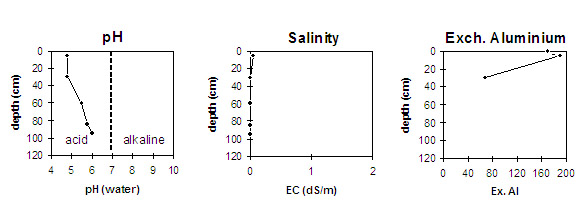
Horizon | Horizon Depth (cm) | pH (water) | pH (CaCl2) | EC 1:5 | Exchangeable Aluminium mg/kg | Field Capacity pF 2.5 | Wilting Point pF 4.2 |
A11 | 0-10 | 4.8 | 4.2 | 0.05 | 170 | 31 | 10 |
A12 | 10-40 | 4.8 | 4.1 | <0.05 | 190 | 28 | 6 |
B21 | 40-70 | 5.5 | 4.6 | <0.05 | 69 | 26 | 9 |
B22 | 70-100 | 5.8 | 5.1 | <0.05 | 24 | 17 | |
2A | 100+ | 6.0 | 5.1 | <0.05 |
Management Considerations:
Whole Profile
- Plant available water capacity (PAWC) is likely to be medium at this site.
- The surface horizons are very strongly acid and as a consequence, the levels of exchangeable aluminium measured at this auger hole site are quite high (> 170 mg/kg). At these levels the growth of a number of aluminium sensitive species would be restricted. A pH/aluminium test on a bulked sample taken from across the paddock would be useful for determining the amount of lime required to raise the soil pH in order to reduce aluminium toxicity. However, other factors need to be considered before lime is recommended e.g. pasture species grown, method of application, local trial responses, likely cost/benefit.
- Deficiencies in molybdenum, phosphorus and potassium may occur in the very strongly acid surface soil. Lime application may assist in increasing phosphorus availability. Plant tissue analysis could a more accurate assessment of molybdenum requirements.
- The soil pH increases in the subsoil to 5.5 in water and continues to increase with depth. As a consequence, the level of exchangeable aluminium has significantly decreased.
- Lime has not been used.
