Victorian Resources Online (archived)
LP45
| Property: LP45 | Australian Soil Classification: Epicalcareous-Epihypersodic, Epipedal, Brown VERTOSOL |
| Northcote Factual Key: Ug 5.2 | Great Soil Group: grey clay |
| General Landscape Description: Old alluvial plain with Black Box (Eucalyptus largiflorens). Gilgai microrelief is present. | |
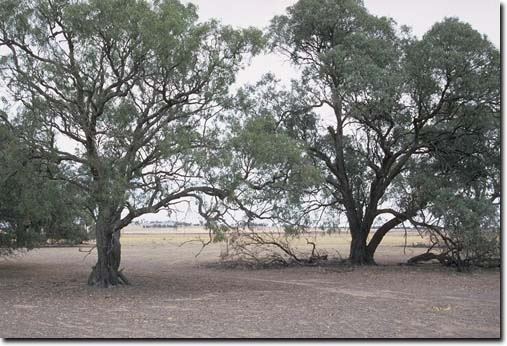 LP45 Landscape |
Soil Profile Morphology
Surface Soil
| A1 | 0-10 cm | Dark brown (10YR3/3); light medium clay; surface crusting; moderate coarse blocky structure; very firm consistence dry; pH 6.5; abrupt change to: | 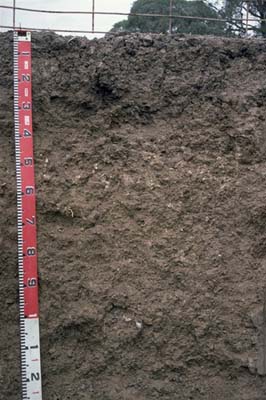 LP45 Profile |
| Subsoil | |||
| B21 | 10-20 cm | Dark greyish brown (10YR4/2); medium heavy clay; strong fine polyhedral structure; strong consistence dry; pH 8.0; clear change to: | |
| B22 | 20-45 cm | Brown (10YR5/3) and yellowish brown (10YR5/4); medium clay; strong coarse blocky, parting to moderate medium polyhedral structure; firm consistence moist; pH 8.7; clear change to: | |
| B23k | 45-65 cm | Light yellowish brown (10YR6/4); medium clay; strong coarse to medium polyhedral structure; contains few (10%) calcareous nodules; strong consistence moist; pH 9.0; gradual change to: | |
| B31 | 65-100 cm | Pale brown (10YR6/3); medium clay; strong medium polyhedral, parting to strong fine polyhedral structure; contains a few (2-5%) calcareous nodules (with silica) and a few (<5%) gypsum crystals in pockets as well as manganese stains; very firm consistence moist; pH 8.1; gradual change to: | |
| B32 | 100+ cm | Light yellowish brown (10YR6/4); medium clay; strong medium polyhedral structure; small slickensides present; strong consistence moist; pH 8.3. | |
Note: This soil corresponds partly to Kerang Clay as described by Skene (1971). | |||
Key Profile Features
- Clay texture throughout the profile.
- Soil profile cracks when dry (with surface cracking)
- Slickensides evident at depth.
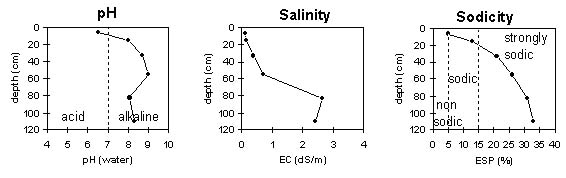
pH | Salinity Rating | |||
Surface (A1 horizon) | slightly acid | low | nearly sodic | none1 |
Subsoil (B21 horizon) | moderately alkaline | very low | sodic | strong |
Deeper subsoil (1 m) | moderately alkaline | medium - high | strongly sodic | - |
| 1 Strong dispersion after remoulding. | ||||
 |
Horizon | Horizon Depth | pH (water) | EC 1:5 | NaCl | Exchangeable Cations | |||
Ca | Mg | K | Na | |||||
meq/100g | ||||||||
A1 | 1-10 | 6.5 | 0.13 | 8.2 | 4.4 | 1.1 | 0.7 | |
B21 | 1-20 | 8 | 0.16 | 11 | 8.2 | 1.5 | 3 | |
B22 | 20-45 | 8.7 | 0.38 | <0.05 | 11 | 9.1 | 1.3 | 5.5 |
B23K | 45-65 | 9 | 0.7 | 0.06 | 9.3 | 10 | 1.4 | 7.3 |
B31 | 65-100 | 8.1 | 2.65 | 0.12 | 10 | 9.3 | 1.5 | 9.3 |
B32 | 100+ | 8.3 | 2.4 | 0.17 | 8 | 13 | 1.4 | 11 |
Horizon | Horizon Depth | Ex Al mg/kg | Ex Ac meq/100g | Field pF2.5 | Wilting Point pF4.2 | Coarse Sand (0.2-2.0mm) | Fine Sand (0.02-0.2mm) | Silt (0.002-0.02mm) | Clay (<0.002mm) |
A1 | 1-10 | 26.3 | 17.2 | 7 | 30 | 15 | 45 | ||
B21 | 1-20 | 39.5 | 27.4 | 4 | 16 | 11 | 66 | ||
B22 | 20-45 | ||||||||
B23K | 45-65 | ||||||||
B31 | 65-100 | ||||||||
B32 | 100+ |
Management Considerations:
- In general, management strategies for all soils should aim to increase organic matter levels in the surface soil; minimise the degradation of soil aggregates and porosity; promote the development of stable biopores; improve the calcium status of the ion exchange complex (particularly when sodium is a significant part), and break up any hardpans. Less frequent tillage; using less aggressive implements, and working the soil at optimum moisture conditions can all assist in maintaining soil aggregation and porosity as well as reducing the breakdown of organic matter.
Surface (A) Horizons
- The surface soil disperses strongly after remoulding. This suggests that this horizon could disperse and develop surface crusting and exacerbated cloddiness if cultivated or over-stocked in a moist condition. Gypsum may be beneficial for soils such as these – a gypsum responsiveness test of the whole paddock would be useful to ascertain this. The surface soil at this site displays some surface crusting.
- Tillage of clayey soils like these should be avoided if the soil is wet (i.e. wetter than the plastic limit). At such moisture conditions, excessive tillage, trafficking or over-stocking could result in some structural damage (e.g. compaction). Ideally, tillage should take place on clayey soils when the soil is drier than the plastic limit – down to at least the tillage depth.
- The relatively high wilting point value (17%) for the surface soil means that plants will not be able to fully utilise light rains falling on relatively dry soil as there will be insufficient moisture to wet the soil above the wilting point value.
Subsoil (B) Horizons
- The upper subsoil is sodic and disperses strongly. This is likely to restrict water and plant root movement into the subsoil. The presence of some sporadic bleaching above the subsoil indicates that periodic waterlogging occurs at this site.
- The subsoil is strongly alkaline from a depth of 20 cm. This indicates that phosphorus and some trace elements such as iron, manganese, zinc and copper may be poorly available to plants and deficiencies may occur. Deficiencies can be determined by plant tissue analysis. Boron toxicity can also occur in strongly alkaline soils.
- The level of soluble salts becomes high at 1 metre depth. This is likely to restrict the growth of deeper-rooted salt-sensitive species.
Landholder Comments:
- Gypsum has not been used for 6 years.
- Crabholey (gilgai) country exits in the lower lying areas.
Notes:
Soil profile described by Mark Imhof, Paul Rampant and Karen de Plater (28/2/95)
