Victorian Resources Online (archived)
LP59
| Property: LP59 Sylvaterre | Group: Pyramid Hill Farm Advance |
| Australian Soil Classification: Endohypersodic, Self-mulching, Grey VERTOSOL | Northcote Factual Key: Ug 3.2 |
| Great Soil Group: grey clay | |
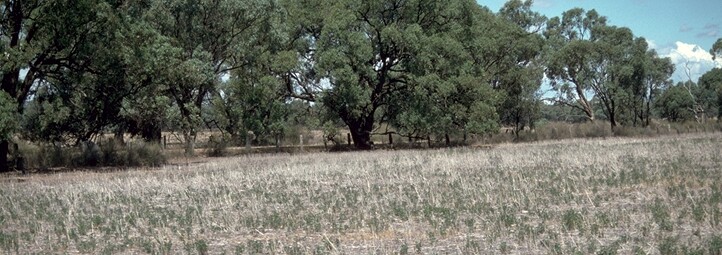
| General Landscape Description: General Landscape Description:Level plain with Black Box (Ecalyptus largiflorens) and Lignum Bush (Muehlenbeckia cunninghamii) occurring in undisturbed areas. This area originally displayed gilgai microrelief. | |
 LP59 Landscape |
Soil Profile Morphology
Surface Soil
| A1 | 0-10 cm | Dark greyish brown (10YR4/2); medium clay; surface flake and surface cracking (with some cracks extending to 1 metre depth); self-mulching surface layer; moderate coarse blocky structure; firm consistence dry; pH 6.3; abrupt change to: | 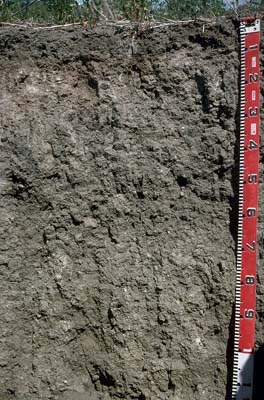 LP59 Profile |
| A2 | 10-20 cm | Dark grey (10YR4/1) sporadically bleached; light medium clay; moderate coarse platy structure; strong consistence dry; pH 6.1; clear change to: | |
| Subsoil | |||
| B21 | 20-60 cm | Grey (10YR5/1); light clay; moderate coarse blocky, parting to strong medium polyhedral structure; very strong consistence dry; contains very few (2%) calcareous nodules; pH 8.3; gradual change to: | |
| B22 | 60-100 cm | Grey (10YR6/1); medium clay; strong medium polyhedral structure; very strong consistence dry; contains very few (3%) calcareous nodules; pH 9.1; gradual change to: | |
| B23 | 100 cm+ | Light brownish grey (10YR6/2) with diffuse brownish yellow (10YR6/6) mottles; medium clay; strong medium to coarse polyhedral structure; very strong consistence dry; pH 9.3. | |
NOTE: This soil corresponds partly to Kinypanial Friable Clay as described by Skene (1971). | |||
Key Profile Features
- Clay surface horizon (clay content 58%) which is self-mulching and cracks when dry.
- Clay texture throughout the profile.
Key Profile Characteristics
pH | Salinity Rating | |||
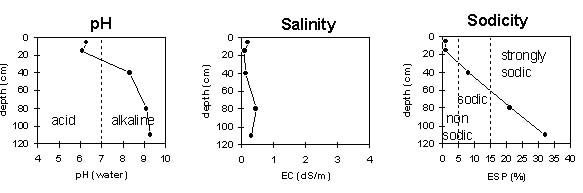
Surface (A1 horizon) | slightly acid | low | non-sodic | very slight1 |
Subsoil (B21 horizon) | moderately alkaline | very low | sodic | complete |
Deeper subsoil (at 1 m) | very strongly alkaline | low | strongly sodic | complete |
| 1 Strong dispersion after remoulding | ||||
 |
Horizon | Horizon Depth | pH (water) | EC 1:5 | NaCl | Exchangeable Cations | |||
Ca | Mg | K | Na | |||||
meq/100g | ||||||||
A1 | 0-10 | 6.3 | 0.21 | 12 | 5.7 | 0.1 | 1 | |
A2 | 10-20 | 6.1 | 0.11 | 12 | 5.5 | 0.2 | 1 | |
21 | 20-60 | 8.3 | 0.12 | 11 | 6.2 | 1.5 | 8 | |
B22 | 60-100 | 9.1 | 0.44 | 0.06 | 7.1 | 10 | 5 | 21 |
B23 | 100+ | 9.3 | 0.31 | 0.11 | 4.3 | 10 | 7.4 | 32 |
Horizon | Horizon Depth | Ex Al mg/kg | Ex Ac meq/100g | Field pF2.5 | Wilting Point pF4.2 | Coarse Sand (0.2-2.0mm) | Fine Sand (0.02-0.2mm) | Silt (0.002-0.02mm) | Clay (<0.002mm) |
A1 | 0-10 | 32.4 | 18.7 | 2 | 18 | 20 | 58 | ||
A2 | 10-20 | 33.3 | 17.6 | ||||||
21 | 20-60 | 35.7 | 20.3 | ||||||
B22 | 60-100 | ||||||||
B23 | 100+ |
Management Considerations:
- In general, management strategies for all soils should aim to increase organic matter levels in the surface soil; minimise the degradation of soil aggregates and porosity; promote the development of stable biopores; improve the calcium status of the ion exchange complex (particularly when sodium is a significant part), and break up any hardpans. Less frequent tillage; using less aggressive implements, and working the soil at optimum moisture conditions can all assist in maintaining soil aggregation and porosity as well as reducing the breakdown of organic matter.
Surface (A) Horizons
- The surface horizon is non-sodic but does disperse when remoulded. This indicates that the soil may disperse when excessively cultivated or over-stocked when wet. This may result in surface sealing. Cracking clay soils such as these are best cultivated when they are dry throughout the cultivation depth. Maintaining surface cover is also important to prevent disruption caused by raindrop action. Gypsum may be an effective ameliorant for such soils – and a gypsum responsiveness test is best performed for the paddock to better guage gyspum requirement.
- The development of platy structure in the subsurface (A2) horizon indicates that the soil has been compacted when in a moist to wet condition.
- The relatively high wilting point (19%) for the surface soil means that plants will not be able to fully utilise light rains falling on relatively dry soil as there will be insufficient moisture to wet the soil above the wilting point value. This will limit growth in a dry spring.
- The overall inherent fertility (based on the sum of the exchangeable cations) is high for the surface horizons.
Subsoil (B) Horizons
- The coarsely structured subsoil is sodic and completely disperses in water. This is likely to result in restricted water and root movement through the profile.
- The subsoil profile becomes very strongly alkaline from about 60 cm depth. This indicates that phosphorus and some trace elements such as iron, manganese, zinc and copper may be poorly available to plants and deficiencies may occur. Deficiencies can be determined by plant tissue analysis. Boron toxicity can also occur in strongly alkaline soils.
Landholder Comments:
- Was "crabholey" country prior to clearing.
- Lucerne and barley have been grown.
- Good barley country.
- Roots have been noted to 1 metre.
- Gypsum (2.5 t/ha) has been applied.
