Victorian Resources Online (archived)
LP70
| Group: Oakvale Farm Advance Group | Australian Soil Classification: Calcic, Mesonatric, Red SODOSOL |
| Northcote Factual Key: Dr 2.13 | Great Soil Group: solodic soil |
| General Landscape Description: Level plain near fringe of the Cannie Ridge. Original vegetation includes Red Mallee (E. socialis). This site is located on a grassed area just outside a cropping paddock. | |
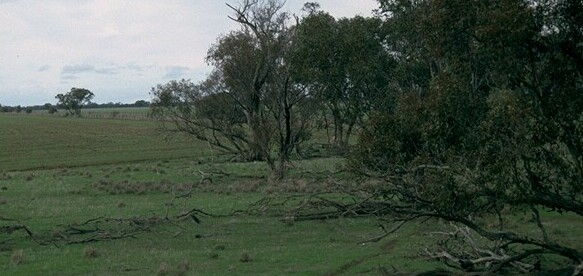 LP70 Landscape |
Soil Profile Morphology
Surface Soil
| A11 | 0-5 cm | Dark reddish brown (5YR3/3); sandy clay loam; hardsetting surface condition; weak coarse blocky structure; firm consistence moist; pH 7.3; abrupt change to: | 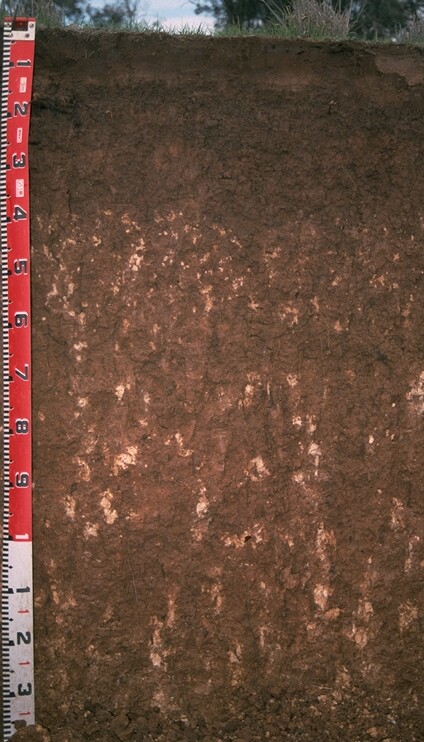 LP70 Profile |
| A12 | 5-10 cm | Dark reddish brown (5YR3/4); sandy clay loam; weak coarse blocky structure; firm consistence moist; pH 6.8; sharp change to: | |
| Subsoil | |||
| B21 | 10-40 cm | Reddish brown (5YR4/4); medium clay; moderate sub-angular blocky, breaking down to strong fine sub-angular blocky structure (with shiny faced peds); firm consistence moist; pH 8.6; clear change to: | |
| B22 | 40-80 cm | Yellowish red (5YR5/6); medium clay; moderate blocky, breaking down to strong fine polyhedral structure (with shiny faced peds); strong consistence dry; contains very few (2%) carbonate nodules (up to 5 mm diameter) and a few (5-10%) soft carbonates; pH 9.3; gradual change to: | |
| B23 | 80+ cm | Yellowish red (5YR5/8); medium clay; strong coarse blocky, breaking down to moderate polyhedral structure (with shiny faced peds); strong consistence dry; contains very few (2%) carbonate nodules (up to 10 mm diameter) and a few (5-10%) soft carbonates; pH 9.1. | |
- Strong texture contrast between the surface (A) horizons and the top of the subsoil (B21) horizon.
- Strongly sodic and calcareous subsoil.
Soil Profile Characteristics
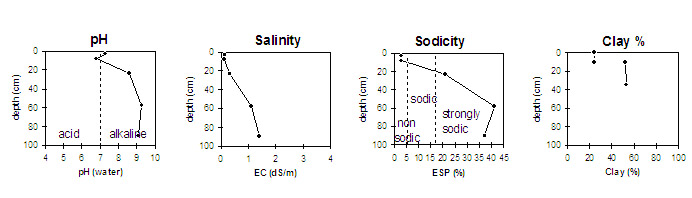
pH | Salinity Rating | |||
Surface (A1 horizon) | Slightly Alkaline | Low | Non-sodic | None1 |
Subsoil (B21 horizon) | Strongly Alkaline | Low-Medium | Strongly Sodic | Complete |
Deeper subsoil (at 80+ cm) | Very Strongly Alkaline | High-Very High | Strongly Sodic | Slight |
| 1 Strong dispersion occurs after remoulding. 2 Due to the high level of soluble salts. | ||||
 |
Horizon | Horizon Depth | pH (water) | pH CaCl2 | EC 1:5 | NaCl % | Exchangeable Cations | |||
Ca | Mg | K | Na | ||||||
meq/100g | |||||||||
A11 | 0-5 | 7.3 | 6.7 | 0.14 | 6.2 | 3.6 | 2 | 0.3 | |
A12 | 5-10 | 6.8 | 5.8 | 0.13 | 3.9 | 2.2 | 1 | 0.2 | |
B21 | 10-35 | 8.6 | 7.5 | 0.33 | 0.06 | 7.7 | 9.9 | 2 | 5.2 |
B22K | 35-80 | 9.3 | 8.6 | 1.1 | 0.16 | 4.7 | 10 | 1.6 | 11 |
B23K | 80+ | 9.1 | 8.6 | 1.4 | 0.23 | 4.4 | 10 | 1.7 | 9.2 |
Horizon | Horizon Depth | Ex Al mg/kg | Ex Ac meq/100g | Field pF2.5 | Wilting Point pF4.2 | Coarse Sand (0.2-2.0mm) | Fine Sand (0.02-0.2mm) | Silt (0.002-0.02mm) | Clay (<0.002mm) |
A11 | 0-5 | 21.5 | 11.2 | 23 | 38 | 10 | 24 | ||
A12 | 5-10 | ||||||||
B21 | 10-35 | 35.9 | 22 | 18 | 20 | 6 | 52 | ||
B22K | 35-80 | 41.7 | 25 | 16 | 17 | 7 | 53 | ||
B23K | 80+ |
Management Considerations:
Whole Profile
- Plant available water capacity (PAWC) is considered to be low (estimated 50 mm) at this site. This is based on available laboratory data and assumes on affective rooting depth of 80 cm. Rooting depth will be limited to the strongly sodic subsoil.
Surface (A) Horizons
- The surface soil is non-sodic but will disperse strongly when remoulded. This indicates that dispersion may occur if the soil is cultivated or overstocked in a wet condition. This could result in surface sealing and exacerbate the hardsetting nature of the soil. Raindrop action has a similar effect to remoulding, so base soil should be protected by plant cover or stubble.
- The surface soil is hardsetting and has a high fine sand (38%) content. When cultivated in a dry condition, these soils will become "powdery" and subsequent rain may form a surface crust. Maintaining adequate organic matter levels is important to assist in limiting structural degradation (e.g. compaction) on such soils. Practices such as minimum tillage, stubble retention and pasture rotation should continue to be used if cropping occurs. Improving soil organic matter content will assist in enhancing soil fertility as well as improving aggregation and water holding capacity in the A1 horizon.
Subsoil (B) Horizons
- The top of the subsoil is strongly alkaline which suggests that some nutrients (e.g. copper, iron, manganese and zinc) may be poorly available.
- The subsoil is strongly sodic and disperses completely in water. This will result in soil structural conditions which restrict root and water movement down the profile. Waterlogging is likely to occur after heavy rains. The use of gypsum together with deep tillage has been advocated as a ameliorative technique for some soils (Jayawardane and Chan, 1994). A test strip in the paddock should be used to assess likely benefits.
- At a depth of 80 cm, the salinity rating level is high to very high. This will restrict the growth of deeper rooted salt sensitive species. The high salt levels in the deeper subsoil decreases dispersion markedly.
Comments from Landholder:
- Gypsum has been used on the adjacent paddock. However, no gypsum application has occurred on this pit site.
- Direct drilling used.
Profile described by: Mark Imhof, Paul Rampant and Sonia Thompson (25/5/95)
