Victorian Resources Online (archived)
LP85
| Group: Raywood Farm Advance Group | Australian Soil Classification: Ferric, Subnatric, Red SODOSOL |
| Northcote Factual Key: Dr 2.23 | Great Soil Group: red-brown earth |
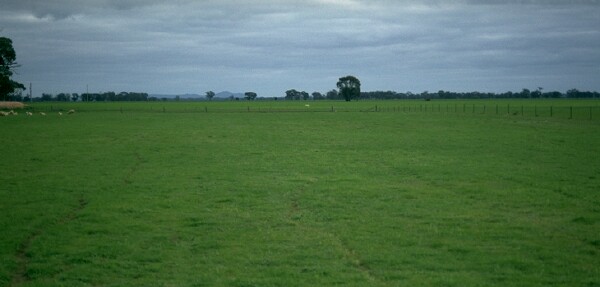
| General Landscape Description: Old alluvial plain with prior stream activity. Original vegetation included Grey Box (Eucalyptus microcarpa) and Buloke (Casuarina luehmannii). | |
 LP85 Landscape |
Soil Profile Morphology
Surface Soil
| A1 | 0-15 cm | Dark brown (7.5YR3/4); light fine sandy clay loam; weak to moderate medium blocky structure; strong consistence dry; pH 6.3; abrupt change to: | 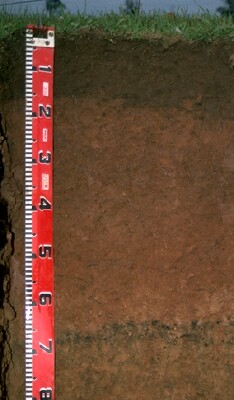 LP85 Profile |
| A2 | 15-25 cm | Yellowish red (5YR4/6); light fine sandy clay loam; structureless; firm to strong consistence dry; contains a few (2%) quartz (2-4 mm diameter); pH 7.1; clear change to: | |
| Subsoil | |||
| B21 | 25-45 cm | Yellowish red (5YR4/6); medium heavy clay; structured (with shiny faced peds); strong consistence dry; pH 8.1; gradual change to: | |
| B22 | 45-60 cm | Red (2.5YR4/8); medium heavy clay; strong consistence dry; pH 8.5; clear change to: | |
| B23 | 60-70 cm | Yellowish red (5YR5/6) with reddish yellow (7.5YR6/6) mottles; medium clay; weak consistence moist; contains many (25%) ferromanganiferous concretions (approximately 8 mm diameter); pH 8.9; clear change to: | |
| B31 | 70-90 cm | Strong brown (7.5YR5/6) and yellowish red (5YR5/8); medium clay; structured (with smooth faced peds); weak consistence moist; contains very few (2%) manganese concretions (<8 mm diameter) and few (5-10%) quartz gravels (2-4 mm diameter); pH 8.9; gradual change to: | |
| B32 | 90-120 cm | Yellowish brown (10YR5/4) with red (2.5YR4/8) mottles; medium clay; moderate fine polyhedral structure; very strong consistence dry; contains a common (10%) amount of quartz gravel (2-5 mm diameter); pH 8.9. | |
Key Profile Features
- Strong texture contrast between surface (A) horizons (<20% clay) and subsoil (B21) horizons (45% clay).
- Sodic subsoil.
Key Profile Characteristics
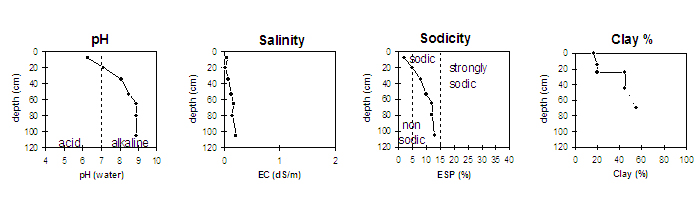
pH | Salinity Rating | |||
Surface (A1 horizon) | slightly acid | very low | non-sodic | none1 |
Subsoil (B21 horizon) | moderately alkaline | very low | sodic | moderate-strong |
Deeper subsoil (at 1 m) | strongly alkaline | very low - low | sodic | moderate-strong |
| 1 Moderate dispersion after remoulding. | ||||
 |
Horizon | Horizon Depth | pH (water) | pH CaCl2 | EC 1:5 | NaCl | Exchangeable Cations | |||
Ca | Mg | K | Na | ||||||
meq/100g | |||||||||
A1 | 0-15 | 6.3 | 5.3 | 0.05 | 6.1 | 1.3 | 0.6 | 0.1 | |
A2 | 15-25 | 7.1 | 5.9 | <0.05 | 3.5 | 1.9 | 0.6 | 0.3 | |
B21 | 25-45 | 8.1 | 6.7 | 0.08 | 6.4 | 5.9 | 1.2 | 1.1 | |
B22 | 45-60 | 8.5 | 7.1 | 0.12 | 6.4 | 6.7 | 1.3 | 1.5 | |
B23 | 60-70 | 8.9 | 7.8 | 0.17 | 6.7 | 8.6 | 1.6 | 2.2 | |
B31 | 70-90 | 8.9 | 7.8 | 0.15 | 7.8 | 12 | 2.2 | 2.8 | |
B32 | 90-120 | 8.9 | 7.5 | 0.21 | 6.8 | 10 | 2 | 2.7 | |
Horizon | Horizon Depth | Ex Al mg/kg | Ex Ac meq/100g | Field pF2.5 | Wilting Point pF4.2 | Coarse Sand (0.2-2.0mm) | Fine Sand (0.02-0.2mm) | Silt (0.002-0.02mm) | Clay (<0.002mm) |
A1 | 0-15 | 19.2 | 6.8 | 12 | 48 | 25 | 17 | ||
A2 | 15-25 | 15.5 | 6.6 | 8 | 42 | 26 | 20 | ||
B21 | 25-45 | 27.9 | 15.3 | 11 | 26 | 17 | 45 | ||
B22 | 45-60 | 28 | 15.4 | 12 | 26 | 16 | 45 | ||
B23 | 60-70 | ||||||||
B31 | 70-90 | ||||||||
B32 | 90-120 |
Management Considerations:
Whole Profile
- Soluble salt levels are low throughout the profile and will not affect cropping.
- Plant Available Water capacity (PAWC) is estimated to be medium (approximately 115 mm) for this site. This is based on available laboratory data and assumes an effective rooting depth of 90 cm.
Surface (A) Horizons
- The surface soil has a moderate overall nutrient status. The total nitrogen and organic carbon levels, however, are relatively low. Improving organic matter levels will assist in minimising structural problems such as surface sealing and hardsetting, as well as improving soil fertility and water holding capacity. Soils such as these with high fine sand (48%) and silt (25%) contents rely, to a large extent, on organic matter for soil aggregation.
- When dry, the soil becomes hard and may be difficult to work. If cultivated when dry it will become "powdery" and subsequent rain will result in surface sealing developing. The soil disperses moderately when remoulded which indicates that excessive cultivation or overstocking when the soil is wet may lead to surface crusting and exacerbate soil cloddiness as well as the hardsetting condition. Gypsum application may assist in reducing this structural deterioration. A bare cultivated soil is also likely to suffer structural damage from raindrop action. A cover of plants or stubble will provide some protection.
- The surface soil slakes when rapidly wet and is therefore prone to surface sealing. Improving organic matter levels will assist in improving soil aggregation and minimising slaking. Organic matter levels will improve by utilising practises such as minimum tillage, pasture rotation and stubble retention.
- The subsurface (A2) horizon disperses strongly in water (and disperses completely after remoulding). If excessively cultivated in a moist to wet condition it may develop into a plough pan.
Subsoil (B) Horizons
- The subsoil is sodic and disperses moderately to strongly in water. This is likely to result in water and root movement being restricted. Deep tillage together with gypsum application has been advocated as an ameliorative technique for some soils (Jayawardene and Chan, 1994). A test strip in the paddock could be used to assess any benefits from such a technique.
- The deeper subsoil (from 60 cm depth) is strongly alkaline which indicates that some nutrients (e.g. copper, iron, manganese, and zinc) may be poorly available to deeper rooted plants.
Comments from Landholder:
- Better cropping soil than Site LP84.
- Gypsum (1 tonne per acre) applied in 1988 and 1991. Crop yields improved significantly as a result.
- Lime (1 tonne per acre) applied in 1993.
- Agroplough used.
Notes
- Profile described by Mark Imhof, Paul Rampant and Karen De Plater (4/7/95)
