Victorian Resources Online (archived)
NTF1
| Location: Corack East | Aust. Soil Class.:Vertic (& Hypercalcic), Mesonatric, Red SODOSOL |
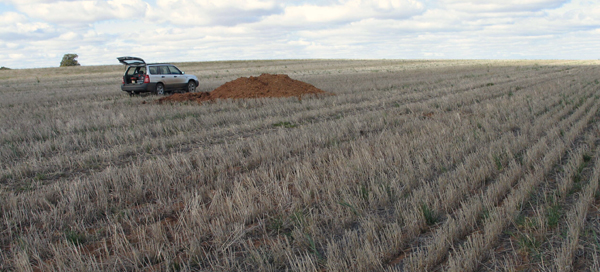
| General Landscape Description: Upper/mid slope of rise, possible lunette or unconsolidated ridge. | Site Description: Approximately 150m from home/road. |
| Geology: Neogene/Pleistocene | Aspect: 1% NW |
| Vegetation: Eucalyptus on ridge crest, Buloke | |
 NTF1 Landscape |
Soil Profile Morphology
Surface Soil
| A1 | 0-7 cm | Very dark greyish brown (7.5YR3/2); loamy sand; apedal; weak consistence (dry); non dispersive; pH 6.3; strong change to: | 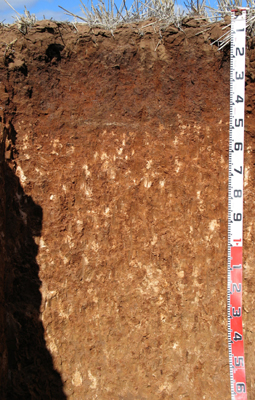 NTF1 Profile |
| A2 | 7-12 cm | Dark reddish brown (5YR3/2); sandy clay loam; massive; strong consistence (dry); fine macropores; pH 6.7; abrupt change to: | |
| Subsoil | |||
| B21 | 12-25 cm | Reddish brown (5YR4/3) with patches of yellow red (5YR4/6) mottles; medium clay; moderate coarse prismatic, parting to strong coarse-medium angular blocky structure; strong consistence (dry); slightly sub-plastic; medium sandy cutans; pH 8.3; clear change to: | |
| B22 | 25-50 cm | Yellowish red (5YR4/6); medium heavy clay; moderate coarse prismatic, parting to strong coarse-medium angular blocky structure; firm consistence (moist); cutans common; distinct clay roots follow structure; few slickensides; pH 8.7; clear change to: | |
| B23k | 50-85 cm | Yellowish red (5YR4/+); medium clay; moderate coarse-medium subangular blocky structure; weak consistence (moist); soft very coarse calcareous (20-60 mm) segregations common very few fine (<2 mm) manganiferous segregations and very few medium (2-6 mm) organic tubules; finer than above rootline infills; pH 8.9; gradual change to: | |
| B24k | 85-120 cm | Yellowish red (5YR5/6); light medium clay; weak very coarse prismatic, parting to moderate coarse-medium subangular blocky structure; firm consistence (moist); soft very coarse (20-60 mm) calcareous segregations common and very few hard medium (2-6 mm) calcareous segregations; pH 9.1; gradual change to: | |
| B25 | 120-170 cm | Brownish yellow (7.5YR6/6) with reddish yellow (5YR6/6) mottles; medium clay; weak coarse prismatic structure; firm consistence (moist); soft very coarse (20-60 mm) calcareous segregations common; pH 9.3: | |
| B3 | 170+ cm | Brownish yellow (7.5YR6/6) with reddish yellow (5YR6/6) mottles; medium clay; moderate coarse-medium subangular blocky structure. | |
Key Profile Features
|
Key Profile Characteristics
pH | Salinity Rating | |||
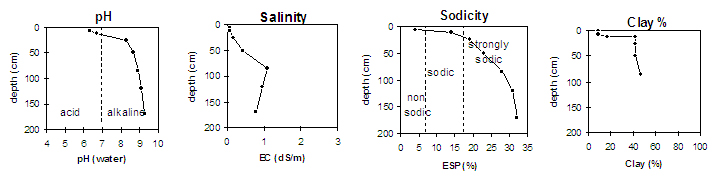
Surface (A1 horizon) | Slightly Acid | Very Low | Non-Sodic | None1 |
Subsoil (B21 horizon) | Moderately Alkaline | Very Low | Strongly Sodic | Strong-Complete |
Deeper subsoil (at 120-170 cm) | Very Strongly Alkaline | High | Very Strongly Sodic | Slight-Moderate2 |
- 1 slight dispersion after remoulding
2 due to high level of soluble salts
 |
Horizon | Horizon Depth | pH (water) | pH CaCl2 | EC 1:5 | NaCl | Exchangeable Cations | |||
Ca | Mg | K | Na | ||||||
meq/100g | |||||||||
A1 | 0-7 | 6.3 | 5.6 | 0.06 | 2.8 | 1.0 | 0.56 | 0.19 | |
A2 | 7-12 | 6.7 | 5.5 | 0.08 | 3.7 | 2.4 | 0.24 | 0.99 | |
B11 | 12-25 | 8.3 | 7.2 | 0.17 | 8.9 | 8.8 | 0.46 | 4.2 | |
B22 | 25-50 | 8.7 | 7.9 | 0.43 | 0.04 | 9.5 | 12 | 0.7 | 6.5 |
B23k | 50-85 | 8.9 | 8.3 | 1.1 | 0.16 | 8.5 | 15 | 1.1 | 9.5 |
B24k | 85-120 | 9.1 | 8.4 | 0.95 | 0.13 | 6.5 | 13 | 1.0 | 8.9 |
B25 | 120-170 | 9.3 | 8.4 | 0.79 | 0.09 | 6.4 | 12 | 1.2 | 9.2 |
Horizon | Horizon Depth | Boron mg/kg | Field pF2.5 | Wilting Point pF4.2 | Coarse Sand (0.2-2.0mm) | Fine Sand (0.02-0.2mm) | Silt (0.002-0.02mm) | Clay (<0.002mm) |
A1 | 0-7 | 0.7 | 8.6 | 3.2 | 49 | 37 | 4 | 9 |
A2 | 7-12 | 1.1 | 11.9 | 5.3 | 43 | 36 | 4 | 17 |
B11 | 12-25 | 4.3 | 33.6 | 16.3 | 30 | 22 | 5 | 42 |
B22 | 25-50 | 9.1 | 38.6 | 18.9 | 27 | 20 | 10 | 42 |
B23k | 50-85 | 16 | 43.4 | 22.2 | 19 | 16 | 8 | 47 |
B24k | 85-120 | |||||||
B25 | 120-170 |
Management Considerations:
Whole Profile
- Management strategies for all soils should aim to increase organic matter levels in the surface soil; minimise the degradation of soil aggregates and porosity; promote the development of stable biopores; improve the calcium status of the cation exchange complex (particularly when sodium is a significant part), and break up any hardpans. Less frequent tillage; using less aggressive implements, and working the soil at optimum moisture content can all assist in maintaining soil aggregation and porosity as well as reducing the breakdown of organic matter.
Surface (A) Horizons
- Surface soil pH levels are in the slightly acid to neutral range – favourable for plant growth and presenting few chemical limitations.
- The hardsetting surface soil is non-sodic but disperses slightly after remoulding. This indicates that some structure degradation (e.g. surface sealing, increased cloddiness) may occur if the soil is cultivated or over stocked in a moist to wet condition. Management practices such as minimum tillage, stubble retention and pasture rotations can be used to improve organic matter levels. Gypsum may be a suitable ameliorant, but a gypsum requirement test should be carried out on a bulked sample (taken from across the paddock) to assess the required levels of gypsum.
- The subsurface (A12) horizon is sodic and disperses strongly after remoulding. Distribution to this horizon by cultivating when moist to wet could cause structural degradation (e.g. plough pans development). Gypsum incorporated into this horizon (and the upper subsoil) will assist in ameliorating this sodic condition.
Subsoil (B) Horizon
- The upper subsoil is strongly sodic and dispersive. This indicates that root and water movement into the subsoil will be restricted and as a result waterlogging is likely to occur after heavy rains.
- The level of soluble salts become high in the deeper subsoil (from 50 cm depth) and is likely to restrict the growth of deeper-rooted salt-sensitive species.
- Boron toxicity can occur in strongly alkaline soils. The boron levels measured in the deeper very strongly alkaline subsoil (i.e. from 50 cm depth) are reasonably high at this site and may affect boron-sensitive species (including cereals, pulses, pasture legumes). Concentrations as low as 10 ppm, for example, can reduce lentil yield. Limited data estimates that the threshold for level of soluble born for cereals is 55 mg/kg (Cartwright et al. 1984). Other work at DPI Horsham, indicates that without the presence of significant levels of soluble salts, the boron tolerance can be comparatively high, with little reduction in wheat yields of up to 45 ppm (Quinlan 2001). At this site however, soluble salt levels are high in the deeper subsoil.
- A fair amount of biological activity was noted in the subsoil (particularly ants) – indicating adequate soil conditions for biological activity.
Notes
- Profile described by Mark Imhof and David Rees, April 2005.
