Victorian Resources Online (archived)
GP59
| Location: Richardson Hill | Aust. Soil Class.: Endoacidic-Mottled, Epipedal, Black VERTOSOL |
| General Landscape Description: Footslope (5% slope) of low hill | Geology: Quarternary sediments overlying tertiary basalt. |
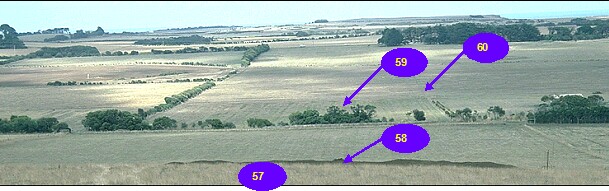
GP57-GP60 Landscape
Soil Profile Morphology:
Surface Soil
| A1 | 0-10 cm | Dark brown (10YR3/3); light clay; moderate coarse polyhedral parting to medium structure; strong consistence dry; subplastic; pH 6.1: | 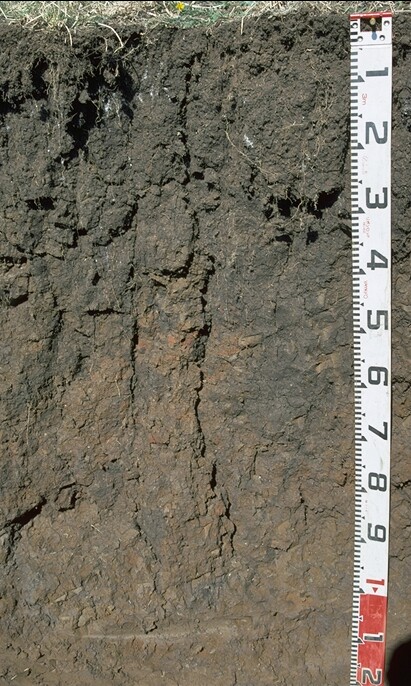 GP59 Profile |
| Subsoil | |||
| B21 | 10-40 cm | Very dark greyish brown (10YR3/2); medium heavy clay; moderate coarse prismatic, parting to moderate coarse blocky structure; very strong consistence dry; dark staining on prism faces; slickensides from 30 cm depth; pH 6.0: | |
| B22 | 40-90 cm | Very dark greyish brown (10YR3/2) with faint yellowish brown (10YR5/6) mottles; medium heavy clay; moderate coarse prismatic, parting to coarse blocky structure; strong consistence dry; dark staining on prism faces; strong slickenside development; pH 5.1: | |
| B23 | 90+ cm | Greyish brown (10YR5/2) with yellowish brown (10YR5/6) and red (2.5YR5/8) mottles; heavy clay; strong consistence moist; pH 4.8. | |
Key Profile Features:
- High fertility throughout the profile.
- Vertic properties present within the subsoil i.e. slickensides.
pH | Salinity Rating | |||
Surface (A1 horizon) | Slightly Acid | Moderate | Non-Sodic | None1 |
Subsoil (B21 horizon) | Moderately Acid | Very Low | Non-Sodic | None2 |
Deeper subsoil (at 90 cm) | Very Strongly Acid | Moderate | Sodic | Strong |
2strong dispersion after remoulding
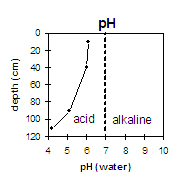 The surface horizon is slightly acid. The subsoil is moderately acid becoming very strongly acid at 90 cm. | 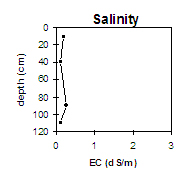 The salinity rating is low to moderate in the surface. The subsoil is very low becoming moderate at 90 cm. | 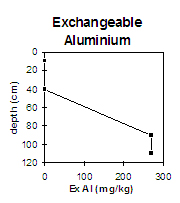 The exchangeable aluminium levels are low in the surface becoming very high in the subsoil. | 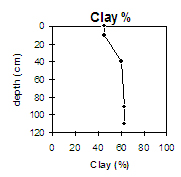 The clay content increases markedly at the A/B boundary. |
Horizon | Horizon Depth | pH (water) | pH CaCl2 | EC 1:5 | NaCl | Exchangeable Cations | |||
Ca | Mg | K | Na | ||||||
Meq/100g | |||||||||
A1 | 0-10 | 6.1 | 5.4 | 0.2 | 10 | 11 | 1.6 | 1.6 | |
B21 | 10-40 | 6 | 5 | 0.12 | 9.6 | 16 | 1.5 | 2.1 | |
B22 | 40-90 | 5.1 | 4.2 | 0.27 | <0.03 | 5.1 | 17 | 0.3 | 3.7 |
B23 | 90+ | 4.2 | 0.72 | 0.11 | 3.7 | 20 | 0.2 | 6 | |
Horizon | Horizon Depth | Ex Al mg/kg | Ex Ac meq/100g | Wilting Point pF4.2 g/100g | Coarse Sand (0.2-2.0mm) % | Fine Sand (0.02-0.2mm) % | Silt (0.002-0.02mm) % | Clay (<0.002mm) % |
A1 | 0-10 | <10 | 18 | 27.6 | 2 | 16 | 24 | 45 |
B21 | 10-40 | <10 | 16 | 30.6 | 2 | 11 | 17 | 60 |
B22 | 40-90 | 270 | 20 | 34.7 | 1 | 12 | 16 | 63 |
B23 | 90+ | 270 | 19 | 34.1 | 1 | 12 | 18 | 63 |
Management Considerations:
Whole Profile
- The high to very high inherent fertility of this soil makes it very beneficial to root development and plant growth.
- The surface (A1) horizon is non-sodic but has a low exchangeable calcium to magnesium ratio (0.9) and disperses slightly after remoulding. This indicates that tillage or over-stocking of the soil whilst in a moist to wet condition may result in structural degradation (e.g. surface sealing, increased cloddiness) occurring. Raindrop action on bare soil may have a similar effect, so it is important to maintain surface cover. Gypsum application may assist in improving surface soil structural condition on such soils.
- The level of soluble salts in the surface is low to moderate and may restrict the growth of salt sensitive species (e.g. faba beans, linseed, chick peas and lupins).
- Organic matter and nitrogen levels are high throughout the surface soil which is beneficial to plant growth.
- The high wilting point value (i.e. 28%) indicates that plants will be unable to utilise light rains when the soil is relatively dry.
- The upper subsoil (B21) has vertic properties i.e. slickensides which indicates that significant shrinking and swelling occurs during wetting-drying cycles. This can disrupt the roots of perennial plants and will have implications for engineering applications (e.g. building foundations and fence lines).
- The subsoil below the B21 horizon is sodic with a low exchangeable calcium to magnesium ratio (0.3), strong dispersion and an exchangeable aluminium content of 270 mg/kg. Root development will be considerably effected by these factors.
- The presence of mottling within the subsoil (B22) horizon indicates that some waterlogging may occur.
- At 90 cm the subsoil becomes very strongly acid, with moderate salinity and high exchangeable sodium and magnesium levels but these factors would only effect very deep rooted species.
