Victorian Resources Online (archived)
GP79
| Location: Athlone | Aust. Soil Class.: Acidic, Mesotrophic, Brown DERMOSOL (moderate soil depth) |
| General Landscape Description: Rolling hills. | Site Description: Lower slope (West), rolling low hills. |
| Geology: Cretaceous sandstone. | |
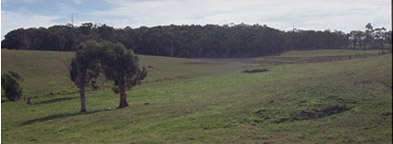
GP79 Landscape
Soil Profile Morphology:
Surface Soil
| A1 | 0-15 cm | Dark brown (7.5YR 3/2); very fine sandy clay loam; moderate coarse polyhedral parting to moderate medium polyhedral structure; very firm consistence (dry); pH 4.7; clear change to: | 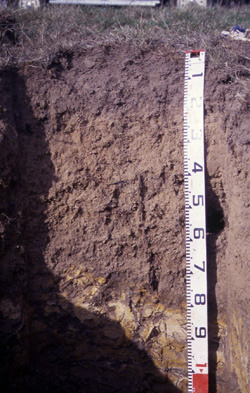 GP79 Profile |
| A2 | 15-22 cm | Brown (7.4YR 4/2) conspicuously bleached (10YR 6/3 dry); very fine sandy clay loam; moderate coarse blocky parting to moderate medium blocky structure; very firm consistence (dry); pH 4.6; clear change to: | |
| Subsoil | |||
| B21 | 22-40 cm | Dark yellowish brown (10YR 4/4) conspicuously bleached (10YR 6/3); light clay; moderate coarse prismatic parting to moderate coarse blocky parting to moderate medium blocky structure; strong consistence (dry); pH 4.7; clear change to: | |
| B22 | 40-70 cm | Dark yellowish brown (10YR 4/4); light clay; moderate coarse blocky parting to strong medium block structure; strong consistence (dry) pH 4.6; abrupt change to: | |
| C | 70+ cm | Mottled rock. | |
Key Profile Features:
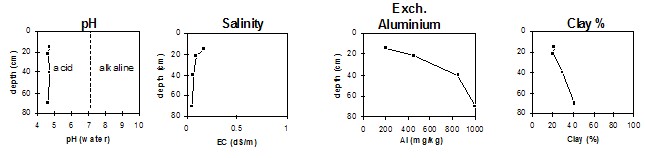
- Gradual increase in clay content with depth down the profile and medium soil profile depth.
pH | Salinity Rating | |||
Surface (A1 horizon) | Very Strongly Acid | Very Low | Non-Sodic | None |
Subsoil (B21 horizon) | Very Strongly Acid | Very Low | Non-Sodic | None |
Deeper Subsoil (at 1 m) | Very Strongly Acid | Very Low | Non-Sodic | None |
Horizon | Horizon Depth | pH (water) | pH CaCl2 | EC 1:5 | NaCl | Exchangeable Cations | |||
Ca | Mg | K | Na | ||||||
Meq/100g | |||||||||
A1 | 0-15 | 4.7 | 4.2 | 0.17 | 6.1 | 2.2 | 0.57 | 0.21 | |
A2 | 15-22 | 4.6 | 4.0 | 0.09 | 3.9 | 2.2 | 0.50 | 0.16 | |
B21 | 22-40 | 4.7 | 4.0 | 0.06 | 1.7 | 1.4 | 0.44 | 0.14 | |
B22 | 40-70 | 4.6 | 3.9 | 0.05 | 1.4 | 1.8 | 0.49 | 0.14 | |
Horizon | Horizon Depth | Ex Al mg/kg | Ex Ac meq/100g | Field pF 2.5 | Wilting Point pF4.2 g/100g | Coarse Sand (0.2-2.0mm) % | Fine Sand (0.02-0.2mm) % | Silt (0.002-0.02mm) % | Clay (<0.002mm) % |
A1 | 0-15 | 200 | 24 | 39.9 | 16.7 | 2.8 | 34.1 | 29.0 | 21.5 |
A2 | 15-22 | 450 | 26 | 40.2 | 14.9 | 3.0 | 35.6 | 34.0 | 20.5 |
B21 | 22-40 | 850 | 24 | 36.4 | 15.5 | 0.6 | 32.8 | 32.0 | 30.0 |
B22 | 40-70 | >1000 | 24 | 37.5 | 15.0 | 0.2 | 28.4 | 28.0 | 41.5 |
Whole Profile
- High levels of exchangeable aluminium (increasing to very high levels in deeper subsoil) which will restrict the growth of aluminium sensitive species. High levels of aluminium will also test to "fix” phosphorus and make it less available to plants (and therefore reduce the effectiveness of applied phosphorus fertiliser). Raising the pH levels of the soil by liming will help reduce the level of exchangeable aluminium. A lime test (samples across the whole paddock) may be appropriate to determine the amount of lime needed to raise pH. Other factors need to be considered however before lime is recommended (e.g. species growth, method of application, long trial response, likely cost benefit).
