Victorian Resources Online (archived)
4.2.2.1 What is the right system capacity and can it supply enough water in hot weather?
Return to Main Menu | Return to Step 4 | Return to Step 4.2.2 | Next Step
| System capacity is the most important design parameter for centre pivots. In the past many systems were under-designed to minimise capital investment and the systems were not able to match peak crop water requirements. This has been the single main reason for centre pivot failure. System capacity should be large enough to cater for peak crop evapotranspiration rates while allowing for realistic application efficiency and system operating times So what is system capacity? The system capacity is the rate at which water can be pumped onto the irrigated area, normally expressed in mm/d – typically between 8 and 20 mm/d. Note: This is not the peak crop water requirement, or the evaporation rate, or the amount that is applied in an irrigation - these will be discussed below. It is the design criterion that the pump, pipes and sprinkler capacities are based on. For example, a system capacity of 12 mm/d means the machine cannot apply more than 12 mm in 24 hours EVER. The machine might be able to apply 24 mm in a pass, but this would take 48 hours to cover the entire irrigated area. System capacity can be calculated as follows: 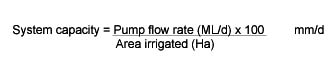 |
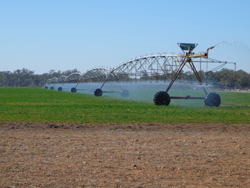 It looks good, but can it supply enough water? |
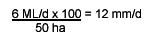
If the system capacity is too low (i.e. the system is ‘under-designed’, probably to minimise cost), the system may not be able to supply enough water over a hot spell. A relatively high system capacity ensures that the irrigation requirements can be met comfortably, even under extreme climatic conditions. However, the investment costs would be higher (larger pipes, pumps and/or pressure). Also, a higher capacity machine can aggravate high average application rate problems at the outer end of the pivot (see “Average application rate” in Step 4.2.2.3).
- Application depth (the amount applied) - The depth of water actually applied in an irrigation cycle depends on the system capacity of the pivot and the speed the machine is set to rotate at.
- E.g , A pivot with a system capacity of 12 mm/d set to complete a full circle in two days will apply 24 mm. If it is set to complete the full circle in 24 hours, it applies 12 mm (ignoring evaporative losses, or application efficiency)
- Application efficiency (AE) – The proportion of the applied water that reaches the crop root zone; assume 95% for a modern, well-designed machine. Older machines with knocker-type sprinklers on top of the span-pipe, or sprinklers with excessively small droplets can have significant evaporation losses, resulting in lower application efficiency.
- Pumping utilisation ratio (PUR) – The proportion of time that the machine needs to operate to meet the peak irrigation requirement. Operating 24 hours per day 7 days per week is not realistic. A maximum PUR of 8.5 days in 10 is recommended (PUR = 0.85). This does not mean that the machine operates for 8.5 days continuously – operating for 20.4 hours in 24 hours, or 6 days in 7 is a PUR of 0.85. When the crop water use is less than the peak requirement (most of the time), the machine does not need to operate for as long. The water supply availability also needs to be considered here – can the water supply authority supply water to meet these requirements?
- A lower PUR may be attractive if operating primarily on off-peak electricity (88 hours per week of 168 hrs) is planned, or a more conservative operating regime is desired. A conservative PUR requires a higher system capacity (and capital cost) but gives more flexibility to manage extreme events and down-time.
- Peak irrigation requirement – This parameter is crop dependent. For perennial pasture at Tatura, 3-day evapotranspiration events of 9 mm/d or greater occur on average once every two years. This could be considered as the basis for a reasonably conservative design for the location. In higher irrigation demand years such as during 1994/95, three or four such events can occur.
The Managed System Capacity is the effective system capacity needed to match peak irrigation requirements, given an assumed application efficiency (AE) and pumping utilisation ratio (PUR):
Managed System Capacity = System Capacity x PUR x AE
- E.g. With a system capacity of 14 mm/d, 95% application efficiency and irrigation 2 days in 3 (or 16 hours in 24 - a PUR of 0.66), the managed system capacity is:
Managed System Capacity = 14 mm/d x 0.66 x 0.95
- = 8.8 mm/d
For perennial pasture or lucerne around Tatura, a minimum system capacity of 12 mm/d is suggested. For a Managed System Capacity of 9 mm/d to be achieved (matching the peak irrigation requirement) with a system capacity of 12 mm/d, a PUR of 0.8 would be required, which is close to the maximum value of 0.85 suggested above.
I.e. Managed system capacity = 12 mm/d x 0.8 x 0.95 = 9.1 (say 9) mm/d. A higher system capacity, as in the above example, may be preferable, but at greater cost.
For more information, see the DPI Agnote “Centre Pivot System Capacity”.
Reference
Foley, J. (2005) "Centre Pivot and Lateral Move Machines" in Cotton Catchment Communities Cooperative Research Centre, Section 4.6 (external link).
