Victorian Resources Online (archived)
Victorian State Soil Contender - Aeric Podosol

Back to: Contenders for State Soil
Why should the Aeric Podosol be Victoria’s State Soil?
- Melbourne's "sand belt", which includes the south-eastern suburbs of Caulfield, Oakleigh, Brighton and Black Rock, provided the early city with most of its vegetables and building sand. As Melbourne developed, sand was also needed for its gardens and recreational facilities such as bowling greens, golf courses, tennis courts and other sporting venues thus enhancing Melbourne's reputation as the Garden City. So if you have been trapped in a bunker at a golf course then you may have been in a Podosol. The major soils of the "sand belt" are Podosols and in recognition of their importance to the development of Melbourne, their nomination as a State Soil of Victoria is justified.
- Podosols fall into two main groups - Aeric Podosols, which are freely drained, and Aquic Podosols which are saturated in the subsoil for prolonged periods. Although Podosols are poor chemically, the main attraction of Aeric Podosols for horticulture is that they can be cultivated throughout the year. Now that the "sand belt" is mostly urbanised, the Aeric Podosols around Cranbourne, Lang Lang and parts of the Nepean Peninsula are used for high value horticultural crops, with carrots, celery and lettuces being the most important.
- Aeric Podosols are widespread on the sand deposits in the mid to high rainfall areas of the State, generally where annual rainfall exceeds 600 mm. Extensive areas of Aeric Podosols are also found on French Island, West Gippsland south of Wonthaggi, south-east of Venus Bay, Wilson's Promontory and around Longford. In south-western Victoria, large areas occur near the South Australian border.
- Significant remnants of original vegetation remain on the Podosols, mainly heathlands and heathy woodlands, with much under protection from clearing. These vegetation communities support a biologically diverse ecosystem and allow bird and animal species dependent on heathland communities to survive. A plant species that thrives in these infertile soils is Victoria's floral emblem Pink Heath (Epacris impressa). Examples of the original vegetation vegetation can be found in the Cranbourne Royal Botanic Gardens reserve, French Island, Wilson's Promontory, Providence Ponds and Lower Glenelg National Park.
- Podosols only occupy a small proportion of the State.
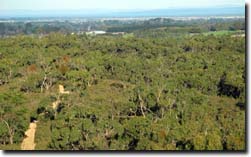 Podosols are the dominant soil in the Cranbourne Botanic Gardens and support heathland communities. Elsewhere in the region they have largely been cleared of natural vegetation and support land uses such as horticulture. | 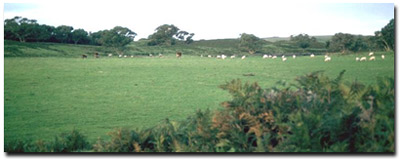 Aeric Podosols are often associated with windblown sand dunes. |
Key features of the Aeric Podosol
- These soils are uniform texture soils which are sandy throughout the soil profile. The surface soil, which is sand or loamy sand, is usually dark in colour because of organic matter. Below the surface soil is conspicuously bleached subsurface sand. Beneath the bleached sand is variably cemented subsoil (B horizon) which is due to the accumulation of compounds of organic matter and aluminium with or without iron. This material is commonly referred to as "coffee rock".
- Aeric Podosols are well drained, strongly leached, strongly acidic and inherently infertile (often with trace element deficiencies) soils. These chemical restrictions can be minimised by the addition of fertilisers and lime (i.e. to increase pH). Water holding capacity is very low and frequent irrigation is required for cropping. Regular applications of organic matter, including green manure crops and chicken manure, helps to improve fertility and water holding capacity of the surface soils. Their major advantage is that they can be cultivated throughout the year and support continual cropping.
| This example of an Aeric Podosol occurs near Wonthaggi. It is formed on sand dunes deposited during a period of cold, drier and windier conditions that prevailed during a previous ice age. The sand most likely originated from coastal dunes, and the calcium carbonate from any shells that were originally present has been leached out - leaving residual quartzose or siliceous sand. During the development of this soil profile, organic matter has accumulated in the surface soil (A1) and compounds of organic matter with aluminium and iron have been leached out of the bleached subsurface (A2) and accumulated in the deeper subsoil (Bhs). The brownish yellow deep sand subsoil (C) contains aluminium and iron oxides and hydroxides which have not reacted with organic matter. |  Aeric Podosol in West Gippsland. | ||
| Surface Soil | |||
| A1 | 0-30 cm | Dark grey (10YR4/1); loamy sand; loose surface condition; structureless; pH 5.5; clear change to: | |
| A2 | 30-75 cm | Light grey (10YR7/2); sand; structureless; pH 5.7; clear and wavy change to: | |
| Subsoil | |||
| Bhs | 75-140 cm | Strong brown (7.5YR5/8) and dark reddish brown (5YR3/3); sand with tongues of variably cemented "coffee rock"; structureless; firm to strong consistence dry; pH 5.6; diffuse change to: | |
| C | 140+ cm | Brownish yellow (10YR6/6); sand; structureless; pH 5.5. | |
Other examples of Podosols on the Victorian Resources Online Website
Aquic Podosol in the Bald Hills Reserve near Wonthaggi in West Gippsland
Semiaquic Podosol near Cranbourne in the Port Phillip and Westernport region
