Victorian Resources Online (archived)
Archived content — This page contains material from the Victorian Resources Online (VRO) website. It is no longer maintained and is provided for reference only. This content is hosted by CeRDI and is not endorsed by Agriculture Victoria.
Sitemap
Victorian State Soil Contender - Brown Dermosol
- The Surface of a Soul

Back to: Contenders for State Soil
Why should the Brown Dermosol be Victoria’s State Soil?
Poem: 'The Surface of a Soul'
- These soils are common in hilly to mountainous country in southern Victoria (particularly in the Otway and Strzelecki ranges) and the Eastern highlands. In the Otways and Strzelecki ranges, they support dairy and some potato cropping.
- The Giant Gippsland Earthworm can be found living in Brown Dermosols in the Strzelecki ranges.
- Brown Dermosols are widespread soils in the higher rainfall mountainous areas of eastern and northeastern Victoria - so it would be fair to say that a significant amount of the State's water resource is initially filtered by these soils.
Any reasons why this soil should not be Victoria’s State Soil?
- Brown Dermosols are not as widespread as soils such as Sodosols.
Key features of the Brown Dermosol
- Brown Dermosols are not texture contrast soils (such as Sodosols, Chromosols and Kurosols). They are characterised by a gradual (or negligible) change in texture (i.e. clay content) with depth down the soil profile. The subsoils of Dermosols display structural development and the main colour is brown. Brown Dermosols are usually strongly acid where they occur in higher rainfall areas of Victoria (e.g. Strzelecki and Otway ranges and eastern highlands).
| 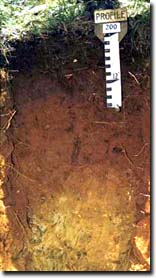
Brown Dermosol typical of mountainous areas in the eastern highlands of Victoria. |
Typical soil profile
This profile is of a Brown Dermosol formed on Cretaceous hills in the Strzelecki ranges. | 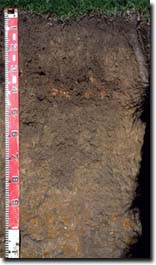
Brown Dermosol in the Strzelecki ranges. |
| Surface Soil | |
| A11 | 0-15 cm | Dark greyish brown; silty clay loam; very strongly acid (pH 4.8) |
| A12 | 15-35 cm | Brown; silty clay loam |
| Subsoil | |
| B21 | 35-60 cm | Yellowish brown; light clay; moderate polyhedral structure; very strongly acid (pH 4.7) |
| B22 | 60-80 cm | Pale brown; light medium clay; moderate polyhedral structure |
| B23 | 80-100 cm | Pale brown; medium clay; very strongly acid (pH 4.7) |
| C | 100 cm+ | Weathered sedimentary rock |
