Victorian Resources Online (archived)
Victorian State Soil Contender - Hypercalcic Calcarosol

Back to: Contenders for State Soil
Why should the Hypercalcic Calcarosol be Victoria’s State Soil?
- Calcarosols are a common soil in Victoria’s semi-arid zone in the north-west of the State. They are widespread in the Mallee region – and support the typical ‘mallee’ eucalypts that provided the name for this region. These soils also occur in the northern parts of the Wimmera region.
- In the first half of the 1900s, the Victorian Government allocated land in the north-west of the state for soldier settlement schemes after World War 1 and 2. The Government cleared huge areas of mallee vegetation in the north-west of the state for soldier and closer settlement schemes. Behind the idea of these government settlement schemes was the belief in the virtue and wealth of tilling the soil. Many soldier and closer settlers toiled to make a productive living and Calcarosols were used for grazing and cereal cropping.
- Calcarosols are productive soils when managed carefully and are extensively used for dryland cropping (cereals and pulses) as well as for viticulture and horticulture where irrigated (e.g. from Mildura to Swan Hill).
- Calcarosols are much more widespread in South Australia and are likely to be chosen as the SA State Soil.
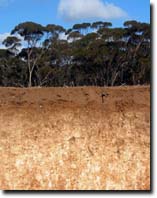 Calcarosols typically support 'mallee' vegetation communities. | 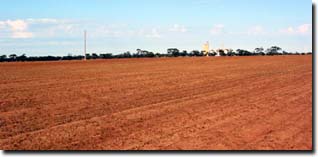 Typical Mallee landscape with Calcarosol soils |
Key features of the Brown Chromosol
- Calcarosols have formed on calcareous aeolian sediments of variable texture. These soils generally have a small, gradual increase in clay content with depth. Calcium carbonate (lime) is abundant in the subsoils, either in soft form, in nodules or sometimes as blocks, and it may extend to the surface of medium to heavy textured soils. These soils are highly alkaline and sodicity and salinity levels are usually high in the heavier subsoils. In many areas, boron toxicity to certain plants can be associated with these strongly alkaline soils. Hypercalcic Calcarosols are characterised by having large amounts (i.e. more than 20%) of mainly soft lime as well as hard fragments in the soil profile. Further information on Calcarosols in the Mallee region can be found elsewhere on this website.
| This example Hypercalcic Calcarosol occurs near Birchip | 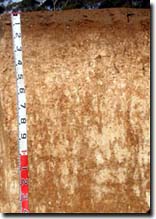 Calcarosol near Birchip | ||
| Surface Soil | |||
| A1 | 0-10 cm | Dark brown; sandy clay loam; highly calcareous; moderately alkaline pH (pH 8.5) | |
| Subsoil | |||
| B21 | 10-15 cm | Brown; light clay; highly calcareous; moderately alkaline pH (pH 8.6) | |
| B22k | 15-40 cm | Reddish yellow; light medium clay; very many (> 50%) fine-earth carbonates (lime) and calcareous nodules; very strongly alkaline pH 9.4. | |
| B23k | 40-80 cm | Reddish yellow and yellowish red; light medium clay; very many (> 50%) fine-earth carbonates (lime); extremely alkaline pH (pH 10.1) | |
| B24 | 80-130 cm | Yellowish red and reddish yellow; medium clay (sandy); very many (>50%) fine earth carbonates; extremely alkaline (pH 10.0). | |
| B25 | 130+ cm | Reddish yellow with few light pinkish brownand light greymottles; medium clay (sandy); manganese flecks; moderately calcareous; extremely alkaline (pH 10.1). | |
Other examples of Hypercalcic Calcarosols on the VRO website:
Hypercalcic Calcarosol near Berriwillock in the Mallee region
Hypercalcic Calcarosol near Walpeup in the Mallee region
