Victorian Resources Online (archived)
Victorian State Soil Contender - Organosol

Back to: Contenders for State Soil
Why should an Organosol be Victoria's State Soil?
- Organosols differ from all other soils in that they are dominated by organic materials and their occurrence is determined by site wetness and the resulting plant communities that develop in a given climatic environment. They are soils, therefore, for which the concept of soil parent material is not as relevant in the usual sense of determining the kind of soil that forms in a particular climate and landscape. Organosols in the alpine areas support a rich diversity of 'bog' plants and organisms.
- Because Organosols are formed by the progressive accumulation of plant material over time, they often contain evidence of changes in vegetation types in response to changing environmental conditions. They can therefore be a very valuable resource in environmental studies.
- These soils are quite rare in Victoria - occurring mainly in wet drainage depressions (bogs) in some alpine and sub-alpine areas, as well as in some former swamps. The most extensive distribution of Organosols in Australia occurs in south-west Tasmania - so Tasmania would have greater claims to having an Organosol as their State Soil.
 Organosol from the Wellington Plains in Eastern Victoria | 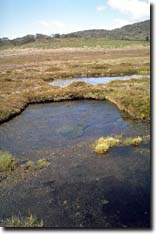 Bog community on the Victorian high plains. |
Key features of Organosols
Organosols are soils that are dominated by organic materials (i.e. plant-derived accumulations). Some of these soils have long been known as peats. These soils are usually very dark brown to black in colour. Ages of up to 12 000 years have been measured for these soils, but 3 000 to 4 500 years are more common in Victorian Organosols. These ages are relatively young compared to many Australian soils.
The saturated conditions that sustain these soils are often regarded as inimical for development and they have been extensively drained. Drainage causes the rate of humification to increase and the volume of soil shrinks. The resultant soil is probably still an Organosol in terms of its high organic matter content - but it will be more compact, have different water-holding capacity and the processes that lead to its development will have ceased.
| Typical soil profile This example of an Organosol occurs in the Hamilton area. It formed within an old swamp that has since been drained and used for pasture.
| 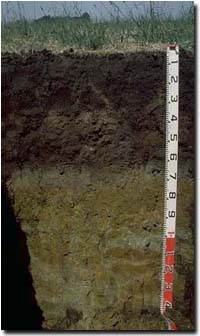 Organosol developed on former swamp near Hamilton | |||||||||||||||||||||
