Victorian Resources Online (archived)
Soil erosion: mechanics
Water erosion | Wind erosion | Risk management
Back to Soil erosion
Physics of soil erosion
- Erosion results when the power of water or wind applied exceeds the ability of the land to dissipate and absorb it
- Erosion is related more to the rate of application of energy (ie power) than the total energy applied
- Power is applied by raindrop action, surface flows of water, or wind shear
- Dissipation is provided by vegetative cover, mulch and other durable materials at the soil surface
- Resistance is the ability of soil to absorb applied power without disruption or removal
Erosive power is the capacity of an event (i.e. wind or rain storm) to cause erosion.
The contributing factors are:
- Rain fall duration, drop size, and intensity
- Generation of runoff
- Velocity of runoff
- Wind velocity
- Wind turbulence
This diagram illustrates the four options for soil erosion control
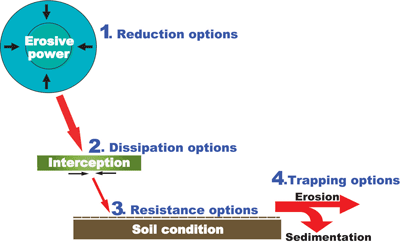
1. Reduction in power
Direct reduction of the power produced by natural events is not a practical option.
However it is practical to reduce the focus of such power by avoiding the funnelling of wind, or preventing the accumulation and concentration of surface water flows.
The power of surface flows of water during a rainstorm can produce much erosion. It is important to decrease the volume of water that flows overland during a rainstorm (hence decreasing velocity of runoff) by maximising the infiltration of rain and secondary runoff into soil.
2. Dissipation of power (cover)
Any durable material which intercepts an erosive force will dissipate the power and convert it to movement or heat.
The interception by trees, pastures, stubble, mulch, and even surface stone can do this.
Dissipation is usually the first principle of soil conservation - maintain surface cover.
3. Resistance (erodibility)
- Soil resistance is a measure of the capacity of the soil to absorb applied power without disruption or removal. Resistance will be determined by:
- Detachability
- Particle size
- Particle density
- Permeability
- Different soils have different inherent resistance, but resistance can be significantly increased by building soil strength through the incorporation of organic matter
If erosion does occur then rapid sedimentation of the eroded soil by trapping is desirable.
Trapping can be by:
- Sediment trap structures
- Vegetative strips
- Filter fences
- Runoff dispersal
Soil erosion is a significant component of land degradation. Further information on land degradation is available, including a detailed explanation of soil erosion, soil degradation and ecosystem decline.
