Victorian Resources Online (archived)
Key to blown-grass species (Lachnagrostis spp.)
The following dichotomous key can be used as a guide to identifying a particular blown-grass species. The key works by selecting one of the two choices given for each pair of descriptions, which lead to either another pair or the identification of your species.
| 1. | Leaves flat when fresh | 2 |
| 1. | Leaves inrolled or closely folded | 4 |
| 2. | Outer glumes of spikelets with a long awn-like bristle, flower-heads somewhat narrow and stiff with lower branches strongly deflexed (pointing backwards) | Lachnagrostis deflexa (Deflexed Blown-grass)# |
| 2. | Outer glumes finely pointed but without a bristle | 3 |
| 3. | Leaves less than 3 mm wide, flower-heads drooping or weeping | Lachnagrostis filiformis (Common Blown-grass) |
| 3. | Leaves greater than 3 mm wide, flower-heads more or less stiff and erect | Lachnagrostis billardierei (Coast Blown-grass) |
| 4. | Florets awnless or with non-bent or gently bent awns to 5 mm long or less | 5 |
| 4. | Florets with sharply bent awns, usually at least 5 mm long | 7 |
| 5. | Florets more or less awnless, floret hairy | Lachnagrostis leviseta (Awnless Blown-grass) |
| 5. | Florets with awns at least 1.5 mm long, floret hairless or sometimes with a few short hairs on the mid-back | 6 |
| 6. | Straight or slightly curved awn to 3 mm, arising from near floret tip; | Lachnagrostis adamsonii (Adamson’s Blown-grass |
| 6. | Straight or gently bent awn 3-5 mm long, arising from near mid-back of floret | Lachnagrostis sp.## |
| 7. | Upper part of florets with a rough surface | Lachnagrostis robusta (Salt Blown-grass) |
| 7. | Upper part of florets smooth | 8 |
| 8. | Lower parts of florets covered in hairs | Lachnagrostis punicea ssp. punicea (Purple Blown-grass) |
| 8. | Lower parts of florets hairless |
## This species has yet to be formally described. It has been found on the edges and beds of a few fresh-water Western Victorian Region lakes but appears tolerant of some salinity. Generally found in association with Common Blown-grass and generally treated as such.
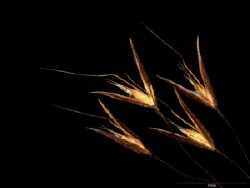 Purple Blown-grass (L. punicea ssp. punicea) | 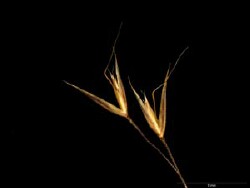 Salt Blown-grass (L. robusta) | 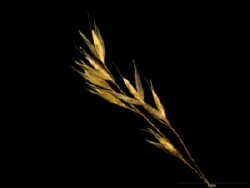 Adamson’s Blown-grass (L. adamsonii) |
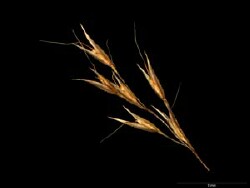 Common Blown-grass (L. filiformis) | 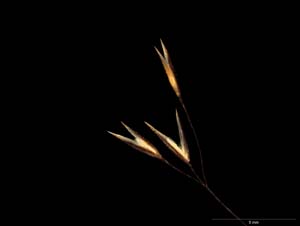 Awnless Blown-grass (L. leviseta) | 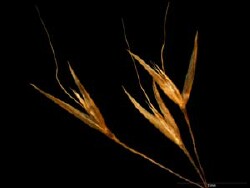 Coast Blown-grass (L. billardierei) |
