Victorian Resources Online (archived)
Archived content — This page contains material from the Victorian Resources Online (VRO) website. It is no longer maintained and is provided for reference only. This content is hosted by CeRDI and is not endorsed by Agriculture Victoria.
Sitemap
Hexham Scent
Back | Salinity Indicator Plants Home | Common name home | Scientific name home | Photo Gallery | Glossary
| Scientific Name: | Melilotus indicus | |
Other Common Names:
|
Annual Yellow Sweetclover, Sour Clover, Senji, Indian Clover, Small Melilot, Sweet Melilot, Common Melilot, King Island Melilot, Californian Lucerne, King Island Clover
|
Status: | Native to the Mediterranean and south-west Africa. Naturalised in southern States of Australia and New Zealand. |
Plant Description:
|
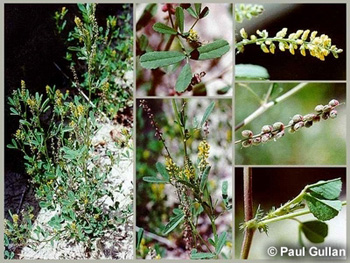
Erect hairless annual forb, to about 60 cm high, usually fragrant. Leaves alternate, each composed of three leaflets, 12 – 30 mm long, attached near the tip of the stalk. The leaflets obovate, the upper ones finely toothed along the margins.
Flowers yellow and pea-like, 2 mm long, in dense narrow racemes slightly longer than the leaves and borne in the leaf axils. Fruit is an almost globular pod, 2 – 3 mm long, olive green and slightly wrinkled, carrying only one seed.Flowering late winter – early summer
|
Habitat:
|
Found along lake margins, riverbanks, and black box communities with grey heavy clay soils. Occurs in a wide range of habitats.
|
Comments: | Coumarin in dairy grazed foliage gives a distinctive taint to milk. | |
Hexham Scent Photos
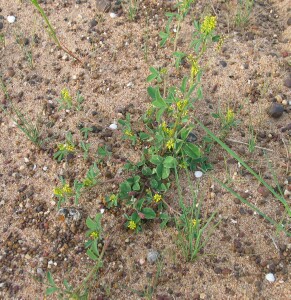
Hexham Scent - plant
Photo: A J Brown | 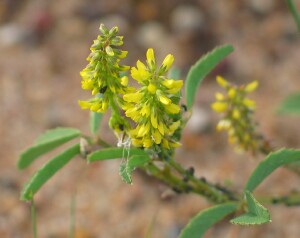
Hexham Scent - flowers
Photo: A J Brown |