Victorian Resources Online (archived)
Slender Barb-Grass
Back | Salinity Indicator Plants Home | Common name home | Scientific name home | Photo Gallery | Glossary
| Slender Barb-Grass photos | Family: Grass (Poaceae syn. Gramineae) |
| Scientific Name: | Parapholis strigosa | 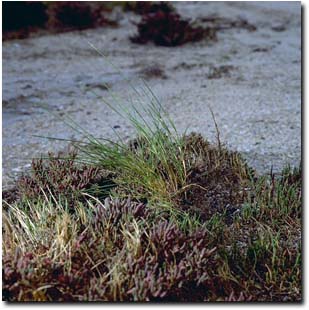 Slender Barb-grass - plant Ex Matters & Bozon | |||||
Other Common Names: | Sea Hard-grass | ||||||
Status: | Native to Western European coasts. Naturalised in Victoria, South Australia and New South Wales | ||||||
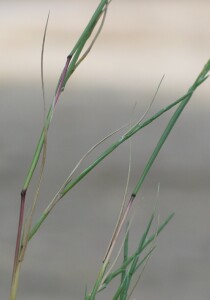
Plant Description: | Annual grass up to 40 cm tall. Leaves smooth and hairless to 6 cm long and flat or folded. Flower-heads are erect, cylindrical, green or purplish spikes to 20 cm long and rigidly erect or very slightly curved. Individual flowers (florets) are alternate on the spike and embedded within the stem (rachis) with pairs of thin pointed outer husks or glumes. Flowers mainly in spring. | ||||||
Habitat: | Mainly sandy soils. Also on clay loams and clays.
| ||||||
Comments: | Commonly found in sandhills. Also found in lignum swamps, bladder saltbush communities and coastal areas. Winter-spring growing grass, not grazed much by livestock. Very similar to Coast Barb-grass (Parapholis incurva) and Common Barb-grass (Hainardia cylindrica) which also grow in saline environments. A simplified key to the Barb-grasses can be accessed here – Key to Barb-grasses. |
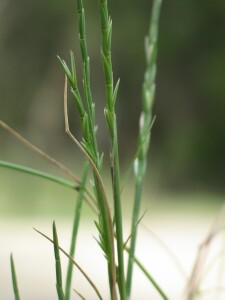 Slender Barb-grass - flower heads Photo: A J Brown | 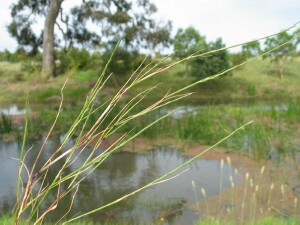 Slender Barb-grass - plant Photo: A J Brown |
Photo: A J Brown |